Publicado el

Käthe Kollwitz Schmidt

Kathe Kollwitz@

Käthe Kollwitz Schmidt

(Königsberg, 1867 – Moritzburg, 1945)

Pintora y escultora alemana, relacionada con el movimiento expresionista, cuya obra se caracteriza por su profunda crítica social. Su padre, Karl Schmidt, fallecido en 1898, estimuló sus habilidades para el dibujo desde su infancia. En 1881 comenzó sus estudios artísticos bajo la tutela de Rudolf Mauer, grabador que ejerció su profesión en Königsber, donde recibió clases del pintor Gustav Naujok.

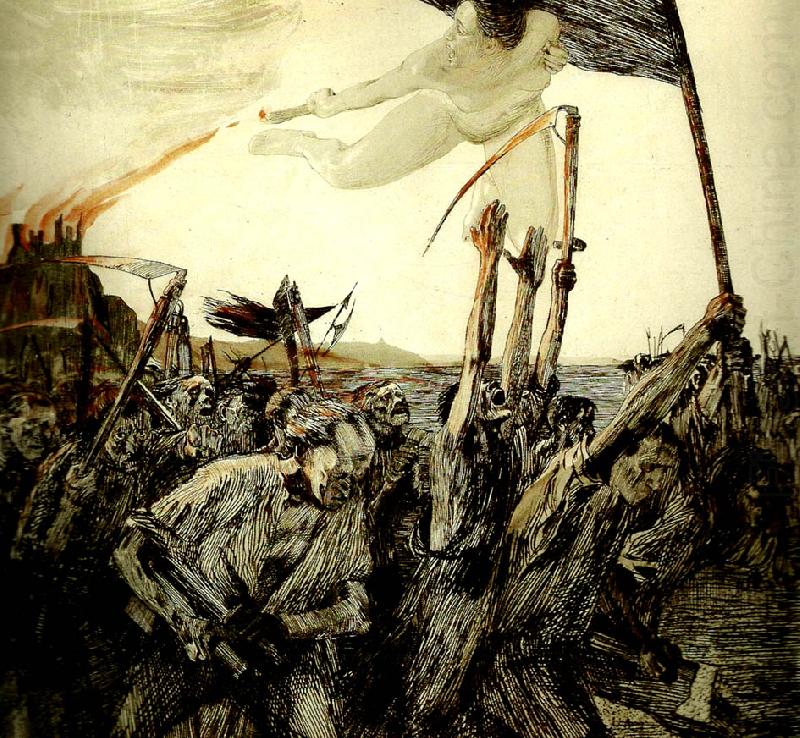
En 1885 se trasladó a Berlín para cursar estudios en la Künstlerinnenschule (Escuela de arte femenina), donde Karl Stauffer-Bern animó su interés por la obra de Max Klinger, cuyas estampas dramáticas fueron su primera gran influencia. De regreso a Königsberg en 1887, inició su producción pictórica, bajo la supervisión del pintor Emil Neide. Los dos años siguientes, 1888-89, se matriculó en la Künstlerinneschule de Munich, en la que recibió clases de Ludwig Herterich. Regresó a Königsberg ese mismo año, donde estableció su estudio y comenzó su producción pictórica a la vez que realizó su primera obra gráfica.

En 1891 contrajo matrimonio con el Dr. Karl Köllwitz. Ambos se trasladaron a Berlín, donde se establecieron en uno de los barrios más pobres de la capital, donde su marido ejerció su actividad tanto como médico como activo militante socialista. Esta militancia tuvo una importancia capital en la obra de Kathe Köllwitz, pues la visión de las miserables condiciones de vida de la masa obrera y su activismo político fueron motivos centrales en sus primeras obras. Al año siguiente nació su hijo Hans.

Durante su estancia en la Weussennurger Strasse, Köllwitz abandonó progresivamente su faceta de pintora y empezó a cultivar el dibujo y el grabado, ya que ambas técnicas le permitieron desarrollar sus obras de profundo contenido social con mayor expresividad y dramatismo. En 1893 asistió a la representación de la obra de Gerhat Hauptmanns Los tejedores, pieza teatral que dejó profunda huella en su particular sensibilidad y a la que dedicó una serie de aguafuertes, La revuelta de los tejedores, compuesta por un total de seis grabados que fueron expuestos en la Gran Exhibición de Arte celebrada en Berlín en 1898. Por esta obra obtuvo el reconocimiento del público y de la crítica, aunque anteriormente Julius Elias había llamado favorablemente la atención sobre su trabajo.

En 1896 nació su segundo hijo, Peter Köllwitz. Dos años mas tarde se incorporó a la Sezession de Berlín, fundada en ese año, y empezará a impartir clases de dibujo en la Künstlerinnenschule, institución en la que permaneció hasta 1902. Entre 1901 y 1908 realizó una serie de viajes que influyeron decisivamente en las series de aguafuertes La guerra de los campesinos que, gracias al patrocinio de la Asociación de Arte Histórico, inició en villa Romana, para finalizar posteriormente en Florencia (1907). También visitó París en 1904 y 1907. Durante su estancia en París visitó la Academie Julien y estableció contacto con el escultor Auguste Rodin y con Teophile Steinlen, en la que fue su primera aproximación a la escultura. En 1909 inició su serie de Escenas de la miseria.

Al estallar la Primera Guerra Mundial, Peter, su hijo menor, fue llamado a filas y falleció en combate en Flandes el 23 de octubre de 1914. Esta tragedia, unida a sus convicciones pacifistas que compartió con su marido, la animaron a manifestarse públicamente en contra del conflicto armado. En 1917, con motivo de la celebración de su quincuagésimo cumpleaños, se celebró en la Jubilee Exhibition de Paul Cassirer una exposición de su obra.

Pese a la impopularidad que le supuso su oposición a la guerra, en 1919 fue nombrada miembro de la Academia Prusiana de las Artes y se convirtió en la primera mujer en ocupar una plaza en esa institución, en la cual permaneció hasta su forzada dimisión en 1933, a causa de la ascensión al poder del partido nacionalsocialista, como ocurrió con tantos otros miembros de su generación artística. Entre 1920 y 1925 realizó las seriesSeven Woodcuts on War, publicada en 1924 junto con el portafolio Parting and Death, y al año siguiente publicó la serie titulada El proletariado; trabajos todos ellos de fuerte crítica social que recrean las condiciones más penosas de la guerra y las injusticias sociales.

En 1927 realizó un viaje a Rusia, país al que se sentía vinculada políticamente, aunque este sentimiento se transformó pronto en profunda decepción. Realizó en 1932 su primera escultura monumental, Monumento a los muertos (cementerio de Essen, Bélgica), obra realizada en homenaje a su hijo Peter fallecido en la guerra. En esta obra, Kölwitz manifiesta la tragedia a través de la representación, no de un soldado fallecido, sino de dos figuras que representan a sus progenitores, desolados ante la pérdida.

A partir de la ascensión al poder de los nazis, fue víctima de la hostilidad que caracterizó al régimen nacionalsocialista frente a los artistas de vanguardia. Sus obras fueron incluidas en la Exposición de Arte Degenerado (Entartete Kunst) celebrada en Berlín, cuya inauguración tuvo lugar el 19 de julio de 1937 y corrió a cargo del presidente de la Cámara del Reich para las Artes Plásticas. En ella se presentaron cerca de 650 pinturas, esculturas y dibujos pertenecientes a museos y colecciones alemanas, seleccionadas entre más de 16.000 obras, con el objeto de ridiculizar el arte de vanguardia. Paralelamente a esta exposición, el régimen organizó una exposición de arte oficial, la Grosse Deutsche Kunstausstellug (Exposición del Gran Arte Alemán), cuya inauguración fue presidida por el propio Adolf Hitler. Paradójicamente, en contra de las intenciones de los organizadores de ambas, la primera recibió dos millones de visitantes, frente a los apenas medio millón de la segunda.

El periodo entre 1937 y 1944 fue especialmente trágico para Köllwitz. A las continuas presiones del régimen nacionalsocialista se sumó la destrucción de su estudio con la práctica totalidad de su obra durante los bombardeos aliados. Este pesimismo vital se percibe en su última serie de grabados, Muerte (compuesta por ocho litografías), que parece preludiar el fallecimiento de su marido en 1940 y el suyo propio el 22 de abril de 1945 en Moritzburgo, adonde se había trasladado dos años antes, tras la destrucción de su estudio.

La importancia de la obra de Kathe Köllwitz se basa tanto en la selección de sus temas como en su capacidad para transmitirles el sentimiento dramático que los caracteriza, ya sea en sus representaciones de las miserables condiciones de vida de los obreros, o en la de los dramas sobre la guerra. Su capacidad expresiva proviene tanto de su atenta observación de la realidad social que la circundó como de su profundo estudio de los medios técnicos de impresión. Practicó el grabado en sus numerosas variantes, desde la punta seca a los aguafuertes pasando por el entallado, aunque, a partir de 1910, la litografía se convirtió en su forma preferida de expresión plástica.

Kathe Kollwitz 1 Kathe Kollwitz 2 Kathe Kollwitz 3 Kathe Kollwitz 4 Kathe Kollwitz 5 Kathe Kollwitz 6 Kathe Kollwitz 7 Kathe Kollwitz 8 Kathe Kollwitz 9 Kathe Kollwitz 10 Kathe Kollwitz 11 Kathe Kollwitz 12Kathe Kollwitz 14Kathe Kollwitz 13

Publicado el

Jackson Pollock: An Interview

Jackson pollock@

Jackson Pollock: An Interview 

Digitized and edited by Maria Caamano

This interview was taped by William Wright in the summer of 1950 for presentation on the Sag Harbor radio station, but was never used. 

William Wright.: Mr. Pollock, in your opinion, what is the meaning of modern art?

Jackson Pollock.: Modern art to me is nothing more than the expression of contemporary aims of the age that we’re living in.

W.W.: Did the classical artists have any means of expressing their age?

J.P.: Yes, they did it very well. All cultures have had means and techniques of expressing their immediate aims….The thing that interests me is that today painters do not have to go to a subject matter outside of themselves. They work from a different source. They work from within.

W.W.: Would you say that the modern artist has more or less isolated the quality, which made the classical works of art valuable, that he’s isolated it and uses it in a purer form?

J.P.: Ah —the good ones have, yes.

W.W.: Mr. Pollock, there’s been a good deal of controversy and a great many comments have been made regarding your method of painting. Is there something you’d like to tell us about that?

J.P.: My opinion is that new needs need new techniques. And the modern artists have found new ways and new means of making their statements.…Each age finds its own technique.

W.W.: Which would also mean that the layman and the critic would have to develop their ability to interpret the new techniques.

J.P.: Yes—that always somehow follows. I mean, the strangeness will wear off and I think we will discover the deeper meanings in modern art.

W.W.: I suppose every time you are approached by a layman they ask you how they should look at a Pollock painting, or any other modern painting—what they look for—how do they learn to appreciate

modern art?

J.P.: I think they should not look for, but look passively—and try to receive what the painting has to offer and not bring a subject matter or preconceived idea of what they are to be looking for.

W.W.: Would it be true to say that the artist is painting from the unconscious, and the—canvas must act as the unconscious of the person who views it?

J.P.: The unconscious is a very important side of modern art and I think the unconscious drives do mean a lot in looking at paintings.

W.W.: Then deliberately looking for any known meaning or object in an abstract painting would distract you immediately from ever appreciating it as you should?

J.P.: I think it should be enjoyed just as music is enjoyed—after a while you may like it or you may not. …I think at least give it a chance.

W.W.: Well, I think you have to give anything the sort of chance. A person isn’t born to like good music, they have to listen to it and gradually develop an understanding of it or liking for it. If modern painting works the same way—a person would have to subject himself to it over a period of time in order to be able to appreciate it.

J.P.: I think that might help, certainly.

W.W.: Mr. Pollock, the classical artists had a world to express and they did so by representing the objects in that world. Why doesn’t the modern artist do the same thing?

J.P.: …The modern artist is living in a mechanical age and we have a mechanical means of representing objects in nature… is working and expressing an inner world…expressing the energy, the motion, and other inner form. 2

W.W.: Would it be possible to say that the classical artist expressed his world by representing the objects, whereas the modern artist expresses his world by representing the effects the objects have upon him?

J.P.: Yes, the modern artist is working with space and time, and expressing his feelings rather than illustrating.

W.W.: Well, Mr. Pollock, can you tell us how modern art came into being?

J.P.: …It’s a part of a long tradition dating back with Cezanne, up through the cubists, the post-cubists, to the painting being done today.

W.W.: Then, it’s definitely a product of evolution?

J.P.: Yes.

W.W.: Shall we go back to this method question that so many people today think is important? Can you tell us how you developed your method of painting, and why you paint as you do?

J.P.: Method is… a natural growth out of a need, and from a need the modern artist has found new ways of expressing the world about him….I paint on the floor and this isn’t unusual—the Orientals did that.

W.W.: How do you go about getting the paint on the canvas? I understand you don’t use brushes or anything of that sort, do you?

J.P.: Most of the paint I use is a liquid, flowing kind of paint. The brushes I use are used more as sticks rather than brushes—the brush doesn’t touch the surface of the canvas, it’s just above.

W.W.: Would it be possible for you to explain the advantage of using a stick with paint—liquid paint rather than a brush on canvas?

J.P.: …to have greater freedom and move about the canvas, with greater ease.

W.W.: Well, isn’t it more difficult to control than a brush? I mean, isn’t there more a possibility of getting too much paint or splattering or any number of things? Using a brush, you put the paint right where you want it and you know exactly what it’s going to look like.

J.P.: No, I don’t think so.…with experience—it seems to be possible to control the flow of the paint, to a great extent, and I don’t use the accident….

W.W.: I believe it was Freud who said there’s no such thing as an accident. Is that what you mean?

J.P.: I suppose that’s generally what I mean.

W.W.: Then, you don’t actually have a preconceived image of a canvas in your mind?

J.P.: …I do have a general notion, of what I’m about and what the results will be.

W.W.: That does away, entirely, with all preliminary sketches?

J.P.: Yes, I approach painting in the same sense as one approaches drawing; it’s direct. I don’t work from drawings; I don’t make sketches and drawing and color sketches into a final painting. Painting, I think, today—the more immediate, the more direct—the greater the possibilities of making a direct…of making a statement.

W.W.: Well, actually every one of your paintings your finished canvases, is a absolute original.

J.P.: Well—yes—they’re all direct painting. There is only one.

W.W.: Well, now, Mr. Pollock, would you care to comment on modern painting as a whole? What is your feeling about your contemporaries?

J.P.: Painting today certainly seems very vibrant, very alive, very exciting. …the direction that painting seems to be taking here—is—away from the easel—into some sort, some kind of wall—wall painting.

W.W.: I believed some of your canvases are of very unusual dimensions, isn’t that true?

J.P.: They are an impractical size—9 x 18 feet. But I enjoy working big and… whenever I have a chance, I do it whether it’s practical or not.

W.W.: Can you explain why you enjoy working on a large canvas more than on a small one?

J.P.: Well, not really. I’m just more at ease in a big area than I am on something 2 x2; I feel more at home in a big area.

W.W.: You say “in a big area”. Are you actually on the canvas while you’re painting?

J.P.: Very little. I do step into the canvas occasionally.… 3

W.W.: I notice over in the corner you have something done on plate glass. Can you tell us something about that?

J.P.: Well, that’s something new for me. That’s the first thing I’ve done on glass and I find it very exciting. I think the possibilities of using painting on glass in modern architecture…in modern

construction…terrific.

W.W.: Well, does the one on glass differ in any other way from your usual technique?

J.P.: It’s pretty generally the same….

W.W.: Well, in the event that you do more of these for modern building, would you continue to use various objects?

J.P.: I think so, yes. The possibilities…are endless.

W.W.: Mr. Pollock, isn’t it true that your method of painting, your technique, is important and interesting only because of what you accomplish by it?

J.P.: I hope so. Naturally, the result is the thing…and…it doesn’t make much difference how the paint is put on as long as something has been said. Technique is just a means of arriving at a statement.

Jackson Pollock: A Response to a Questionnaire 

Digitized and edited by Maria Caamano

First published in Arts and Architecture (February 1944) 

Question: Where were you born?

Jackson Pollok: Cody, Wyoming, in January 1912. My ancestors were Scotch and Irish.

Q.: Have you traveled any?

J.P: I’ve knocked around some in California, some in Arizona. Never been to Europe.

Q.: Would you like to go abroad?

J.P: No, I don’t see why the problems of modern painting can’t be solved as well here as elsewhere.

Q.: Where did you study?

J.P: At the Art Student’s League, here in New York. I began when I was seventeen. Studied with Benton, at the League, for two years.

Q.: How did your study with Thomas Benton affect your work, which differs so radically from his?

J.P: My work with Benton was important as something against which to react very strongly, later on; in this, it was better to have worked with him than with a less resistant personality who would

have provided a much less strong opposition. At the same time, Benton introduced me to Renaissance art.

Q.: Why do you prefer living here in New York to your native West?

J.P: Living is keener, more demanding, more intense and expansive in New York than in the West; the stimulating influences are more numerous and rewarding. …

Q.: Has being a Westerner affected your work?

J.P: I have always been very impressed with the plastic qualities of American Indian art. The Indians have the true painter’s approach in their capacity to get hold of appropriate images…and in their

understanding…their color…. Some people find references to American Indian art and calligraphy in parts of my pictures. That wasn’t intentional; probably the result of early memories and

enthusiasms.

Q.: Do you consider technique to be important in art?

J.P: Yes and no. Craftsmanship is essential to the artist. He needs it just as he needs brushes, pigments, and a surface to paint on.

Q.: Do you find it important that many famous modern European artists are living in this country? 4

J.P: ….the fact that good European moderns are now here is very important, for they bring with them an understanding of the problems of modern painting. I am particularly impressed with their concept

of the source of art being the unconscious.

Q.: Do you think there can be a purely American art?

J.P: An American is an American and his painting would naturally be qualified by that fact, whether he wills it or not. But the basic problems of contemporary painting are independent of any one

country.

Jackson Pollock: “My Painting” 

Digitized and edited by Maria Caamano

This brief document appeared in the first and only issue of Possibilities (Winter 1947-48), published by Wittenborn, Schultz, Inc. 

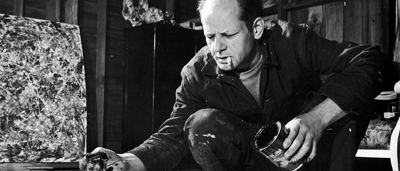
My painting does not come from the easel. I need the resistance of a hard surface. On the floor I am more at ease. I feel nearer, more a part of the painting…

I continue to get further away from the usual painter’s tools such as easel, palette, brushes, etc. I prefer sticks, trowels, knives and dripping fluid paint or a heavy impasto with sand, broken glass and

other foreign matter added.

When I am in my painting, I’m not aware of what I’m doing. It is only after a sort of “get acquainted” period that I see what I have been about. …the painting has a life of its own. …It is only when I lose contact with the painting that the result is a mess. Otherwise there is pure harmony, an easy give and take, and the painting come out well.


Jackson pollock 1 Jackson pollock 2 Jackson pollock 3   Jackson pollock 6 Jackson pollock 7 Jackson pollock 8Jackson pollock 9 Jackson pollock 10 Image: FILE PHOTO:  100 Years Since Birth Of Painter Jackson PollockJackson pollock 5

Publicado el

Robert Motherwell : Elegías a la República Española


Robert Motherwell:  Elegías por la República Española

Posiblemente el expresionismo abstracto no habría pasado de ser un grupo de chiflados que manchan telas en Nueva York, si no hubiera existido Robert Motherwell.

Robert Motherwell estudió Filosofía en la Universidad de Stanford para poco antes de doctorarse, comenzar estudios de arte. Todo fue repentino, pero sin darse cuenta paso del surrealismo de sus primeros pasos como pintor, a pertenecer al rompedor grupo expresionista abstracto de la escuela de NY… Y en parte a liderarlo.

Todo tiene una sencilla explicación. Gracias a sus conocimientos del ámbito universitario y sus cualidades filosóficas, Motherweel fue el teórico de tan ilustre grupo. Se dedicó, en parte, en dar a conocer a sus compañeros, explicar lo que hacían y plasmar teóricamente las ideas que cambiaron para siempre la historia del arte. Viajó a través de todo el mundo, acercando el golpe de efecto que había dado la estética contemporánea en NY. Si no hubiera sido así, es posible que Rothko, por ejemplo, jamás se hubiera dado a conocer, pues jamás salía de su estudio a causa de su timidez.


Pero no solo hay que reconocer a Motherwell su labor didáctica . Motherwell es un verdadero genio de la pintura por méritos propios. Todas sus obras parten de una composición perfectamente estudiada. A un primer vistazo, parece como si únicamente la fuerza expresiva hubiera sembrado el resultado del cuadro, pero simplemente parándose un segundo a analizarlo, descubrimos como el cuadro está dominado por una estructura geométrica que nos acentúa las sensaciones propuestas por el autor… Y como muestra un botón:

ELEGIAS POR LA REPUBLICA ESPAÑOLA

En 1948, Motherwell ilustra con un dibujo a tinta un poema del critico Harold Rosenberg y lo reutiliza para ilustrar LLANTO POR LA MUERTE DE IGNACIO SANCHEZ MEJIA. Esta misma “Ilustración”, es la matriz de la primera de las Elegías por la República española. Una serie a través de la cual el artista analiza la misma composición de formas, una y otra vez, cambiándolas de color y peso, aunque predominando siempre el blanco y el negro. En todas ellas, una composición de manchas circulares y rectángulos rectilíneos, toman el espacio produciendo el lleno absoluto. Un agobio de falta de espacio que dirige el resto de la composición. Son formas abstractas, no perfectas, que sin embargo se reparten la tela creando una estabilidad neutra dentro del agobio.

Aunque cada nueva “elegía”, bebe de la anterior, todas son diferentes. El reparto del peso a través de los mismos elementos y la frescura de la pincelada, que transforma las formas matemáticas en gestos pictóricos, crean una serie compacta pero no repetitiva.

Aunque lo cierto, es que para comprender la grandeza de Motherwell hay que adentrarse en su obra posterior, cuando todavía se acerca más a la geometría y los planos de color. Cuando realmente adquiere un valor pictórico prácticamente inigualable y que tan solo Rothko puede compartir.

Robert Motherwell 2 Robert Motherwell 3 Robert Motherwell 4Robert Motherwell 5