
Jackson Pollock: An Interview
Digitized and edited by Maria Caamano
This interview was taped by William Wright in the summer of 1950 for presentation on the Sag Harbor radio station, but was never used.
William Wright.: Mr. Pollock, in your opinion, what is the meaning of modern art?
Jackson Pollock.: Modern art to me is nothing more than the expression of contemporary aims of the age that we’re living in.
W.W.: Did the classical artists have any means of expressing their age?
J.P.: Yes, they did it very well. All cultures have had means and techniques of expressing their immediate aims….The thing that interests me is that today painters do not have to go to a subject matter outside of themselves. They work from a different source. They work from within.
W.W.: Would you say that the modern artist has more or less isolated the quality, which made the classical works of art valuable, that he’s isolated it and uses it in a purer form?
J.P.: Ah —the good ones have, yes.
W.W.: Mr. Pollock, there’s been a good deal of controversy and a great many comments have been made regarding your method of painting. Is there something you’d like to tell us about that?
J.P.: My opinion is that new needs need new techniques. And the modern artists have found new ways and new means of making their statements.…Each age finds its own technique.
W.W.: Which would also mean that the layman and the critic would have to develop their ability to interpret the new techniques.
J.P.: Yes—that always somehow follows. I mean, the strangeness will wear off and I think we will discover the deeper meanings in modern art.
W.W.: I suppose every time you are approached by a layman they ask you how they should look at a Pollock painting, or any other modern painting—what they look for—how do they learn to appreciate
modern art?
J.P.: I think they should not look for, but look passively—and try to receive what the painting has to offer and not bring a subject matter or preconceived idea of what they are to be looking for.
W.W.: Would it be true to say that the artist is painting from the unconscious, and the—canvas must act as the unconscious of the person who views it?
J.P.: The unconscious is a very important side of modern art and I think the unconscious drives do mean a lot in looking at paintings.
W.W.: Then deliberately looking for any known meaning or object in an abstract painting would distract you immediately from ever appreciating it as you should?
J.P.: I think it should be enjoyed just as music is enjoyed—after a while you may like it or you may not. …I think at least give it a chance.
W.W.: Well, I think you have to give anything the sort of chance. A person isn’t born to like good music, they have to listen to it and gradually develop an understanding of it or liking for it. If modern painting works the same way—a person would have to subject himself to it over a period of time in order to be able to appreciate it.
J.P.: I think that might help, certainly.
W.W.: Mr. Pollock, the classical artists had a world to express and they did so by representing the objects in that world. Why doesn’t the modern artist do the same thing?
J.P.: …The modern artist is living in a mechanical age and we have a mechanical means of representing objects in nature… is working and expressing an inner world…expressing the energy, the motion, and other inner form. 2
W.W.: Would it be possible to say that the classical artist expressed his world by representing the objects, whereas the modern artist expresses his world by representing the effects the objects have upon him?
J.P.: Yes, the modern artist is working with space and time, and expressing his feelings rather than illustrating.
W.W.: Well, Mr. Pollock, can you tell us how modern art came into being?
J.P.: …It’s a part of a long tradition dating back with Cezanne, up through the cubists, the post-cubists, to the painting being done today.
W.W.: Then, it’s definitely a product of evolution?
J.P.: Yes.
W.W.: Shall we go back to this method question that so many people today think is important? Can you tell us how you developed your method of painting, and why you paint as you do?
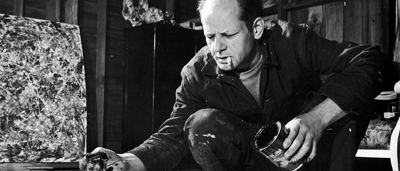
J.P.: Method is… a natural growth out of a need, and from a need the modern artist has found new ways of expressing the world about him….I paint on the floor and this isn’t unusual—the Orientals did that.
W.W.: How do you go about getting the paint on the canvas? I understand you don’t use brushes or anything of that sort, do you?
J.P.: Most of the paint I use is a liquid, flowing kind of paint. The brushes I use are used more as sticks rather than brushes—the brush doesn’t touch the surface of the canvas, it’s just above.
W.W.: Would it be possible for you to explain the advantage of using a stick with paint—liquid paint rather than a brush on canvas?
J.P.: …to have greater freedom and move about the canvas, with greater ease.
W.W.: Well, isn’t it more difficult to control than a brush? I mean, isn’t there more a possibility of getting too much paint or splattering or any number of things? Using a brush, you put the paint right where you want it and you know exactly what it’s going to look like.
J.P.: No, I don’t think so.…with experience—it seems to be possible to control the flow of the paint, to a great extent, and I don’t use the accident….
W.W.: I believe it was Freud who said there’s no such thing as an accident. Is that what you mean?
J.P.: I suppose that’s generally what I mean.
W.W.: Then, you don’t actually have a preconceived image of a canvas in your mind?
J.P.: …I do have a general notion, of what I’m about and what the results will be.
W.W.: That does away, entirely, with all preliminary sketches?
J.P.: Yes, I approach painting in the same sense as one approaches drawing; it’s direct. I don’t work from drawings; I don’t make sketches and drawing and color sketches into a final painting. Painting, I think, today—the more immediate, the more direct—the greater the possibilities of making a direct…of making a statement.
W.W.: Well, actually every one of your paintings your finished canvases, is a absolute original.
J.P.: Well—yes—they’re all direct painting. There is only one.
W.W.: Well, now, Mr. Pollock, would you care to comment on modern painting as a whole? What is your feeling about your contemporaries?
J.P.: Painting today certainly seems very vibrant, very alive, very exciting. …the direction that painting seems to be taking here—is—away from the easel—into some sort, some kind of wall—wall painting.
W.W.: I believed some of your canvases are of very unusual dimensions, isn’t that true?
J.P.: They are an impractical size—9 x 18 feet. But I enjoy working big and… whenever I have a chance, I do it whether it’s practical or not.
W.W.: Can you explain why you enjoy working on a large canvas more than on a small one?
J.P.: Well, not really. I’m just more at ease in a big area than I am on something 2 x2; I feel more at home in a big area.
W.W.: You say “in a big area”. Are you actually on the canvas while you’re painting?
J.P.: Very little. I do step into the canvas occasionally.… 3
W.W.: I notice over in the corner you have something done on plate glass. Can you tell us something about that?
J.P.: Well, that’s something new for me. That’s the first thing I’ve done on glass and I find it very exciting. I think the possibilities of using painting on glass in modern architecture…in modern
construction…terrific.
W.W.: Well, does the one on glass differ in any other way from your usual technique?
J.P.: It’s pretty generally the same….
W.W.: Well, in the event that you do more of these for modern building, would you continue to use various objects?
J.P.: I think so, yes. The possibilities…are endless.
W.W.: Mr. Pollock, isn’t it true that your method of painting, your technique, is important and interesting only because of what you accomplish by it?
J.P.: I hope so. Naturally, the result is the thing…and…it doesn’t make much difference how the paint is put on as long as something has been said. Technique is just a means of arriving at a statement.
Jackson Pollock: A Response to a Questionnaire
Digitized and edited by Maria Caamano
First published in Arts and Architecture (February 1944)
Question: Where were you born?
Jackson Pollok: Cody, Wyoming, in January 1912. My ancestors were Scotch and Irish.
Q.: Have you traveled any?
J.P: I’ve knocked around some in California, some in Arizona. Never been to Europe.
Q.: Would you like to go abroad?
J.P: No, I don’t see why the problems of modern painting can’t be solved as well here as elsewhere.
Q.: Where did you study?
J.P: At the Art Student’s League, here in New York. I began when I was seventeen. Studied with Benton, at the League, for two years.
Q.: How did your study with Thomas Benton affect your work, which differs so radically from his?
J.P: My work with Benton was important as something against which to react very strongly, later on; in this, it was better to have worked with him than with a less resistant personality who would
have provided a much less strong opposition. At the same time, Benton introduced me to Renaissance art.
Q.: Why do you prefer living here in New York to your native West?
J.P: Living is keener, more demanding, more intense and expansive in New York than in the West; the stimulating influences are more numerous and rewarding. …
Q.: Has being a Westerner affected your work?
J.P: I have always been very impressed with the plastic qualities of American Indian art. The Indians have the true painter’s approach in their capacity to get hold of appropriate images…and in their
understanding…their color…. Some people find references to American Indian art and calligraphy in parts of my pictures. That wasn’t intentional; probably the result of early memories and
enthusiasms.
Q.: Do you consider technique to be important in art?
J.P: Yes and no. Craftsmanship is essential to the artist. He needs it just as he needs brushes, pigments, and a surface to paint on.
Q.: Do you find it important that many famous modern European artists are living in this country? 4
J.P: ….the fact that good European moderns are now here is very important, for they bring with them an understanding of the problems of modern painting. I am particularly impressed with their concept
of the source of art being the unconscious.
Q.: Do you think there can be a purely American art?
J.P: An American is an American and his painting would naturally be qualified by that fact, whether he wills it or not. But the basic problems of contemporary painting are independent of any one
country.
Jackson Pollock: “My Painting”
Digitized and edited by Maria Caamano
This brief document appeared in the first and only issue of Possibilities (Winter 1947-48), published by Wittenborn, Schultz, Inc.
My painting does not come from the easel. I need the resistance of a hard surface. On the floor I am more at ease. I feel nearer, more a part of the painting…
I continue to get further away from the usual painter’s tools such as easel, palette, brushes, etc. I prefer sticks, trowels, knives and dripping fluid paint or a heavy impasto with sand, broken glass and
other foreign matter added.
When I am in my painting, I’m not aware of what I’m doing. It is only after a sort of “get acquainted” period that I see what I have been about. …the painting has a life of its own. …It is only when I lose contact with the painting that the result is a mess. Otherwise there is pure harmony, an easy give and take, and the painting come out well.