David Hockney / CAMARA WORKS

David Hockney is a great painter,but he has also known fame through photography, although he does not mince his words when he says ‘Photography will never equal painting!’
Perhaps this is the wrong argument as they are different media and needn’t be compared.
However he does make judgemental comments about photography such as ‘Photography is only good for mechanical reproduction’. ‘Photography can’t show time’ and more…I’ve seen professional photographers shoot hundreds of pictures but they are all basically the same. They are hoping that in one fraction of a second something will make that face look as if there were a longer moment…If you take a hundred, surely one will be good. It could be anybody doing it… There are few good photographs, and those good ones that do exist are almost accidental. Photography has failed…How many truly memorable pictures are there? Considering the milllions of photographs taken, there are few memorable images in this medium, which should tell us something. Photography can’t lead us to a new way of seeing. It may have other possibilities but only painting can extend the way of seeing.
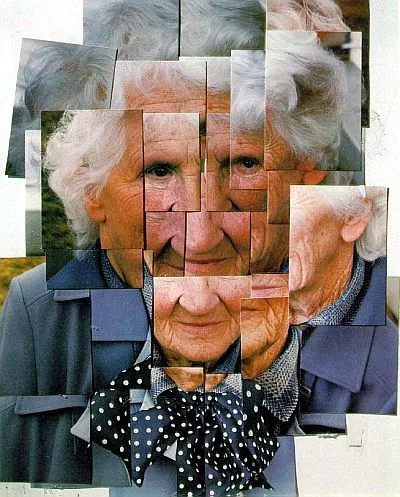
Perhaps Hockney has not succeeded with one image but his photo collages and photo montages – ’Joiners’ = certainly caught the eye of the public in the 1980′s.
Mother – Hockney
Hockney’s creation of the “joiners” occurred accidentally. He noticed in the late sixties that photographers were using cameras with wide-angle lenses to take pictures. He did not like such photographs because they always came out somewhat distorted. He was working on a painting of a living room and terrace in Los Angeles. He took Polaroid shots of the living room and glued them together, not intending for them to be a composition on their own. Upon looking at the final composition, he realized it created a narrative, as if the viewer was moving through the room. He began to work more and more with photography after this discovery and even stopped painting for a period of time to exclusively pursue this new style of photography. From 1982 Hockney explored the use of the camera, making composite images of Polaroid photographs arranged in a rectangular grid. Later he used regular 35-millimetre prints to create photo collages, compiling a ‘complete’ picture from a series of individually photographed details.

My mother
The main obstacle Hockney thinks he has overcome is the limited perspective of a stationary camera. A single photograph can only show one point of view, usually for a small period of time. “All photographs share the same flaw,” he says. “Lack of time.” He then goes on to trace photography’s misguided view back hundreds of years to the Renaissance and invention of the Camera Obscura.

Don and Christopher
Cubism helped to topple the single perspective in the hand-arts, but with photography it still exists. The idea behind Hockney’s grids was to inject multiple reference points into photography, in short to make it cubist.

Noya and Bill Brandt
And the very well known ‘Pearl Bllossom Highway”

Pearl blossom highway

Kasmin

Merced river 1982

Telephone pole 1982

Pre historic museum 1982
Photographing Annie Leibovitz While She Is Photographing Me

Walking in the zen garden

Nicolas-wilder-studying-picasso

Celia’s Children Albert & George Clark

Sun on the pool

Patrick Procter