Publicado el

DAVID LACHAPELLE: SURREAL POP PHOTOGRAPHY

David Lachapelle@

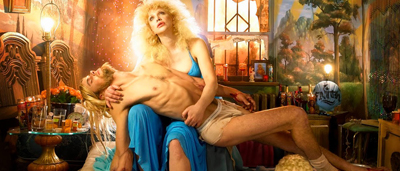
David LaChapelle is well known for his career as a contemporary photographer, fine art enthusiast and also, for his involvement with video. After initially gaining his social reputation and position within the artistic community, LaChapelle’s work became noticed by huge artistic figures. Andy Warhol spotted his artistic creations and offered him his first job, at Interview magazine.

He initially focused his intention upon commercial photograph, featuring his images in the following publications- Italian Vogue, French Vogue, Vanity Fair, GQ, Rolling Stone and i-D. As well as this huge contribution towards largely circulated publications, LaChapelle photographed many famous names; including the likes of- Tupac Shakur, Pamela Anderson, David Beckham, Leonardo DiCaprio… you get the gist. He eventually moved away from this commercialised environment though, finding solace in fine art.

His photography throughout the years is appropriate for both advertorial and editorial/commercialised purposes. Lots of his photos withhold cartoon connotations and are content specific- attention is always focused upon the figure or the product that is being showcased within the image. Although his photos often promote commercial values, more often than not they look like paintings. This fine art impression on photography is perhaps what established David LaChapelle as a huge art inspiration.

Both his photography and his fine art work present colour dramatically and emphasize form. These two methods of abstraction enable his work to advance from commercialised and largely mass produced –dynamic and contemporary. It is apparent that his fine art background has largely influenced his photographic career and furthermore, that his art presents the same photographic 3 dimensional qualities that are infused through photography. His paintings largely focus on still life: flower paintings highlight colour and he often pushes an overcrowded feeling of constraint which intensifies the floral display.

David LaChapelle: “If I could choose any period to have been an artist, it would definitely be the Baroque”

The artist-photographer discusses his affinity with the dynamism, drama and spirituality of 17th-century art

By Adrian Dannatt. Features, Issue 201, April 2009
Published online: 15 April 2009

Star artist-photographer David LaChapelle is a committed fan of the Baroque, whether the show opening this month at the V&A in London or the exhibition at the Bargello in Florence, “Living Marble: Bernini and the Birth of the Baroque Portrait Bust”, which he singled out in these pages as one of the best happening this year. Any connection between this “porno-chic” snapper notorious for ultra-gloss images of decadent celebrity-culture and Catholic 17th-century devotional imagery seems considerably less improbable after pondering their mutual devotion to high artifice and grand effect. For LaChapelle (surely an almost baroque name in itself despite his all-American origins in Fairfield, Connecticut) builds his vast, labyrinthine images with a scale, grandeur and drama whose excesses rival those of any Pietro da Cortona painted ceiling. Like baroque art, LaChapelle’s work always strives for direct emotional involvement, a visceral appeal aimed at the senses, to impress even the simplest visitor. Like baroque artists, he explores repeated and varied patterns, abundant details, thunderously bright polychromy, all in deliberate promotion of a populist conception of the function of art. Thus LaChapelle has coined an iconography that is direct, simple, obvious and dramatic, its broad and heroic tendencies suggesting not only the intensity and immediacy of the Baroque but most importantly its overall sense of awe.

The Art Newspaper: Do you see the Baroque in your work?

David LaChapelle: I’ve been called a lot of things, and “baroque” is one of the better. Of course there is a link because I love the baroque period so much. Also because it’s just so diverse, you have everything from Caravaggio to Andrea Pozzo, that guy who does this giant “Apotheosis of St Ignatius”, some giant, crazy painting all over that ceiling [in the Church of Saint Ignatius Loyola, Rome]. It’s so dramatic, so over the top, it encompasses so much. The Baroque is always dramatic, always dynamic, with that element of spirituality. To me it’s everything I love, everything. I’m not comparing myself to the masters…yet! But when I started having to do celebrity portraits for Interview magazine, I would always try to define that person within that portrait, flattering or not, to capture them. If that celebrity were to die, this would be the image that summed them up.

TAN: Your use of bold, bright colour is baroque itself.

DL: These artists have really, really inspired me. We do live in a different world today, but if I could choose any period to have been an artist, it would definitely be the Baroque.

TAN: Is the veneration of celebrities now almost religious?

DL: I have always been fascinated by the idea of religious ecstasy, whether crying over the Jonas Brothers or the Beatles. It’s the same emotion, the apparition, whether Elvis or the Virgin Mary, it’s definitely some sort of devotional ecstasy, fainting, swooning. The supernatural comes into play a lot in celebrity, along with the transience; the impermanence of life I am always very drawn to.

TAN: The celebrity can also gain a sort of immortality?

DL: Well they’re meant to have immortality, at the time we think they’re going to last forever and then just two years later we see how old they look. As soon as they age or gain weight, it’s over. I could name celebrities I work with who are supposed to be huge superstars then they get fat. They’re going to be the next big thing, supposed to play Bat Girl and then they start calling her Fat Girl! It’s over! But the permanent in baroque art really was permanent.

The Catholic Church called on the Baroque to invigorate people, to draw them into the church. Celebrity definitely stirs up the same sort of emotions. Also it’s interesting that at a certain point the Baroque was thought to be really tasteless—in the 18th century Bernini and even Michelangelo were considered tasteless. And I definitely know myself about walking the line with the tasteless.

TAN: Some believe that the Council of Trent decreed that, for the sake of the illiterate, painting and sculpture should not obscure the religious message and that this was the beginning of the Baroque.

DL: Well I’m not going to say I make my work for less-educated people—that sounds like something the Catholic Church might say. I come from the school of Diego Rivera, making art for everyone, appealing to every sort of person. Right now I have this show in Paris which is breaking attendance records, it’s mostly kids, such a diverse group of people because I actually make an attempt to give a narrative, tell a story. I don’t want my work to be something just for an elite little group of art critics, there’s enough of that work already. You walk round art fairs and you have to have someone explain to you what the work means: “Oh I see…that ball of yarn and that projection, I see now.” I have a huge love of contemporary art but at a certain point I feel, “Enough!” These artists who are not making any attempt at all to communicate, it’s so obscure, their intellectual and conceptual reasons for it, but only looking to reach that tiny elite audience. And that is something that doesn’t interest me at all, either as an audience-member or as an art-maker myself.

TAN: Jeff Koons is another artist interested in baroque kitsch.

DL: For sure, I love Jeff. My favourite stuff was the ceramics like Michael Jackson. I think he’s such a funny and such a sweet guy. The first time I ever met him he was totally obsessed with this girl: he brought me into this room and there were just stacks of porno magazines—it was La Cicciolina. He was obsessed! It was so innocent somehow, even with his “double-penetration” and coming all over her face and he hadn’t even met her yet. I was, like, “Dude…” I mean the power of manifestation going from being this devoted fan to actually marrying her, that’s the real deal.

TAN: Koons collects art of all periods. Do you?

DL: When I first started making money—which I never expected as I didn’t even finish high school and in America that’s meant to mean you’re poor for life—I started collecting art by my contemporaries. I tried the stock market for a little while, but then realised I would never understand those numbers, so I started buying people I knew when I was just a kid in the East Village. I made some pretty good choices. Naturally I collected work by my first boss Andy [Warhol], drawings and paintings when prices were very good at that time, then I bought Keith Haring’s very last painting, a huge canvas, from Tony Shafrazi and I have at least 20 drawings by him too. I also have works by some younger people like Cecily Brown, but I think baroque art is out of my price range.

TAN: Mary Magdalene was supposedly a woman who had a wild time, bordering on the wanton…

DL: That’s the legend the Catholic Church wanted to make her into, who knows; she might have been Jesus’s wife for all we know. Caravaggio’s painting people he got off the street, having them pose as the Holy Family, dressing them in clothes of that day—that was really shocking, almost blasphemous.

TAN: Is Mary Magdalene’s mythology like that of celebrities today?

DL: I think the redemption here is our soap opera, having worked with so many of these people for so long, especially with Paris [Hilton] since the beginning. When Princess Diana had her big fairy-tale wedding, we lived our fantasy romantic life through her in a positive, aspirational way. Then when we found out about her cutting herself, throwing herself down stairs, her bulimia, then it was, like, “Well my life isn’t so bad—if she’s a princess with fame and money and servants and she’s still puking all over the place, then my life isn’t so bad in my trailer park with my own cheating husband.”

There’s definitely a connection in the fallen woman and the redemption of the fallen woman. Those great paintings of Mary Magdalene were created because of the ideas of redemption, forgiveness, starting over, through Christ and the Catholic Church. There’s still the same basic need for human drama, for the arc of redemption. It’s the same narrative we can see in baroque art or today’s celebrity-culture. It’s sort of gossip even—“Psst, that’s Mary Magdalene over there”—it’s almost like gossip.

David Lachapelle 1 David Lachapelle 2 David Lachapelle 3 David Lachapelle 4 David Lachapelle 5 David Lachapelle 6 David Lachapelle 7 David Lachapelle 8 David Lachapelle 9 David Lachapelle 10 David Lachapelle 11 David Lachapelle 12 David Lachapelle 13 David Lachapelle 14 David Lachapelle 15 David Lachapelle 16 David Lachapelle 17 David Lachapelle 18 David Lachapelle 19 David Lachapelle 20 David Lachapelle 21 David Lachapelle 22 David Lachapelle 23

Publicado el

August Sander

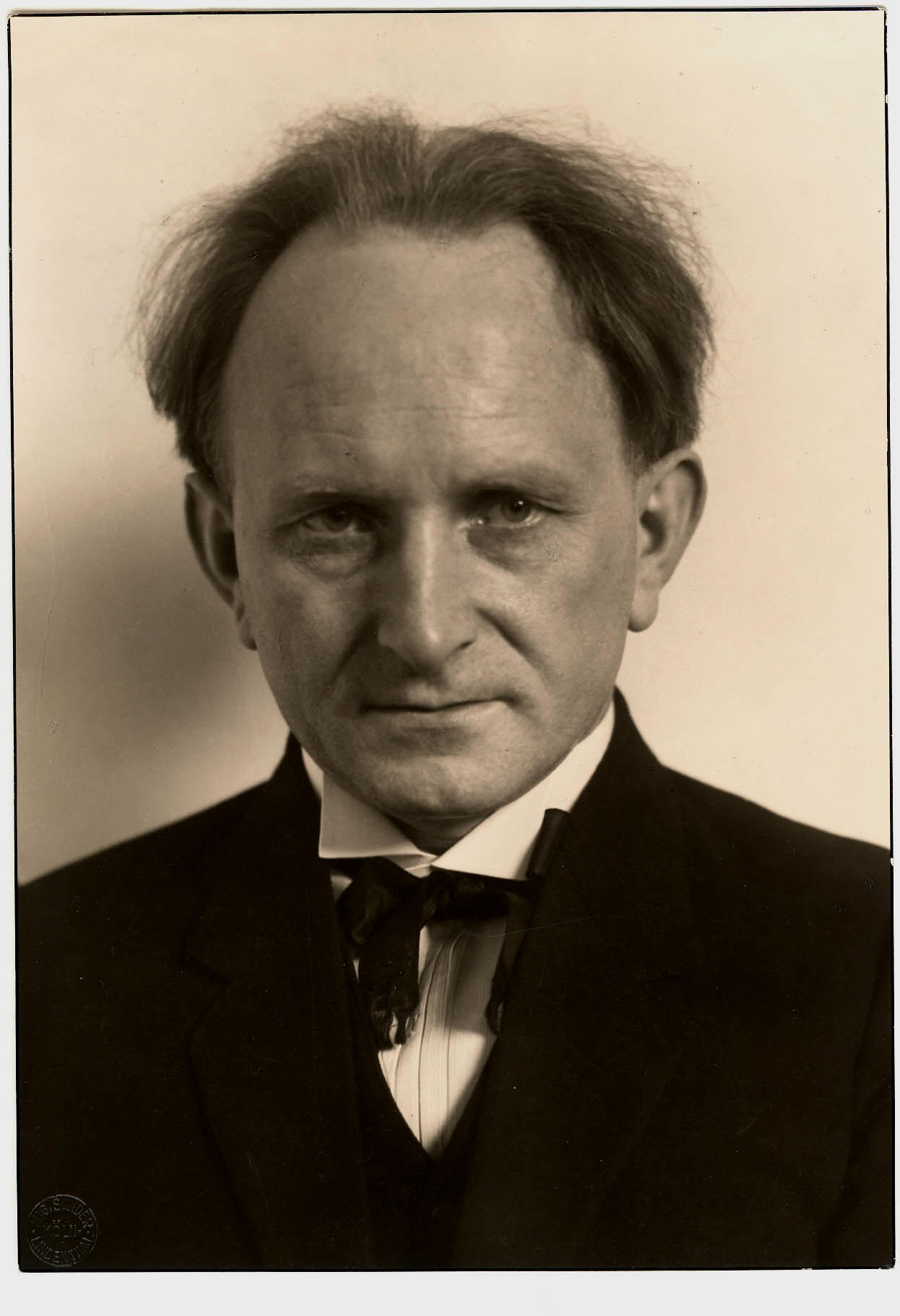
German photographer. After seven years as a miner and a period of national service, he studied painting in Dresden from 1901 to 1902, which allowed him to approach photography artistically. He had developed an interest in photography through work in photographic firms in Berlin, Magdeburg, Halle and Dresden from 1898 to 1899. In 1901 he went to Linz, where he first worked in the Greif Studio, which he ran from 1902 with his partner Franz Stukenberg as the Studio Sander & Stukenberg, until he founded the Studio August Sander für Kunstphotographie und Malerei in 1904. He sold the studio in 1909 and returned to Cologne, where he ran the Studio Blumberg & Hermann, and in 1910 he founded his own studio in Lindenthal.

At this point Sander started his major project, Menschen des 20. Jahrhunderts, with which he was involved until the 1950s. The theme for the project grew out of the portraits he made of Westerwald farmers, in whom he saw the archetypal contemporary man. Building on this, Sander developed a philosophy that placed man within a cyclic model of society. In these terms, the peasant class constituted the basis of society, hence his title for the series of 12 peasant portraits,Stamm-Mappe (see G. Sander, 1980, nos 1–12). The next group, of skilled workers, is the foundation of civic life, from lawyer to member of parliament, from soldier to banker. These are followed by intellectuals: artists, musicians and poets. The cycle closes with the Letzte Menschen, the insane, gypsies and beggars.

Although this cyclic model of society was anything but progressive, Sander came into conflict with the Nazis. The political activities of his son Erich were also held against him, and he had to interrupt work on this project between 1933 and 1939, when he devoted himself mainly to the themes of the Rhine countryside and the city of Cologne. The unusual quality of his portraiture is, above all, its systematic manner; this made the work a well-designed unity, not only in a sociological and philosophical sense, but also in photographic terms.

Sander’s portraits, whether half- or full-length, are always set in a simple environment. He gave a controlled and intentional hint at the origin and profession of the sitter through the background or through clothes, hairstyle and gesture. There is no doubt of the peasant origin of the Three Young Farmers in Sunday Dress, Westerwald (1913; Cologne, Mus. Ludwig) on their way to a dance, for example, despite their clothing. They are given away by the landscape background, their physiognomy, their clumsy shoes and the rough walking-sticks they are carrying. In contrast, Three Generations of a Farming Family (1912; see G. Sander, 1980, no. 12) shows clearly that the group had sat on their chairs especially for the photograph. In the same way, the Master Cobbler (c. 1924; see G. Sander, 1980, no. 97) is sitting almost demonstratively at his work table, looking into the camera. In the picture of the Publisher (c. 1923–4; see G. Sander, 1980, no. 280), posing nonchalantly with stick and newspaper, it is apparent that the subject’s relationship with the countryside behind him is not that of a farmer but of a walker.

Sander tried in all his works to incorporate this relationship of sitter to setting up to the last detail, with great confidence but at the same time with caution. Unfortunately he did not manage to publish his cycle during his lifetime. Through publication of Antlitz der Zeit and Deutschenspiegel in 1929, he could at least exhibit excerpts of his idea in book form. His son Gunther worked on Sander’s archive of more than 540 portraits and published them under the title that August had originally planned, Menschen des 20. Jahrhunderts, in Munich in 1980.

After the demolition of his studio by bombing in 1944, when 40,000 negatives were destroyed, Sander retired to Kuchhausen in the Westerwald, where he carried on working under primitive conditions. His name was almost forgotten in Cologne, when L. Fritz Gruber, the organizer of the Photokina photographic exhibitions there, brought his photographs back to public attention by showing them at Photokina in 1951. He also convinced the city of Cologne to purchase for the Stadtmuseum the whole archive of views of the city, taken between 1935 and 1945, including the negatives. A publication titled Das alte Köln was to commemorate this purchase but was only completed posthumously in 1984. This part of Sander’s work also shows a systematic approach, giving proof on the one hand of his closeness to his home town and, on the other hand, of a very specific and unusual mode of perception. His series of landscape photographs of the Rhine area, taken between 1934 and 1939, is an analogous case, forgotten for a long time and only published in book form in 1975.

The reason for Sander’s international reputation as one of the most important German post-war photographers lies in his strict documentation of his view of Man. Although his selection of people was mainly influenced by personal meetings and was thus hardly representative in a demographic sense, his portraits remain highly accurate reflections of their time. His individual approach determined the nature of his work and guaranteed him an outstanding position in international documentary photography. In 1964 he received the culture prize of the Deutsche Gesellschaft für Photographie, of which he had already been an honorary member since 1961. The great breakthrough in his public reputation, attested to by the retrospective mounted in 1969 by the Museum of Modern Art in New York, occurred only after his death.

Reinhold Misselbeck
From Grove Art Online

© 2009 Oxford University Press

august sander 2
august sander 12
august sander 1
august sander 3
august sander 6
august sander 5
august sander 9
august sander 7
august sander 11
august sander 4
SS Captain 1937, printed 1990 by August Sander 1876-1964
august sander 10

Publicado el

Michal Chelbin

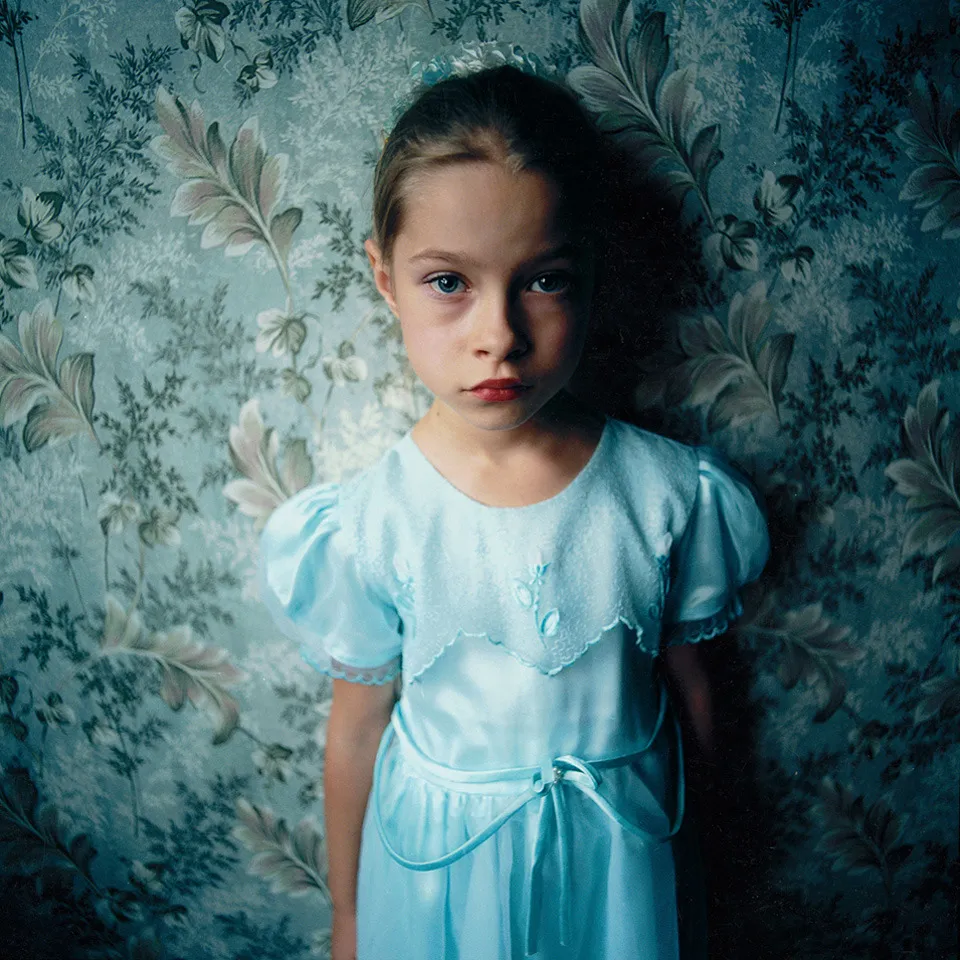
Los retratos de la fotógrafa israelita Michal Chelbin de adolescentes prisioneros rusos y ucranianos dejan mella. Las materias primas, «expresiones sombrías yuxtapuestas con colores de alto contraste para crear una miseria escénica que provoca el deseo de mirar.»

En cierto modo, las cárceles parecen ser una broma cruel. Los internos parecen seres inanimados y sin vida por delante, y en sus celdas guardan imágenes sorprendentes: carteles de paisajes marinos fantásticos o granjas bucólica. Se supone que el fin de los carteles es que se sientan como si estuvieran fuera, pero a juzgar por la expresión de sus caras, es más bien un gesto de burla que uno liberador. Los prisioneros están magullados y tristes. Sus crímenes van desde el robo de asalto sexual al asesinato. Hay un centro de día en una de las instituciones en las que los presos mayores femeninos (algunos de los cuales son condenados asesinas) sirven como niñeras.

Michal Chelbin 02
Michal Chelbin 03
Michal Chelbin 04
Michal Chelbin 05
Michal Chelbin 06
Michal Chelbin 07
Michal Chelbin 08


Publicado el

Mark Laita – Created Equal

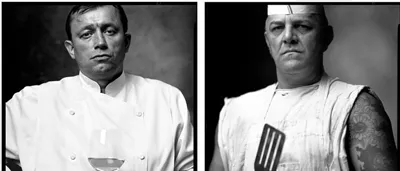
Detroit-born photographer Mark Laita questions what it is in life that puts people, who were born equal, to follow completely different paths. His album Created Equal is a a study of social and cultural clashes, as well as the influence of different background, schooling and upbringing. All diptychs in the book compare two people, who have some kind of a connection that ends up being the biggest contrast between them: for example, out-laws are put next to policemen, school drop-outs next to college graduates, and Amish teens are paired with punk teenagers.

Created Equal, Mark’s first non-commercial work, took him 8 years to complete and was published in 2010. “I photograph what I love about my country, which is the American. By that I mean the individual who is shaped from more than 200 years of liberty and independence mixed with all the successes and failures that America has experienced in its short life. So here is a collection of these creatures. Tragic and wonderful, great and ordinary, they stand proud and ready for scrutiny,” says Mark. Discover what “the American” is to this photographer!

http://www.marklaita.net/projects/ce.html

Mark Laita 11
Mark Laita 9
Mark Laita 2
Mark Laita 1
Mark Laita 3
Mark Laita 5
Mark Laita 6
Mark Laita 4
Mark Laita 7
Mark Laita 8
Mark Laita 10
Mark Laita 12

Publicado el

Vee Speers

«I don’t like to follow the crowd.
I like to seduce, with images that are at once disturbing and beautiful,
but leaving a space for the viewer to enter my world.
My portraits combine elements which evoke conflicting
emotions that can surprise the viewer, telling a story that is somewhere
between fantasy and reality, the obvious and the unexpected.»

Vee Speers

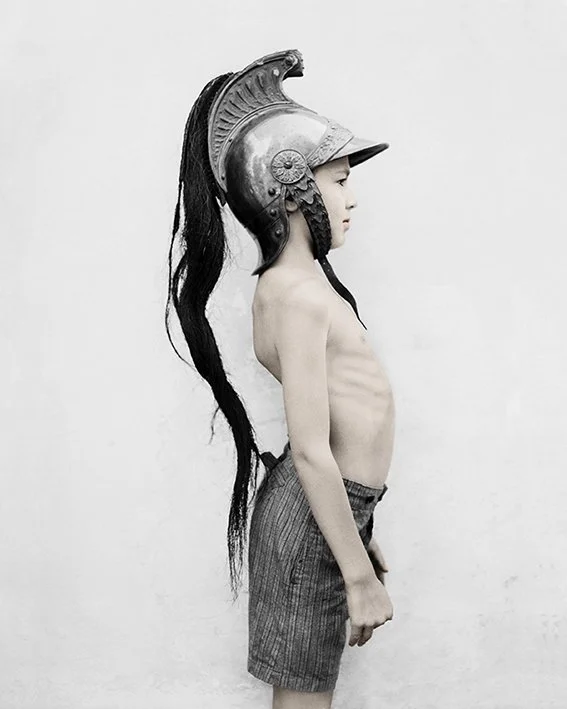
Vee Speers was born in Australia and has lived in Paris since 1990. Her timeless portraits have been exhibited and published world-wide and are part of many private and museum collections including the Elton John Collection, Michael Wilson Collection, DZ Bank, Museum 21C Kentucky, George Eastman House, Museum of Fine Arts Houston, Clerici Collection Italy. Speers monograph Bordello with a foreword by Karl Lagerfeld is available world-wide, and her second book The Birthday Party was released in October 2008 by Dewi Lewis, UK.

Vee Speers 12
Vee Speers 8
Vee Speers 3
Vee Speers 1
Vee Speers 4
Vee Speers 5
Vee Speers 6
Vee Speers 10
Vee Speers 9


http://www.veespeers.com/

Publicado el

Ingar Krauss – Portraits

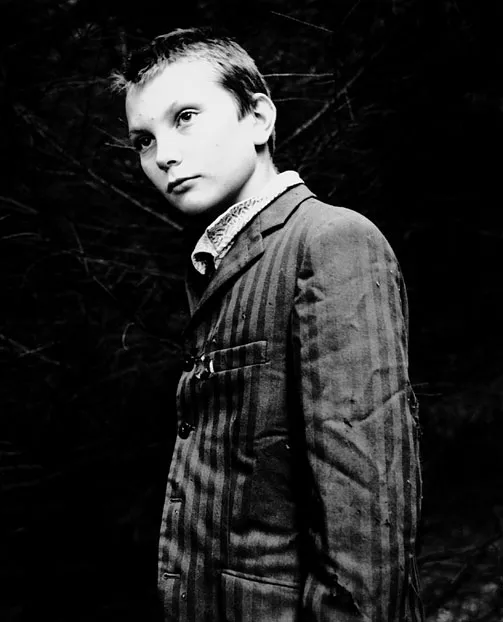
With his black-and-white portraits of children and teenagers in Germany and Russia, Ingar Krauss reveals quietly intense moments of transformation and the emotional turmoil just below the surface of life’s thresholds. His young subjects seem to have knowledge and wisdom beyond their years. Despite the mask-like appearance each tries to project, their eyes, faces and postures reveal confusion, frustration, melancholy. They are serious, remote, sad, defiant. They have already seen too much, and the innocence lost is painfully etched into each of these images.

Krauss started his photography in the mid-1990s, focusing first on neglected buildings (never published), and then on his daughter and her friends as they grew up in Berlin and in the countryside near the border of Poland. Encouraged by the successful responses to this first work, he traveled to places in the former Soviet Union, and made portraits of children the same ages, but living in state-run orphanages, juvenile prisons and camps. Many of these kids are not criminals but these “childhood institutions” are the only places society can find for them. The intensity of these images is haunting and complex.

Krauss prints his black-and-white portraits on old photographic paper produced in Eastern Europe, which gives his pictures even more of a melancholy tone. In 2004 the artist received the Leica Prize of the Grand Prix International de Photographie in Vevey.

http://www.marvelligallery.com/KraussCataloguePortraitsCover.html

Ingar-krauss@
ingar krauss 7
ingar krauss 3
ingar krauss 4
ingar krauss 5
ingar krauss 6
ingar krauss 8


Publicado el Deja un comentario

Axel Hutte – Naturaleza Sublime

Axel Hutte 2

La obra de Axel Hütte se enmarca dentro de una tradición de fotógrafos alemanes herederos directos de la estética conceptual y las enseñanzas de Bernd y Hilla Becher, que, en la década de los ochenta, readaptarán el proyecto originario de la Nueva Objetividad para adoptar una singular manera de enfrentarse al mundo. Al igual que sus compañeros de promoción en la Kunstakedemie de Düsseldorf —entre los que se encontraban Andreas Gursky, Candida Höfer, Thomas Ruff o Thomas Struth—, comparte inquietudes y planteamientos conceptuales afines: pertinaz practicante de la cámara de gran formato, adopta una estética fría, una mirada lo más neutral y desafectada posible, para acabar erigiendo imágenes planas técnicamente impecables y con una calidad de detalles que pone de manifiesto su preocupación formal por la desnudez y la pureza de registro.

Bajo la denominación genérica de «Escuela de Düsseldorf», todos ellos reinventaran la larga tradición de géneros como la fotografía de arquitectura o el retrato, donde, al no retratar el cuerpo o edificio completo, el fragmento o la parte como máxima expresión del todo se convierte en el elemento definitorio.

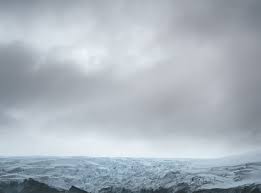
Si bien Hütte ha puesto a todos ellos en el camino de su objetivo, es el del paisaje el que le ha convertido en uno de los fotógrafos más reputados de la escena artística internacional, y que ha abordado cuestionando la tradición artística: prescindiendo de la figura humana e intentando atrapar lo intangible de la Naturaleza, pone en tela de juicio la visión del paisaje romántico, sublime o pintoresco, popularizada de forma masiva a finales del siglo xix y que terminó por transmitir y fijar una iconografía que todavía hoy persiste como constructo de la memoria colectiva.

Axel Hutte 9
!TELEFON B005
Axel Hutte 7
Axel Hutte 6
Axel Hutte 3
Axel Hutte 1

Publicado el Deja un comentario

Robert Mapplethorpe

Mapplethorpe-@

El desnudo masculino alcanzó con Robert Mapplethorpe (Nueva York, 1946-Boston, 1989) unas cotas de belleza que muchos equiparan a la perfección de los escultores griegos. Negros o blancos, total o parcialmente retratados, sus modelos desprenden una elegancia minimalista difícil de capturar con la cámara. Famoso en todo el mundo desde la década de los 60 por sus trabajos homoeróticos, durante su última década de vida, Mapplethorpe optó por el refinamiento y la armonía, sin olvidar una brutal carnalidad en su obra.

Mapplethorpe008 Mapplethorpe009 Mapplethorpe007 Mapplethorpe006 Mapplethorpe005 Mapplethorpe004 Mapplethorpe001 Mapplethorpe002 Mapplethorpe003

Publicado el Deja un comentario

Michael O´Brien – Hard Ground

Michael-O´Brien


Michael O’Brien got out of his car one day in 1975 and sought the acquaintance of a man named John Madden who lived under an overpass. Their initial contact grew into a friendship that O’Brien chronicled for the Miami News, where he began his career as a staff photographer. O’Brien’s photo essays conveyed empathy for the homeless and the disenfranchised and won two Robert F. Kennedy Journalism Awards. In 2006, O’Brien reconnected with the issue of homelessness and learned the problem has grown exponentially since the 1970s, with as many as 3.5 million adults and children in America experiencing homelessness at some point in any given year.

Stephen Blair Michael O´Brien 3 Michael O´Brien 4 Michael O´Brien 5