Publicado el

Francis Bacon interviewed by David Sylvester

Francis Bacon @

Francis Bacon by David Sylvester

‘One continuous accident mounting on top of another’

An edited extract from Interviews with Francis Bacon by David Sylvester in 1963, 1966 and 1979

The Guardian, September 2007


David Sylvester: Have you ever had any desire at all to do an abstract painting?
Francis Bacon: I’ve had a desire to do forms, as when I originally did Three Forms at the Base of the Crucifixion. They were influenced by the Picasso things which were done at the end of the 20s …

After that triptych, you started to paint in a more figurative way: was it more out of a positive desire to paint figuratively or more out of a feeling that you couldn’t develop that kind of organic form further at that time?
Well, one of the pictures I did in 1946, the one like a butcher’s shop, came to me as an accident. I was attempting to make a bird alighting on a field. And it may have been bound up in some way with the three forms that had gone before, but suddenly the lines that I’d drawn suggested something totally different, and out of this suggestion arose this picture. I had no intention to do this picture; I never thought of it in that way. It was like one continuous accident mounting on top of another.

Did the bird alighting suggest the umbrella or what?
It suddenly suggested an opening-up into another area of feeling altogether. And then I made these things; I gradually made them. So that I don’t think the bird suggested the umbrella; it suddenly suggested this whole image. And I carried it out very quickly, in about three or four days.

It often happens, does it, this transformation of the image in the course of working?
It does, but now I always hope it will arrive more positively. Now I feel that I want to do very, very specific objects, though made out of something, which is completely irrational from the point of view of being an illustration. I want to do very specific things like portraits, and they will be portraits of the people, but, when you come to analyse them, you just won’t know – or it would be very hard to see how the image is made up at all. And this is why in a way it is very wearing, because it is really a complete accident. For instance, the other day I painted a head of somebody, and what made the sockets of the eyes, the nose, the mouth were, when you analysed them, just forms which had nothing to do with eyes, nose or mouth; but the paint moving from one contour into another made a likeness of this person I was trying to paint. I stopped; I thought for a moment I’d got something much nearer to what I want. Then the next day I tried to take it further and tried to make it more poignant, more near, and I lost the image completely. Because this image is a kind of tightrope walk between what is called figurative painting and abstraction. It will go right out from abstraction, but will really have nothing to do with it. It’s an attempt to bring the figurative thing up on to the nervous system more violently and more poignantly.

In painting this Crucifixion, did you have the three canvases up simultaneously, or did you work on them quite separately?
I worked on them separately, and gradually, as I finished them, I worked on the three across the room together. I did in about a fortnight, when I was in a bad mood of drinking, and I did it under tremendous hangovers and drink; I sometimes hardly knew what I was doing. And it’s one of the only pictures that I’ve been able to do under drink. I think perhaps the drink helped me to be a bit freer.

Have you been able to do the same in any picture that you’ve done since?
I haven’t. But I think with great effort I’m making myself freer. I mean, you either have to do it through drugs or drink.
Or extreme tiredness?
Extreme tiredness? Possibly. Or will.

The will to lose one’s will?
Absolutely. The will to make oneself completely free. Will is the wrong word, because in the end you could call it despair. Because it really comes out of an absolute feeling of it’s impossible to do these things, so I might as well just do anything. And out of this anything, one sees what happens.

If people didn’t come and take them away from you, I take it, nothing would ever leave the studio; you’d go on till you’d destroyed them all.
Probably so.

Can you say what impelled you to do the triptych?
I’ve always been very moved by pictures about slaughterhouses and meat, and to me they belong very much to the whole thing of the crucifixion. There’ve been extraordinary photographs, which have been done of animals just being taken up before they were slaughtered; and the smell of death. We don’t know, of course, but it appears by these photographs that they’re so aware of what is going to happen to them, they do everything to attempt to escape. I think these pictures were very much based on that kind of thing, which to me is very, very near this whole thing of the crucifixion. I know for religious people, for Christians, the crucifixion has a totally different significance. But as a nonbeliever, it was just an act of man’s behaviour, a way of behaviour to another.

But you do, in fact, paint other pictures which are connected with religion, because, apart from the crucifixion, which is a theme you’ve painted and returned to for 30 years, there are the Popes. Do you know why you constantly paint pictures which touch on religion?
In the Popes it doesn’t come from anything to do with religion; it comes from an obsession with Velasquez’s Pope Innocent X.

But why was it you chose the Pope?
Because I think it is one of the greatest portraits that have ever been.

But aren’t there other equally great portraits by Velasquez which you might have become obsessed by? Are you sure there’s nothing special for you in the fact of its being a Pope?
I think it’s the magnificent colour of it.

But you’ve also done two or three paintings of a modern Pope, Pius XII, based on photographs, as if the interest in the Velasquez had become transferred on to the Pope himself as a sort of heroic figure.
It is true, of course; the Pope is unique. He’s put in a unique position by being the Pope, and therefore, like in certain great tragedies, he’s as though raised on to a dais on which the grandeur of this image can be displayed to the world.

Since there’s the same uniqueness, of course, in the figure of Christ, doesn’t it really come back to the idea of the uniqueness and the special situation of the tragic hero? The tragic hero is necessarily somebody who is elevated above other men to begin with.
Well, I’d never thought of it in that way, but when you suggest it to me, I think it may be so. One wants to do this thing of just walking along the edge of the precipice, and in Velasquez it’s a very, very extraordinary thing that he has been able to keep it so near to what we call illustration and at the same time so deeply unlock the greatest and deepest things that man can feel. Which makes him such an amazingly mysterious painter. Because one really does believe that Velasquez recorded the court at that time and, when one looks at his pictures, one is possibly looking at something which is very, very near to how things looked. But of course so many things have happened since Velasquez that the situation has become much more involved and much more difficult, for very many reasons. And one of them, of course, which has never actually been worked out, is why photography has altered completely this whole thing of figurative painting, and totally altered it.

In a positive as well as a negative way?
I think in a very positive way. I think that Velasquez believed that he was recording the court at that time and recording certain people at that time; but a really good artist today would be forced to make a game of the same situation. He knows that the recording can be done by film, so that that side of his activity has been taken over by something else and all that he is involved with is making the sensibility open up through the image. Also, I think that man now realises that he is an accident, that he is a completely futile being, that he has to play out the game without reason. I think that, even when Velasquez was painting, even when Rembrandt was painting, in a peculiar way, they were still, whatever their attitude to life, slightly conditioned by certain types of religious possibilities, which man now, you could say, has had completely cancelled out for him. Now, of course, man can only attempt to make something very, very positive by trying to beguile himself for a time by the way he behaves, by prolonging possibly his life by buying a kind of immortality through the doctors. You see, all art has now become completely a game by which man distracts himself; and you may say it has always been like that, but now it’s entirely a game. And I think that that is the way things have changed, and what is fascinating now is that it’s going to become much more difficult for the artist, because he must really deepen the game to be any good at all.

Can you say why photographs interest you so much?
Well, I think one’s sense of appearance is assaulted all the time by photography and by film … 99% of the time I find that photographs are very much more interesting than either abstract or figurative painting. I’ve always been haunted by them.

One very personal recurrent configuration in your work is the interlocking of crucifixion imagery with that of the butcher’s shop. The connection with meat must mean a great deal to you.
Well, it does. If you go to some of those great stores, where you just go through those great halls of death, you can see meat and fish and birds and everything else all lying dead there. And, of course, one has got to remember as a painter that there is this great beauty of the colour of meat.

The conjunction of the meat with the crucifixion seems to happen in two ways – through the presence on the scene of sides of meat and through the transformation of the crucified figure itself into a hanging carcass of meat.
Well, of course, we are meat, we are potential carcasses. If I go into a butcher’s shop I always think it’s surprising that I wasn’t there instead of the animal. But using the meat in that particular way is possibly like the way one might use the spine, because we are constantly seeing images of the human body through x-ray photographs and that obviously does alter the ways by which one can use the body. You must know the beautiful Dégas pastel in the National Gallery of a woman sponging her back. And you will find at the very top of the spine that the spine almost comes out of the skin altogether. And this gives it such a grip and a twist that you’re more conscious of the vulnerability of the rest of the body than if he had drawn the spine naturally up to the neck. He breaks it so that this thing seems to protrude from the flesh. Now, whether Dégas did this purposely or not, it makes it a much greater picture, because you’re suddenly conscious of the spine as well as the flesh, which he usually just painted covering the bones. In my case, these things have certainly been influenced by x-ray photographs.

It’s clear that much of your obsession with painting meat has to do with matters of form and colour – it’s clear from the works themselves. Yet the Crucifixion paintings have surely been among those which have made critics emphasise what they call the element of horror in your work.
Well, they certainly have always emphasised the horror side of it. But I don’t feel this particularly in my work. I have never tried to be horrific.

The open mouths – are they always meant to be a scream?
Most of them, but not all. You know how the mouth changes shape. I’ve always been very moved by the movements of the mouth and the shape of the mouth and the teeth. People say that these have all sorts of sexual implications, and I was always very obsessed by the actual appearance of the mouth and teeth, and perhaps I have lost that obsession now, but it was a very strong thing at one time. I like, you may say, the glitter and colour that comes from the mouth, and I’ve always hoped in a sense to be able to paint the mouth like Monet painted a sunset.

The Pope … is it Papa?
Well, I certainly have never thought of it in that way, but I don’t know – it’s difficult to know what forms obsessions. My father was very narrow-minded. He was an intelligent man who never developed his intellect at all. As you know, he was a trainer of racehorses. And he just fought with people. He really had no friends at all, because he fought with everybody, because he had this very opinionated attitude. And he certainly didn’t get on with his children …

And what were your feelings towards him?
Well, I disliked him, but I was sexually attracted to him when I was young. When I first sensed it, I hardly knew it was sexual. It was only later, through the grooms and the people in the stables I had affairs with, that I realised that it was a sexual thing towards my father.

So perhaps the obsession with the Velasquez Pope had a strong personal meaning?
Well it’s one of the most beautiful pictures in the world and I think I’m not at all exceptional as a painter in being obsessed by it. I think a number of artists have recognised it as being something very remarkable.

Most people seem to feel there’s somehow a distinct presence or threat of violence [in your work].
Well, there might be one reason for this, of course. I was born in Ireland, in 1909. My father, because he was a racehorse trainer, lived not very far from the Curragh, where there was a British cavalry regiment, and I always remember them, just before the 1914 war was starting, galloping up the drive of the house which my father had, and carrying out manoeuvres. And then I was brought to London during the war and spent quite a lot of time there, because my father was in the War Office then, and I was made aware of what is called the possibility of danger even at a very young age. Then I went back to Ireland and was brought up during the Sinn Fein movement. And I lived for a time with my grandmother, who married the commissioner of police for Kildare among her numerous marriages, and we lived in a sandbagged house, and as I went out, these ditches were dug across the road for a car or horse-and-cart or anything like that to fall into, and there would be snipers waiting on the edges. And then, when I was 16 or 17, I went to Berlin, and of course I saw the Berlin of 1927 and 1928 where there was a wide open city, which was, in a way, very, very violent. And after Berlin I went to Paris, and then I lived all those disturbed years between then and the war which started in 1939. So I could say, perhaps, I have been accustomed to always living through forms of violence.

We’ve talked before about roulette and about the feeling one sometimes has at the table that one is kind of in tune with the wheel and can do nothing wrong. How does this relate to the painting process?
Well, I’m sure there certainly is a very strong relationship. After all, Picasso once said: «I don’t need to play games of chance, I’m always working with it myself.»

And with the painting?
Well, again, I don’t think one really knows whether it’s a run of luck or whether it’s instinct working in your favour or whether it’s instinct and consciousness and everything intermingling and working in your favour.

Your taste for roulette doesn’t, as it were, extend to Russian roulette.
No. Because to do what I want to do would mean, if possible, living. Whereas the other day somebody was telling me about De Stael – that Russian roulette was an obsession with him and that very often he would drive round the corniche at night at tremendous speed on the wrong side of the road, purposely to see whether he could avoid the thing or not avoid it. I do know how he’s supposed to have died, that out of despair he committed suicide. But for me the idea of Russian roulette would be futile. Also, I haven’t got that kind of what’s called bravery. I’m sure physical danger actually can be very exhilarating. But I think I’m too much of a coward to court it myself. And also, as I want to go on living, as I want to make my work better, out of vanity, you may say, I have got to live, I’ve got to exist.

Where did you go to school? Or did you not?
I went for a short time to a place called Dean Close, in Cheltenham. It was a kind of minor public school and I didn’t like it. I was continually running away, so in the end they took me away. I was there only about a year. So I had a very limited education. Then, when I was about 16, my mother made me an allowance of £3 a week, which in those days was enough to exist on. I came to London, and then I went to Berlin. One is always helped when one is young because people always like you when you are young, and I went with somebody who had picked me up – or whatever you like to say – to stay at the Adlon Hotel. It was the most wonderful hotel. I always remember the wheeling-in of the breakfast in the morning – wonderful trolleys with enormous swans’ necks coming out of the four corners. And the nightlife of Berlin was very exciting for me, coming straight from Ireland. But I didn’t stay in Berlin very long. I went to Paris then for a short time. There I saw at Rosenberg’s an exhibition of Picasso, and at that moment I thought, well I will try and paint too.

How did your parents react when they heard about that idea?
They were horrified at the thought that I might want to be an artist.

You’ve often said that when you’re painting you very much prefer to be alone – that, for instance, when you are doing a portrait you don’t like to have the subject actually there.
I feel that I am much freer if I’m on my own, but I’m sure that there are a lot of painters who would perhaps be even more inventive if they had people round them. It doesn’t happen in my case. I find that if I am on my own I can allow the paint to dictate to me. So the images that I’m putting down on the canvas dictate the thing to me and it gradually builds up and comes along. That is the reason I like being alone – left with my own despair of being able to do anything at all on the canvas.

· Copyright 1975, 1980 and 1987 David Sylvester. Reproduced by kind permission of Thames & Hudson Ltd, London.

Bacon 2 Bacon 3 Bacon 4 Bacon 11 Bacon 13 Bacon 10 Three Studies for Figures at the Base of a Crucifixion circa 1944 by Francis Bacon 1909-1992Bacon 12Bacon 5 Portrait of Isabel Rawsthorne 1966 by Francis Bacon 1909-1992 Bacon 8 Bacon 7 Bacon 6

Publicado el

Lucien Freud by David Kamp

Lucien Freud@

Freud, Interrupted. (February 2012)

Lucian Freud, who died last year, still creating masterpieces at 88, was intensely private, rejecting the idea that an artist’s life mattered to his art. But Sigmund’s grandson, arguably the greatest portrait painter of his era, forged his closest bonds in his studio. With two major Freud retrospectives in view, David Kamp learns that those who sat for him—duchesses, drag queens, most of his women, and many of his children—will never forget what they discovered.

Lucian Freud’s final portrait is of a naked man and a dog. It is unfinished but otherwise betrays no sign of the agedness of its creator, who died last July 20, halfway through his 89th year. The scale is big, a square canvas of about five feet by five feet, and the brushwork is as sure and layered as in any painting he had ever done—smooth and free around the man’s shoulders, crusty and impastoed along the arms. The palette is Caucasian-fleshy from afar but remarkably varied and intricate up close: purples and greens in the man’s legs, vivid streaks of yellow in his right hand, rust and blue at the naughty bits.

For the last 57 years of his life, Freud painted standing up rather than sitting down; the physical restrictions of seated painting, he said, had begun getting him “more and more agitated” in the 1950s, so he kicked the chair away. Painting on his feet required extraordinary stamina, given Freud’s self-imposed work schedule: a morning session with one model, an afternoon break, and an evening session with another model, seven days a week, all year round. What’s more, these sessions had a tendency to stretch on: a deliberate worker, Freud took 6, 12, 18 months or longer to complete a painting, marathoning into the night if the mood struck. But he had stamina in spades. Painting was his workout; he took no other exercise, and yet photographs of him working shirtless in 2005, when he was 82, show him to be lean and all sinew, a jockey-size Iggy Pop.

But by June 2011, Freud recognized that his body was finally failing him, and that he had only so many brushstrokes left. The naked man in the portrait was completed, but the dog, a tan-and-white whippet, would never get its hind legs. Freud prioritized its head and face, adding a little dart of terre verte (“green earth”) mixed with umber to depict the tip of the animal’s pricked-up right ear. In early July, Freud was addressing the painting’s foreground: the folds and ripples in the sheet that covered the low platform upon which his two models sprawled. Here and there, as his energy permitted, he applied quick strokes of flake white, a thick, lead-heavy paint, to the lower part of the canvas.

That was as far as he got. Able to stand no longer, he at last retired to his bedroom, one floor up from the studio he kept in his Georgian town house in West London. As he lay in bed, friends and family gathered to pay their respects. There were many visitors from both categories. Freud had an otherworldly magnetism that his intimates struggle to put into words. Deborah Cavendish, the Dowager Duchess of Devonshire, once ascribed to him “a sort of starry quality … an extraordinary sort of mercurial thing. He’s like something not quite like a human being, more like a will-o’-the-wisp.” Over the course of his life he fathered 14 acknowledged children with six women. Among his nine daughters are the fashion designer Bella Freud and the novelist Esther Freud. Two weeks into their bedside vigil, he was gone.

Freud’s was not one of those postscript deaths, the final headline in a life that had long ago ceased to matter or progress. It was an interruption—the ultimate inconvenience for a man who still had plenty of work to do and plenty of people who wanted to see his work. The restaurateur Jeremy King, who was more than a hundred sittings into an uncompleted etching when Freud died—having already sat for a painting completed in 2007—recalls that the artist “never came to terms with the fact that he was slowing down. He constantly said, ‘What’s wrong with me?’ And I’d say, ‘Well, Lucian, you’re actually much more active than any other 68-year-old I know, let alone 88.’ And the moment he lifted his hands, most of his ailments seemed to melt away. The concentration and the adrenaline pushed him through.”

From his mid-60s onward, the pinochle years for most men his age, Freud had been enjoying a fruitful and vigorous late period. This wasn’t a function of critical recognition, though it happened to be in this period that critical favor finally smiled upon him, with Time’s Robert Hughes judging him “the best realist painter alive,” a sobriquet that stuck. Nor was it a matter of commercial success, though it was in 2008 that Freud’s Benefits Supervisor Sleeping (1995) fetched the highest-ever auction price for a painting by a living artist, selling at Christie’s to the Russian petrogarch Roman Abramovich for $33.6 million.

Freud simply did great work as an old man, some of his greatest. “In a sense, I think he knew this was his last big push at making some remarkable works. I could just see that he was really ambitious, pushing as hard as he could,” says the naked man in that final painting, David Dawson, the artist’s longtime assistant and the owner of Eli, the whippet star of several late paintings. (Freud had bestowed the dog upon Dawson as a Christmas present in 2000.) When Dawson started working for Freud, 20 years ago, the artist was in the middle of a series of nudes of the drag performer and demimonde fixture Leigh Bowery. Bowery was a huge man, lengthwise and girthwise, with a bald, oblong head—a lot to work with in terms of topography, physiognomy, and epidermal hectarage. Yet Freud went bigger still, painting Bowery larger than life-size. Freud had his canvases extended northward, eastward, and westward as it suited him; often, he would work the upper reaches of a painting from atop a set of portable steps.

An Island upon an Island

There were lots of big paintings in this late period: not just of Bowery and his clubgoing friend Sue Tilley, the heavyset welfare-agent-by-day of Benefits Supervisor Sleeping, but of more ordinarily proportioned people, such as Freud’s military-officer friend Andrew Parker Bowles. The seven-foot-tall portrait of Parker Bowles, The Brigadier, painted over 18 months of sittings between 2003 and 2004, was a playful experiment: Freud dispensing with his usual propensity for exposed flesh to do a Reynolds- or Gainsborough-style painting of a distinguished British gentleman in uniform—albeit with a characteristically lumpy, earthy, Freudian twist. “Lucian asked to paint me in the uniform I wore when I was a commander of the Household Cavalry,” says Parker Bowles, the former husband of Camilla and a former Silver Stick in Waiting to the Queen. “But it had been 20 years since I’d worn it, and I’d got fatter. So I undid my tunic and my stomach came out.”

The painting is magnificent—melancholy and funny at the same time: a military man resplendent in his beribboned coat with a gold-braid collar and his smart dark trousers with wide red stripes down the side, but with his face lost in thought (nostalgia? regret? ennui?) and his midsection asserting itself as the picture’s focal point. The placket down the middle of Parker Bowles’s white shirt divides his gut into two testicular bulges. “When I look in the mirror, I think, Not bad, but then I see the painting and hear people say things like ‘It shows the decline of the British Empire,’ ” says Parker Bowles. “Well, so be it.”

In addition to tackling the big canvases, Freud resumed making etchings late in life, returning to a form he’d left behind in his youth. He took on his share of small paintings, too, such as his neck-up portraits of King, David Hockney (2002), and a distinctly Broderick Crawford-resembling Queen Elizabeth II (2001).

At the time of his death, Freud was not only partway through the etching of King, whose restaurant the Wolseley he dined in several nights a week, but also well into his second painted portrait of Sally Clarke, whose restaurant-café, Clarke’s, a Notting Hill institution just down the road from his house, was where he took his breakfast and lunch nearly every day.

This overdrive work ethic was at once an acknowledgment of pending mortality and a hedge against it. Dawson marvels at what his boss managed to achieve. “The sheer volume, the scale,” he says. “He never rushed the work. But, my God, one great painting after another came out. He felt he could do it and he was able to. And this was his last chance.”

Despite standing only about five feet six, Freud was an imposing figure, with a fierce gaze often likened to a hawk’s, and a severe, aristocratic mien; even when painting, he always wore a long scarf, rakishly knotted at the neck. He was also an intensely private man who didn’t want his biography to inform people’s reception of his art. That he was the middle son of the youngest son of Sigmund Freud; that he had been born in 1922 in Berlin and moved with his family to England in 1933, the year Hitler became chancellor of Germany; that his acquaintances over the course of his life ran the gamut from Pablo Picasso to Alberto Giacometti to the Duke of Beaufort to the gangster Kray twins to Kate Moss; that he was a ladies’ man and an inveterate horseplayer—all irrelevant. An artist, he said, should appear in his work “no more than God in nature. The man is nothing; the work is everything.”

And, fair enough, one needn’t know anything about Freud to appreciate his pictures. Consider his mastery, in paintings ranging from Pregnant Girl (1960–61) to Naked Girl with Egg (1980–81) to Woman Holding Her Thumb (1992) to Naked Portrait (2004–5), of how bosoms sag and pool atop a recumbent woman’s chest—an unidealized view of womanhood that’s nevertheless almost feminist in its resistance to prescribed expectations of lady portraiture. Or consider the hyper-masculine whomp delivered by Head of a Big Man (1975), its middle-aged sitter’s florid, meaty noggin rising menacingly out of a pale-blue dress shirt like the head of a cranky tortoise out of its shell. These images may be unsparing, but they are not, as Freud’s detractors and even some of his admirers say, cruel and/or grotesque. Rather, they are intensive engagements with his models as living creatures, what their heads and bodies are like as blood, oxygen, and emotion circulate through them. They’re fun, amazing pictures to get lost in.

This year, two major retrospectives will give the British and American public an unprecedented opportunity for full-on Freud immersion. On February 9 the National Portrait Gallery’s exhibition “Lucian Freud Portraits” opens in London as part of the city’s Cultural Olympiad run-up to the Summer Olympic Games. Featuring more than 130 pieces, it is the first Freud retrospective devoted exclusively to his depictions of people, and the artist was personally involved in its preparation—although, says the museum’s curator of contemporary art, Sarah Howgate, “He did say, ‘Well, I won’t be around in 2012.’ ” The “Portraits” show will move to Texas this summer, opening at the Modern Art Museum of Fort Worth on the second of July. And on February 17 the Blain/Southern gallery, in London, will unveil “Lucian Freud: Drawings,” the most comprehensive survey ever of Freud’s works on paper, presenting more than a hundred drawings and etchings from the 1940s to the near present. The “Drawings” retrospective will be at Blain/Southern through April 5 and then at Acquavella Galleries, in New York, from April 30 through the ninth of June.

It was with the National Portrait Gallery exhibition in mind that Freud dedicated himself to getting as far as he could on Portrait of the Hound, as the square painting of Dawson and Eli has come to be known. He had spent much of his career being deeply unfashionable, a figurative artist besotted with Constable and Titian as the midcentury world around him went Abstract Expressionist, Op, and Pop. Not that this ever seemed to affect him. While others in his cohort—such as the artist-illustrator John Minton, who was the subject of a gloomy, arresting Freud portrait in 1952 and took his own life in 1957—despaired of their irrelevance, Freud carried on, an island upon an island.

He did, however, undergo one major stylistic shift. His early works are coolly colored, draftsman-precise, and strictly two-dimensional—bereft of the fleshly qualities with which he would come to be identified. His late-40s paintings of his first wife, Kitty Garman, the daughter of the sculptor Sir Jacob Epstein, are wonderful in their own way but seemingly the work of some other artist: her face rendered with a rolling-pinned flatness, and every last frizz of her split-ended hair faithfully documented. But Freud’s friendship with the artist Francis Bacon, which began in the 1940s, prompted him to change his approach: “I think that Francis’s way of painting freely helped me feel more daring,” he said.

The new, free approach proved revelatory, not just to the artist but to his audience. The transitional Woman in a White Shirt, painted in 1956 and ’57, is a good example. Its subject was his friend the Duchess of Devonshire, née Deborah Mitford, the youngest of the Mitford sisters. But her English-rose beauty is hardly evident in the portrait, roiled as it is with swabs and swirls of drab color—“all greenish khaki,” as the now 91-year-old Dowager Duchess writes in her newest memoir, Wait for Me! Yet the wonder of it is, Freud’s painting, in its turbulent strokes and M.R.I.-like scrutiny, foretold the future: “As I have got older,” its subject writes, “so my likeness to the portrait grows.”

Freud’s brushwork would get only freer from there as he swapped out his soft sable brushes for stiff, bristly hog’s-hair ones that he would snip down to nubs. From the 60s forward, the paint got thicker, too—whorled, layered, and smeared as he laboriously built up form through color. Not uncoincidentally, Freud’s paintings became more sensual, increasingly if not exclusively focused on nude bodies.

Pampered Sitters

Given Freud’s aversion to publicity and his emphasis on “the work,” it’s tempting to take him at his word and avoid any discussion of “the man.” Yet the truth is, who he was and what he was like were essential to how he went about this work.

The flip side of Freud’s fierceness was his magnetism, his profound charisma. Sebastian Smee, the Australian-born art critic for The Boston Globe and one of the select group of writers that Freud let into his life, describes the time he spent alone with the artist as having been charged with “a kind of emotional risk. At the back of your mind, I suppose, was always the sense that if you said something stupid or obnoxious or somehow deeply irritating to him you might leave and never be summoned again. And yet, countering this, there was the reality of this incredibly sensitive and deeply considerate person who, if he liked you, would forgive all manner of idiocies, extend you no end of courtesies, and, even better, extend you the great compliment of speaking his mind in front of you.”

And that’s from someone who never modeled for Freud. For those who did, he cast still more of a spell. His charisma was crucial to his method. It was what made his models bear happily the long ordeal of sitting for him, and therefore what afforded Freud the opportunity to observe his subjects at length—picking up on every twitch of a facial muscle, every iteration of how a subcutaneous layer of thigh fat bulged through a sitter’s skin.

“I was fascinated by his process,” says David Hockney. “He was slow. Very slow. I worked it out that I sat for him for 120 hours. And because he took a long, long time, we talked a lot: about our lives, people we knew in common, bitchy artist gossip. He wanted you to talk so he could watch how your face moved. He had these incredible eyes that sort of pierced into you, and I could tell when he was working on a specific part of my face, my left cheek or something. Because those eyes would be peering in: peering and piercing.”

The most comprehensive account of what it’s like to sit for Freud is Man with a Blue Scarf, an excellent book published in 2010 by the author and Bloomberg News art critic Martin Gayford. It chronicles, in journal style, the process by which Freud painted a portrait of Gayford over a succession of night sittings between November 2003 and July 2004. Somewhat early in the process, Gayford realizes what he is in for:

When he is really concentrating he mutters constantly, giving himself instructions: “Yes, perhaps—a bit,” “Quite!,” “No-o, I don’t think so,” “A bit more yellow.” Once or twice he is about to apply a stroke, then withdraws, considers again, then re-scrutinizes, measuring my face with little mapping movements of the brush, describing a small curve in the air or moving it upwards. The whole procedure is hugely deliberative. When I get up and stretch my legs after about forty minutes of work, despite what seemed to be plenty of vigorous activity with the brush, little seems to have changed on the canvas.

Freud liked to call himself a biologist at heart, and he applied himself to his work with the discipline and rigor of a scientist in a lab. Each day, he tore a clean piece of white cotton sheeting from the pile of rags he kept in the studio—decommissioned hotel sheets purchased in bulk from a recycling business—and tucked it under his belt to serve as an apron. He wiped his brush clean after each individual brushstroke, painstakingly remixing the colors on the heavy palette he held in his right hand. (Freud painted left-handed.)

Not that his workday was a pageant of solemnity. His subjects talk of the merriment and pampering that being a Freud sitter entailed: the Lucian-led sing-alongs of such standards as Cole Porter’s “Miss Otis Regrets” and Rodgers & Hart’s “Where or When”; the stories he shared of his youth and his bubbly times in 1950s Paris; the silly verse he recited from memory; the meals he’d spring for at the Wolseley and Clarke’s; the food he prepared himself, often woodcock, partridge, or snipe that Parker Bowles may have shot and sent up from the country.

There was an ulterior motive beyond sociability to all this lavishing of attention: “He would be watching you the whole time, so he’d get a bigger understanding of what he was painting,” says Dawson. The biologist in him wanted to subject the sitter to a variety of conditions: hungry, caffeinated, tired, peeved, slightly drunk.

“The time he used to like me most was if I had a hangover,” says Cozette McCreery, the subject of the painting Irish Woman on a Bed (2003–4), who met the artist while working as an assistant to his daughter Bella. “I asked, ‘Is that because I’ll just sit here and shut up?’ And he was like, ‘No, no, you have a sort of glow!’ ”

A favorite conversational topic of Freud’s during sittings, not at all taboo, was his paternal grandfather. Freud had warm personal memories of the old man, both from his childhood on the Continent and from Sigmund’s brief time in London, to which he fled in 1938, a year before his death. But Lucian was scathingly dismissive of psychoanalysis. To his sitters, he was fond of reciting this limerick, with its saucy double entendre at the end:

Those girls who frequent picture palaces
Have no use for this psychoanalysis
And although Dr. Freud
Is extremely annoyed
They cling to their long-standing fallacies.

McCreery remembers the glee with which Freud considered the idea that critics might look for Freudian-as-in-Sigmund resonance in his work. In the very strange picture in which she appears, she slouches, nude and semi-upright, on a rickety-looking wrought-iron bed, her calves resting upon a gashed pillow that is leaking feathers. Some white cherries rest on the bed beside her, a few of them seemingly floating up next to her thigh.

“He said, ‘I’m going to stab the pillow—I want feathers everywhere!’ And he just burst out laughing,” McCreery says. “I was like, ‘What’s so funny?’ And he said, ‘What would my ancestorhave made of this? A stabbed pillow and cherries!’ He actually hoped that it would cause a very obvious ripple somewhere along the line.”

Extended Families

Yet there is no avoiding the obvious parallels between the sitting process and psychotherapy: the regimented one-on-one sessions; the interplay between the observer and the sitter; the accumulated hours fraught with self-examination. “Literally, he would begin a conversation with ‘Tell me about your childhood,’ ” McCreery says.

“I learned an awful lot about myself,” says Jeremy King. “Not just by looking at the portrait, but talking to him, watching him, and just sitting there. Because, of course, it’s an incredibly meditative experience. You do feel quite exposed.”

The crucial difference from therapy was that the artist was the more active participant in the transaction, and, moreover, he had no obligation to observe professionally mandated boundaries. “I’d relish the chance to have such an intense and intimate experience,” says King, “and I could certainly understand why, with some of his models, particularly when he was younger, it would develop into more. Because it is very, very sensual.”

For his nudes, which Freud preferred to call naked portraits—“The word ‘nude’ implied to him an object, not a person,” says Dawson—the artist kept the heat cranked up. This was ostensibly in the interest of keeping his sitters comfortable, and it was certainly useful in keeping dog posers like Eli blissfully still for hours on end. But the radiator warmth also lent an overall air of languor and decadence to the poses of Freud’s naked human sitters, even as the studios in which he painted—in Paddington, Holland Park, and, finally, Notting Hill—appeared in the paintings exactly as they were: ratty, spare, and unsumptuous.

Freud’s women sitters were often lovers, or women who became his lovers, and, in some cases, lovers who became the mothers of his children. He had two children with his first wife, Kitty Garman, his daughters Annie and Annabel. He had none with his second wife, the society beauty Caroline Blackwood (later the wife of poet Robert Lowell), and never married again after they divorced, in 1958. But he had already carried on procreating, fathering a son, Alexander, in 1957 with a student at the Slade School of Fine Art named Suzy Boyt, the subject of his early new-style painting Woman Smiling (1958–59). Three more children with Boyt followed in the next 12 years: Rose, Isobel, and Susie. (Freud considered another child of Boyt’s, Kai, to be his stepson.) More or less concurrently, Freud had four children with Katherine McAdam, whom he had met when she was a student at St. Martin’s art college: Jane, Paul, Lucy, and David.

With another art student, Bernardine Coverley, Freud had Bella and Esther in the early 60s; his painting Pregnant Girl (1960–61) is effectively the “before,” capturing the topless, 18-year-old Coverley in tender repose, to the “after” of Baby on a Green Sofa (1961), in which baby Bella naps with arms outstretched and fists balled. With Lady Jacquetta Eliot, Countess of St. Germans—who lies nude in a bed behind the artist’s seated mother, Lucie, in Large Interior W9(1973)—Freud had a son, Freddie, born in 1971. And with the artist Celia Paul—like Coverley, the subject of a gentle portrait painted while she was expecting, in this case Girl in Striped Nightshirt (1985)—Freud had a son, Frank, who at 27 is the youngest of his children, with Annie, at 63, the eldest.

As raffishly bohemian as these arrangements may sound, it was no easy road for the women and children involved. Freud was selfish about his time—he unapologetically used the word—and had no interest in raising his children as a conventional father would; painting came first. There is a small shelf of literature by the Freud offspring that, directly or indirectly, acknowledges the fallout from having him as a father. Esther Freud, Rose Boyt, and Susie Boyt have written novels with autobiographical elements to them, while Annie Freud has published two collections of poems that, on occasion, nod slyly toward her father. The best known of these works is Esther’s Hideous Kinky, which is based on her and Bella’s experiences living in Morocco with their questing, proto-hippie mom, Coverley, as she tried to figure out her life in the 60s as a partnerless and still very young woman. (The novel, in which the girls’ father is a distant poet who occasionally sends money, was made into a 1998 film starring Kate Winslet in the mother role.)

Even so, all of Freud’s children save the McAdams, whose mother took an unromantic view of his infidelity and cut off communication with the artist, wound up sitting for him. In a 2004 documentary about Freud’s sitters directed by Jake Auerbach, the son of Freud’s best artist friend, the painter Frank Auerbach, some of the younger Freuds reflected on the experience. “You have a choice, and not all of his children have made it, from very young, that you can get the good bit if you want to accept what he’s like. Or you can not get it by being angry for him not being like someone else’s father,” said Esther. “When I was 16, I moved to London, and almost immediately I started to sit for him. And it was a really lovely way to get to know him because until then I hadn’t ever lived in the same city as him.”

Rose Boyt, whose novels Sexual Intercourse and Rose betray a darker sensibility than Esther’s, recalled in the film the circumstances under which Freud’s extraordinary portrait of her, also called Rose (1978–79), came about. It’s an atypical Freud nude, of a pissed-off-looking college-aged girl lying on a couch with one leg planted on the floor and the other folded up tight with tension, her right heel jammed against her right buttock. “I didn’t want to feel floppy and soggy. I wanted to feel ‘I’m just about to spring into action,’ ” Rose said. “I could have been extremely, extremely, extremely angry. And I wasn’t. And I felt that there was a potential for me to suddenly get up and say, ‘Look, fuck off! I’m not doing this anymore!’ or ‘Where were you when I needed you, you bastard?’ And I think he maybe was a little bit worried in case I was suddenly going to actually spring up and protest.”

Yet his children generally seemed to accept that sitting for Freud was the way to have a fulfilling relationship with their father. With further hindsight, Rose’s feelings about the sitting experience have grown warmer. “Sitting for Rose was an education,” she writes via e-mail. “I mean literally—my father taught me about Shakespeare and T.S. Eliot in particular, and I became so interested in books I decided to go to university.” The sessions for the portrait went as late as four in the morning, she says, and “often, once he had finished, my father just chucked a blanket over me and I slept on the sofa in the studio until morning when I went off to college.”

The eldest of Freud’s sons, Alexander Boyt, known in the family as Ali, sat at three very different junctures in his life: as one of the two elfin moppets (the other being Rose) huddled at the feet of their outsize father in one of his most iconic paintings, Reflection with Two Children (Self-Portrait) (1965); as a spaced-out 70s longhair in Ali (1974); and as a pensive, necktied grown man in The Painter’s Son, Ali (1998).

“The memories of stories told and ideas expressed when sitting are the bits that warm me most,” writes Ali, now a services officer for drug and alcohol abusers in North London, in an e-mail. “The talking about women and love and the Pope. The brilliant and ludicrous ‘There is only so much hypocrisy I allow myself’ and ‘All I know about love is that you’d rather have a miserable time with someone you love than a nice time with someone you don’t care about.’ I once apologized to Dad for something I did, and he replied, ‘That’s nice of you to say, but it doesn’t work like that. There is no such thing as free will. People just have to do what they have to do.’ ”

(The Freud children contacted for this article declined to be interviewed in person, out of grief as much as respect for their father’s privacy. Four of them are in double mourning. Garman, known later in life as Kitty Godley, died in January 2011 at the age of 84. Coverley passed away just four days after Freud, and just two weeks after receiving a surprise diagnosis of advanced cancer. She was only 68.)

Leigh Bowery, uninhibited soul that he was, didn’t shy away from being nosy about this family stuff when he interviewed Freud for an underground arts magazine called Lovely Jobly in 1991. “When did you get the idea of working from your naked grown-up daughters?” he asked.

“When I started painting naked people,” Freud replied.

“I can’t think of another artist who has done that. It must make things, well, slightly extreme,” said Bowery.

“My naked daughters have nothing to be ashamed of,” Freud said.

Seven Days a Week

Freud was just about to enter his 70s when Bowery interviewed him, but he was already aware of the clock’s ticking. He talked bluntly of a new penchant for working still-longer hours “as I’ve gotten weaker,” and expressed a fear that if he slept too much or worked too little “I might stiffen up and not be able to get up again.”

It was around this time that Dawson came into his life, a soft-spoken, imperturbable struggling artist who grew up in rural Scotland and Wales and was earning money working for Freud’s then dealer, James Kirkman. Dawson started taking on menial tasks for Freud as a “run-around boy,” he says. Freud shortly thereafter had a falling-out with Kirkman but kept Dawson in the breakup. “I suppose we just liked each other’s company,” Dawson says. “I probably came along at the right time and made sure that all he had to worry about was painting.”

In 1992, Freud sought out the New York art dealer William Acquavella for a lunch, keen to have Acquavella represent him. Acquavella, whose gallery is situated in a large town house on the Upper East Side and specializes in secondary-market sales of big-name dead artists, was surprised at the overture. “I was more into Picasso, Matisse, Miró,” he says. “And I’d heard that Lucian was difficult. But we met, and I went to his studio and saw all these huge Leigh Bowery paintings he’d been working on. I was knocked out and I bought them all. We couldn’t have been more different, but from then on I represented Lucian and we became good friends. It was all handshake. We never had a piece of paper between us.”

Like Dawson, Acquavella took care of things so that Freud, in the homestretch of his life, could focus on painting. The artist alerted his new dealer to the small matter of some gambling debts he had accrued. Acquavella met with Freud’s bookie, Alfie McLean, who owned a chain of betting shops in Northern Ireland. McLean also happened to be the imposing “Big Man” ofHead of a Big Man and its related paintings, The Big Man (1976–77) and The Big Man II(1981–82). McLean, indulgent though he was of Freud—who, in keeping with the familial spirit with which he approached his sitters, had also painted pictures of McLean’s grown sons—told Acquavella that the painter owed him $4.6 million. Acquavella not only settled the debt but started selling Freud’s new paintings at six- and seven-figure prices, making the artist, for the first time in his life, a rich man.

“Once he started making money, he didn’t gamble anymore,” says Acquavella. “He said, ‘It’s not fun when you have the money. It’s only fun when you have no money.’ ”

The older Freud got, the more circumscribed his world became, seldom taking him beyond his circuit of the studio, Clarke’s, the Wolseley, and another favorite dinnertime haunt, the Italian restaurant Locanda Locatelli. He needed to keep painting. Freud had always been an acutely impatient man outside of his workplace, known for walking heedlessly into fast-moving traffic and careering down narrow London roads at terrifying speeds in his old Bentley. (Ali Boyt: “My friend says I drive like a 15-year-old in a stolen car. Dad was the only one who thought I drove well.”) Advanced age did not mellow Freud in this regard. Alexi Williams-Wynn, one of his later models, recalls that “the speed with which I entered his life and began sitting was, I think, very characteristic of him—highly impulsive, urgent, impatient towards anything beyond his life in the studio.”

Williams-Wynn, 50 years Freud’s junior, was studying sculpture at the Royal Academy. She wrote him a fan letter and, to her surprise, received an invitation from the artist to meet for a cup of tea. He asked her on the spot to begin sitting for him, for what became Naked Portrait(2004–5). Shortly into this experience, they became lovers. “I wasn’t taking it seriously at first—I was fully aware of the age difference,” she says, “but I fell in love with him. It was sort of out of my hands.”

Freud had been working at the time on a large self-portrait in his Holland Park space, a sixth-floor walk-up that he kept as a satellite to his Notting Hill base of operations—its walls scenically crusted with years of palette-knife wipe-offs, producing an effect somewhere between seagull guano and action painting. Deciding that the picture was too much of an artist-in-his-atelier cliché, he reconceptualized it so that Williams-Wynn took a prominent role. The painting, the last he ever did in Holland Park, was titled The Painter Surprised by a Naked Admirer. It shows Freud pausing before a canvas with brush in hand, stooped and somewhat befuddled, as the comely Williams-Wynn wraps her unclothed body around his legs, a rapturous expression on her face.

Naked Admirer was technically tricky to execute, especially since the painting Freud is putatively at work on within the picture is of the same image as the real painting: Williams-Wynn wrapping herself around him in the studio—one of those eternal-mirroring mind-warps. To paint it, Freud had to look at his and his model’s reflections in a mirror across the room, disentangle himself from Williams-Wynn, and pivot to the canvas, painting from memory what he had just glimpsed. Then back to positions for the next brushstroke.

“I quickly found myself sitting seven days a week, night and day. This lasted a year,” says Williams-Wynn. “We were lovers, so the situation seemed quite normal in a heightened, exhilarating kind of way.” Yet when the sittings for the two paintings ended, so, effectively, did the affair—a disorienting experience that, Williams-Wynn admits, took a long time to get over. Still, she says, “being with Lucian made me realize that this is no joke: being an artist, being alive. It also made me understand that selfishness is what it takes to make great art.”

King describes a similar lesson learned. “I always thought ‘selfish’ was a pejorative term,” he says, “but what he basically said is ‘I am what I am. This is what I like to do. If you want to fit in with that, you’re very welcome to come into my life. But don’t try and make me something I’m not.’ That form of selfishness I respected a great deal, because there’s a strong honesty about it.”

Running Out of Time

Last April, Freud completed his final naked portrait of a woman, an artist in her 20s named Perienne Christian. Freud found her through her tutor at the Prince’s Drawing School, from which she had recently graduated. It was a platonic relationship, but, inevitably, one that evolved into something as intimate as the artist-sitter relationships that had come before it. “He was extremely aware of running out of time and wanting to do so much more,” says Christian. “We did talk about death towards the end. He was frustrated by his mortality.”

And there was still Portrait of the Hound to work on. It was actually Dawson’s fourth double portrait with a dog. The first was Sunny Morning—Eight Legs (1997), in which he nestled on a bed with Freud’s own whippet, Pluto. Freud, mischievously, resolved the issue of achieving pictorial balance by painting a second set of Dawson’s legs underneath the bed, a choice that required Dawson, ever the model of selflessness, to lie for hours, nude, under the furniture.

Then came the epic David and Eli (2003–4), labeled upon its unveiling a “masterpiece” by Robert Hughes, who couldn’t help noting, given the tricks Freud plays with perspective, that Dawson’s scrotum appears “larger than the pillow behind his head,” and Eli and David (2005–6), which reveals Freud, he of the supposedly clinical, unflinching gaze, at his sweetest. Dawson sits serene and shirtless in a wing chair, Eli in his lap. Dawson’s arms and shoulders are stroked with cold off-whites, but his face and sternum are red, flush with the warmth that Eli, nodding off, provides like a hot-water bottle.

Freud never painted to elicit responses of “Awww!,” but he was not averse to sentiment. There’s a similar sweetness evident in Last Portrait of Leigh, a painting of Bowery’s slumberous head, no bigger than a sheet of A4 paper, that Freud completed shortly after Bowery died of H.I.V.-related illness on New Year’s Eve in 1994. If sitting was a way for his children to develop a closeness to Freud, so was painting a way for Freud, if he so chose, to develop a closeness to his sitters. Notwithstanding his insistence that “the man is nothing” in the finished art, the creation of this art was everything to the man: Freud’s way of relating to the world, the people he encountered in it, and, indeed, the people he put in it. “My work,” he said, “is purely autobiographical. It is about myself and my surroundings. It is an attempt at a record. I work from people that interest me, and that I care about and think about, in rooms that I live in and know.”

Fuente: Vanity Fair. Febrero 2012

Lucien Freud 10 Lucien Freud 11 Lucien Freud 12 Lucien Freud 13

Publicado el

Paula Rego

PAula Rego @

Paula Rego (Lisboa, 1935) es una de las pintoras figurativas más relevantes de la escena internacional y una de las voces plásticas más lúcidas y combativas surgidas en la segunda mitad del siglo XX. La producción artística de Rego está enraizada en experiencias y recuerdos personales, en siniestras fantasías, en la historia del arte y en la literatura. Aprincipios de los años cincuenta se traslada a Inglaterra para estudiar en la Slade School of Fine Art y adopta Londres como ciudad de residencia principal.

Ajena a las modas pasajeras, Rego ha practicado siempre la pintura figurativa bajo formas muy diversas y es de los pocos artistas modernos cuya obra gira en torno a la vida misma, como también lo hicieron los predecesores que reivindica, Goya y Hogarth, revelando así lo mejor y lo peor de la condición humana. Su obra tiene una manifiesta voluntad subversiva y liberadora, con una evidente dimensión de lucha contra la autoridad. En ella la artista habla de la dominación, la opresión y la violencia con lo que cuestiona los estereotipos impuestos socialmente. Con enorme fidelidad a su experiencia del mundo inspirada en los recuerdos de su solitaria pero mágica infancia en Portugal y en los muchos papeles que ha asumido en su vida, Rego ha creado una obra intensamente conmovedora y humana con un lenguaje apasionado y enérgico.

La presente exposición (Septiembre – Diciembre 2007 Museo Reina Sofia) es su retrospectiva más completa y recorre su trayectoria artística a través de importantes grupos de obras de cada periodo, permitiendo explorar en profundidad la interrelación de sus diferentes registros, así como la evolución de la artista como un viaje a través de la mente y de la complejidad de las experiencias vitales. Comienza con obras de su periodo de estudiante, y continúa con las pinturas y collages políticos, alimentados por el odio hacia el régimen de Salazar y realizados con un estilo muy libre en la década de los cincuenta y principios de los sesenta. Tras un periodo de vacío artístico, su creación se reanuda a principios de los ochenta con obras de gran formato y fluida ejecución, pintadas en acrílico sobre papel. En la exposición se presentan además los pasteles de gran formato, por los que tal vez sea más conocida en la actualidad, grupos sustanciales de grabados, que desde finales de 1980 constituyen una parte considerable de su producción y una cuidada selección de sus numerosos dibujos, muchos de los cuales se exponen por primera vez al público.

Paula Rego 1 Paula Rego 2 Paula Rego 3 Paula Rego 4 Paula Rego 5 Paula Rego 6

Publicado el

Tony Bevan

Tony Bevan @

Tony Bevan (b.1951) is one of Britain’s most distinctive figurative painters. Since the early 1980s he has been making images in acrylic and charcoal that extend the tradition of expressive figure-based painting associated with such older painters as Francis Bacon and Frank Auerbach. Bevan’s singular approach focuses in particular on the human head which is frequently enlarged, often isolated, and usually abstracted by being reduced to a structure of vector-like lines and marks. Such taut, linear structures are descriptive but also evoke the artist’s exploration of character, mood and psychic states. Bevan’s approach to portraiture is thus inherently and assertively subjective, transforming literal appearance through the implication of complex and ambiguous emotion.

Tony Bevan 1 Tony Bevan 2 Tony Bevan 5  Tony Bevan 4Tony Bevan 7 Tony Bevan 3Tony Bevan 9 Tony Bevan 10 NPG 6818; Tony Bevan by Tony Bevan

Publicado el

David Hockney – CAMARA WORKS

David Hockney  /  CAMARA WORKS

David Hockney @

David Hockney is a great painter,but he has also known fame through photography, although he does not mince his words when he says ‘Photography will never equal painting!’  

Perhaps this is the wrong argument as they are different media and needn’t be compared.

However he does make judgemental comments about photography such as ‘Photography is only good for mechanical reproduction’. ‘Photography can’t show time’   and more…I’ve seen professional photographers shoot hundreds of pictures but they are all basically the same. They are hoping that in one fraction of a second something will make that face look as if there were a longer moment…If you take a hundred, surely one will be good. It could be anybody doing it… There are few good photographs, and those good ones that do exist are almost accidental. Photography has failed…How many truly memorable pictures are there? Considering the milllions of photographs taken, there are few memorable images in this medium, which should tell us something. Photography can’t lead us to a new way of seeing. It may have other possibilities but only painting can extend the way of seeing.

Perhaps Hockney has not succeeded with one image but his photo collages and photo montages –  ’Joiners’  = certainly caught the eye of the public in the 1980′s.

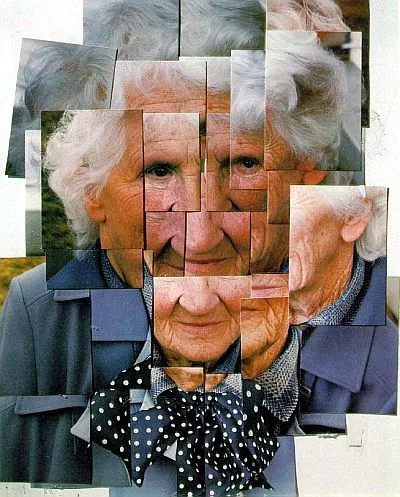
Mother – Hockney

Hockney’s creation of the “joiners” occurred accidentally. He noticed in the late sixties that photographers were using cameras with wide-angle lenses to take pictures. He did not like such photographs because they always came out somewhat distorted. He was working on a painting of a living room and terrace in Los Angeles. He took Polaroid shots of the living room and glued them together, not intending for them to be a composition on their own. Upon looking at the final composition, he realized it created a narrative, as if the viewer was moving through the room. He began to work more and more with photography after this discovery and even stopped painting for a period of time to exclusively pursue this new style of photography.  From 1982 Hockney explored the use of the camera, making composite images of Polaroid photographs arranged in a rectangular grid. Later he used regular 35-millimetre prints to create photo collages, compiling a ‘complete’ picture from a series of individually photographed details.

My mother

The main obstacle Hockney thinks he has overcome is the limited perspective of a stationary camera. A single photograph can only show one point of view, usually for a small period of time. “All photographs share the same flaw,” he says. “Lack of time.” He then goes on to trace photography’s misguided view back hundreds of years to the Renaissance and invention of the Camera Obscura.

Don and Christopher

Cubism helped to topple the single perspective in the hand-arts, but with photography it still exists. The idea behind Hockney’s grids was to inject multiple reference points into photography, in short to make it cubist.

Noya and Bill Brandt

And the very well known ‘Pearl Bllossom Highway”

Pearl blossom highway

Kasmin

Merced river 1982

Telephone pole 1982


Pre historic museum 1982

Photographing Annie Leibovitz While She Is Photographing Me

Walking in the zen garden


Nicolas-wilder-studying-picasso

Celia’s Children Albert & George Clark

Sun on the pool

Patrick Procter


Publicado el

Michael Borremans – Whistling a happy Tune

Michaël Borremans

 Michael Borremans @

WHISTLING A HAPPY TUNE (2008) es el título de una publicación que recoge la última obra dibujada de Michaël Borremans (1963, Geraardsbergen). Como podemos comprobar por el título no vamos a sacar una información clara sobre los contenidos temáticos o sobre las técnicas empleadas por el autor. Sin embargo, es fiel a las tácticas  de aproximación a lo real de Borremans, es tan ambiguo como lo que nos espera en cada una de sus dibujos, sólo al final del recorrido, comprobamos que efectivamente este título se corresponde con la ironía que subyace a ese “mundo feliz” representado por las realidades ilusorias  de su obra.
Como primera aproximación podemos afirmar que los  dibujos de Borremans reflejan la cultura de masas contemporánea. Parece que sus pequeños dibujos tratan de enfrentar al espectador cara-a-cara con las «ilusiones históricas» que subyacen en la sociedad actual, aludiendo al engaño y la indiferencia del mundo que nos rodea. 
Su trabajo se relaciona por tanto, con las ilusiones que percibe a su alrededor, las ilusiones acerca de las opciones políticas, la libertad personal y la capacidad del individuo para actuar en este mundo complejo. Para ello, imprime a sus dibujos de una estética seductora y un cierto grado de provocación con el fin de comunicar mejor esta sensación de ilusión al espectador y con la mayor claridad posible, si es que “claridad” es un término lo suficientemente claro, pues en la obra de Borremans hasta lo más evidente deja de serlo. 

Las referencias explícitas a la historia del arte y las tradiciones culturales juegan un papel muy importante en esto. Sus dibujos incluyen una variedad de géneros como el retrato, el busto escultórico, la máscara de la muerte y el monumento, refiriéndose también, a aquellos lugares donde se muestran las obras de arte, como el estudio, el museo o el espacio público., Reflexiona también sobre las diferentes formas de “puesta en escena” que fueron desarrollados en el curso de la historia del arte reciente: el diorama en el siglo XIX, la fotografía antes de la era digital, y las proyecciones de vídeo de gran tamaño que uno encuentra en la actualidad.
Michael borremans-9
La cuestión de la realidad y la ilusión subyace en las temáticas empleadas por Borremans, como ya hemos indicado, manifestando su carácter más ambiguo e inconsistente a través de sus dibujos. Una y otra vez se preocupa de la distancia entre lo que llamamos la realidad -lo que está ahí afuera- y la ficción o la narración imaginaria de la que se ocupa el arte. 
Esta relación entre lo real y lo imaginario se expresa también en la propia percepción que Borremans tiene de sus dibujos, tratándolos como una especie de propuesta de intervenciones o de instalaciones en el espacio público.
Sin embargo, la ejecución de estos elaborados estudios preliminares, nunca alcanzarán la fase de inserción en la realidad. Dado que invariablemente las intervenciones públicas las ve como «actos de agresión» y prefiere ajustarse al «límite» que impone la ejecución de un modelo dibujado. El trabajo con esta táctica de realizar dibujos como proyectos latentes, permite a Borremans, proteger la muy delgada línea entre la realidad y la ficción tan característica de su obra y para conseguirlo el tiempo y la historia desempeñan un papel crucial.
Borremans hace un uso regular de las primeras fuentes de las imágenes en la que basar sus dibujos. En la mayoría de los casos son fotografías del siglo XIX, revistas y libros ilustrados de los años treinta a los años cincuenta, y las fuentes más recientes, tales como películas, telenovelas y series de televisión, que encuentra ya sea en su forma original o en Internet. Otra fuente fértil es su fascinación por el kitsch, caracterizado por las figuras de porcelana que adornan las ventanas de muchas casas de Flandes. Borremans utiliza imágenes que están disponibles en cantidades masivas, en busca de sus propios temas, -puede por ejemplo mostrar la ropa y la peluquería de moda de otra época, lo que hace que el trabajo aparezca de una manera retrospectiva- y trata de cerrar la brecha entre la conciencia de un pasado histórico, una tradición cultural y los problemas de la actualidad.
En cuanto a la forma y el estilo, los dibujos de Borremans evolucionan muy lentamente, mostrando la influencia de su formación en el grabado, técnica que exige desarrollos largos en el tiempo de ejecución. Cada dibujo es meticulosamente compuesto, y el artista vuelve una y otra vez sobre el papel, a fin de continuar la corrección y profundización capa por capa. Este trabajo cauteloso, revela la afinidad de Borremans con la tradición del norte de Europa, de la pintura en miniatura y los dibujos de los viejos maestros. En cuanto al contenido subyacente de estas opciones formales, también muestra raíces en la tradición de la pintura belga. Al igual que el trabajo de sus compatriotas, James Ensor, Félicien Rops, René Magritte y Thierry de Cordier, la mano de Borremans revela la tendencia surrealista para evitar asociaciones lógicas. 

El uso de los materiales confiere a sus dibujos un aspecto intuitivo, semiacabado y proyectual, que los hace muy sugerentes. Se utiliza casi cualquier tipo de material como apoyo para su trabajo, sobres abiertos desgarrados (con sellos de correos aún adherida), tapas arrancadas de libros, viejas fotos, páginas de calendarios, restos de imágenes, etc. Cada soporte tiene su propia historia que es revelada por las huellas externas del mismo y que el artista al incorporarlas al dibujo las pone en evidencia y son magnificadas. La elección de este tipo de materiales hace hincapié en el hecho de que las obras no han crecido de la nada, y que no pueden ser plenamente comprendidas únicamente sobre la base de lo que en ellas hay dibujado. 
La edad y la estética de las fuentes de imágenes también parecen ser transferidos a sus dibujos por medio de los colores. Sus matices típicos «antiguos» de tonos marrón y gris son adecuados para dotar de una pátina que siempre es inherente al material utilizado para el soporte. Con la excepción de gouache y pintura de aceite (a la que siempre añade una pátina), Borremans generalmente dibuja con lápiz, acuarela y tinta blanca, siendo un número muy pequeño los dibujos realizados sólo con lápiz.

Termino con un reflexión final que me parece que a todos nosotros como artistas nos conviene tener presente en nuestro trabajo diario.  A primera vista los pequeños dibujos de Borremans parecen simples, convincentes y realistas. Nada podría ser menos cierto. Debajo de estas imágenes aparentemente claras, se encuentra contenido un mundo que se manifiesta impresionante, confuso y extraño, provocando una sensación de perplejidad y ambigüedad en el espectador, que paradójicamente hace aumentar su confusión cuanto más detenidamente observa estos dibujos.

Fuente: Antonio Rabazas

Publicado el

Philip Akkerman – Interview

Philip akkerman@

Taking self-portrait as his sole subject, Philip Akkerman (*1957, Vaassen, NL) decided to pursue a career in painting at the tender age of 18 when the others were announcing heroically to him the tragic death of painting. “How can painting be dead if I wanted to paint so much?” In the last 30 years, Akkerman derived an almost methodical approach to painting by creating images of himself through adaptation and reinvigoration of painting techniques offered to him by the old masters throughout the history of art. Declaring that “I paint myself, and so I paint the whole of mankind”, we see in his vast ouvrage of 3,000 self-portraits the diversity of man and art “combined into a philosophical collage of forms”.

A loyal disciple of Schopenhauer, Akkerman believes in individual freedom of creation, yet this freedom has to be backed by a regulated, self-disciplined working method of the medieval time in order to make it positive and productive. “I don’t think I am a child of this age, I am a romantic darkness,” Akkerman defines.

The present interview with Philip Akkerman was conducted on the 29th April, 2011. To mark the day, Akkerman wore a royal hat for the royal wedding.

Akkermania
Philip Akkerman
9 April – 26 June 2011
Kunsthal, Rotterdam (NL)


PA – Philip Akkerman
ST – Selina Ting for InitiArt Magazine


The eye sees everything except itself

ST: Looking at the paintings and meeting the real artist, I see different persons.

PA: [Laughs] Here is just one Philip Akkerman and over there you see 400.  One of the things that I am aiming at with my work is to see who and what I could be if I were born in another time or in another country. We don’t have many choices in life, but I want to know how many Philip Akkermans are possible, and I surprise myself every time.

ST: Is it more about painting or about yourself?

PA: In the first place, I am a painter. Otherwise, I would realize this search in hundreds of novels, or films, etc…

ST: Why is it this sad, serious look? It’s kind of dark, isn’t it? Does the world appear to you as dark and sad?

PA: It’s serious but not sad. It’s the concentration of someone at work. Another reason is that a smiling self-portrait is grotesque, nobody would believe it. And the third reason is that I am a pessimist. It’s dark, as you said, because life is a mystery which we will never be able to understand. It’s perhaps only possible to understand who you are as an individual at the end of your life. We can look at ourselves in two ways: through the senses and through introspection. Our intellectuality applies only to the first, i.e. to our experience with the outside world. Our internal world of feelings and emotions are inaccessible for the intellect. “The eye sees everything except itself”. It’s a nice expression for this paradox that we live in.

©Philip Akkerman. Left: Self-portrait 2010 no.51, 50x43 cm. Centre: Self-portrait 2009 no.24. Right: Self-portrait 2008 no.142. Courtesy of the artist.

©Philip Akkerman. Left: Self-portrait 2010 no.51, 50×43 cm. Centre: Self-portrait 2009 no.24. Right: Self-portrait 2008 no.142. Courtesy of the artist.


ST: When you paint, do you try to look at the psychological aspect of yourself instead of taking a logical approach?

PA: No, it’s more about philosophy than about psychology. I am interested in the most profound meaning of art: What is existence? Who are we ? What is this life that we are living? Then there is the more superficial part of art that is also core to my artistic research, which is the technique. Everything in between, be it psychology, history, social meaning of art, etc. etc. I am not interested in at all.

ST: Not even art history?

PA: No! Art history is a joke! It’s for students and scholars, not for people who enjoy paintings or who make paintings, because all the notions of styles are inventions. There are just individual paintings and when you look at a painting or make a painting, you should not think in styles, movements, schools, etc. It’s too fictional.

ST: We will come back to the idea of art history later. What about the profound aspect of art? How do you capture them with your paintings?

PA: I think about these life issues all day. Since the 1960s, artists like Joseph Beuys tried to convince us that our everyday life is art. But I really do believe that art is something special. It’s not like baking bread.

ST: Because it distills something from our daily life?

PA: Yes, it tells us something more about life. It can somehow stop life.


Painting is dead?

©Philip Akkerman. Left: Self-portrait 1999 no.48, 27 x 25cm. Centre: Self-portrait 1999 no.3, 50x43cm. Right: Self-portrait 1998 no.70, 40x34 cm. Courtesy of the artist.

©Philip Akkerman. Left: Self-portrait 1999 no.48, 27 x 25cm. Centre: Self-portrait 1999 no.3, 50x43cm. Right: Self-portrait 1998 no.70, 40×34 cm. Courtesy of the artist.


ST: What about the old masters and the different period styles that you referred to often in your work?

PA: [Laughs] I am an old master! It’s still the same culture that we live in, nothing has changed. Let me tell you something. When I started doing my self-portraits in the late ’70s and early ’80s, my teachers said to me, “You can’t do that. Painting is dead”. But I really wanted to make paintings, I really loved to paint. How can painting be dead when I love it so much? And I asked myself, when does something die? Something dies when the reason that it came to life can no longer justify its existence. Studio painting emerged at the end of the Middle-Ages and the beginning of the Renaissance, a moment when the totalitarian popes and emperors had to share their power with the civilians. It was the rising individual freedom of the common man that in turn gave rise to the form of studio painting.

ST: When people started painting for themselves…

PA: Exactly! The essence of painting is individual freedom and autonomy. Do you know the American TV show painter Bob Ross? He taught painting on TV in the 1980s. People watched it not because they were interested in painting, but just to relax before they went to bed. He was not taken seriously because he’s a kitsch painter. In the TV show, he says something which to me is the essence of our culture. He says, “Look I am painting a tree. But it’s a lonely tree, isn’t it? So let’s paint another tree next to it. Remember this is your painting and you can do whatever you like!” This is what individual freedom means. It’s your painting; you can do whatever you like with it. We had this freedom when painting started and we still have it! So painting is still alive. It’s still vital even though we now also have photography, conceptual art, video art, etc. It almost died last century under the totalitarian regimes, Fascism and Communism. They tried to stop it because individual freedom was a threat to their regimes.

ST: But we have seen the opposite that paintings, especially underground paintings, can come out very powerful under political repression.

PA: I hope so but it’s really difficult for artists.

ST: Another idea around the notion of the death of painting is that nothing new can be invented or derived from painting because of its long history of experimentations.

PA: Why should there always be something new? That’s the art historical nonsense. Our culture is one of chaos, of crisis. As I said, the essence of our culture is the individual freedom. No two individuals are the same. There are always clashes; there are always people who want to do things differently. People would say, I am going to do it all over again. I am going to make an important step backward. [Laughs] Why always ahead?

ST: Talking about art history, isn’t that you are also experimenting with different styles and techniques developed in the past centuries? Studying different techniques is an essential part of you work.

PA: It is my daily work. I am trying to improve my paintings everyday to make them more disturbing to look at. When you master some tricks, you can catch your audience . Here comes my theory of the “eye” or the retina as part of the skin. You are not aware of your skin until someone pinches it or licks it. It’s with such sensations that you suddenly realize that you have a layer of skin. Paintings can arouse such sensations to the eyes through contrasts between warm and cold colours, sharp and soft edges, dark and light tones, etc. There are hundreds of contrasts that can be applied at different degrees.


©Philip Akkerman. Right: Self-portrait 2006 no.138. Centre: Self-portrait 2006 no.114. Right: Self-portrait 2005 no.104. Courtesy of the artist.

©Philip Akkerman. Right: Self-portrait 2006 no.138. Centre: Self-portrait 2006 no.114. Right: Self-portrait 2005 no.104. Courtesy of the artist.


ST: How can you avoid rendering it routine after 30 years of painting self-portraits every day?

PA: As an artist, you were born with a certain talent and you can’t be any better or any worse than what you were born with. But technically, you can grow.    You can become better each year with practices and rational thinking. Complete control over technique is what people called “routine”. I like it very much even though this is the superficial part of the art. If you look at my work, you will see I am not that far yet, there are many bad paintings, but I am not going to destroy them because they are the witnesses of my struggle. I am not afraid of bad paintings because when you are afraid of bad paintings, you stop experimenting. I am happy to know that I am improving when I look at the bad paintings.

ST: It sounds like a very strict self-disciplinary process on the technical part of painting, while the idea, the contemplation on life, as what you said, is very idiosyncratic.

PA: Yes. In a totalitarian regime, everything is strict – taste, technique, material – everything is censored and standardized. Now, in our culture, everything is free. The content is free, the technique is free, which to me, is as boring as the medieval art. Complete control is boring, complete freedom is also boring. I let these two forces clash, so I use the strict techniques of the Middle-Ages combined with the freedom of ideas of today. What I have is a powerful, disciplined army which marches in one direction, but the soldiers are free to choose their own outfits, they can wear whatever they like, in different styles, hats, shoes, etc. That’s my painting.

ST: These are the rules that you apply to yourself, such as doing only self-portrait but in many different disguises.

PA: Exactly!

ST: Have you ever painted the others?

PA: No. Maybe five or six times…

ST: Why did you choose not to paint the others?

PA: Because I have more freedom with self-portrait. I don’t have the secret desire to beautify the portraits; I don’t need to care about the feeling of the sitter. When I paint myself, I am completely free from all these.

ST: I think you are creating a persona that you can work on freely and evolve with it. It’s also more economically accessible. In a way, these paintings are no longer self-portraits, but the image of a human being in general, like a tool for your work.

PA: That’s why I said I have become paint!


©Philip Akkerman. Right: Self-portrait 1992 no.13, 40x34 cm. Centre: Self-portrait 1991 no.85, 40x34cm. Right: Self-portrait 1991 no.1, 31x28 cm. Courtesy of the artist

©Philip Akkerman. Right: Self-portrait 1992 no.13, 40×34 cm. Centre: Self-portrait 1991 no.85, 40x34cm. Right: Self-portrait 1991 no.1, 31×28 cm. Courtesy of the artist


ST: [Laughs] Do you keep diaries of your work?

PA: Yes. I write diaries and notes. At the young age when I decided to become a painter, I had to write notes, like a declaration, of what I was really concerned and worried about and reflected upon. Later, I wrote about technical matters. Before, I used to have one thick diary for each year, but in the last five years, I only had one. So, the inner struggle is almost over.

ST: You are more certain with yourself…

PA: Probably.


Akkermania

Akkermania – solo show of Philip Akkerman’s work from 11 private collection. 09 April – 26 June 2011. Exhibition installation view of Philip Akkerman’s paintings from the Caldic Collection in Kunsthal, Rotterdam. Courtesy of the artists, the Caldic Collection and the Kunsthal Rotterdam.

Akkermania – solo show of Philip Akkerman’s work from 11 private collection. 09 April – 26 June 2011. Exhibition installation view of Philip Akkerman’s paintings from the Caldic Collection in Kunsthal, Rotterdam. Courtesy of the artists, the Caldic Collection and the Kunsthal Rotterdam.


ST: Is it your idea or the curator’s idea to put up a show from 11 collections?

PA: The idea is from the architectural critic Jeffrey Kipnis. He told me five years ago that he was amazed by the diversity of my work. He told me that I would need 10 curators to put up an exhibition to show the diversity. In the Akkermania show, we don’t have 10 curators but we have 11 collectors who picked their own choices throughout the years according to their own temperaments and visions. The idea is to see my work through their eyes.

ST: The diversity is the theme and the collectors are the tools!

PA: Yes!

ST: How do you find it finally?

PA: I like it. I am crazy about it. I like to experiment with each exhibition and I want each of them to be different. Once I did a show with just paintings from one year, another time we did different ways of hanging for each room in a museum show. There are many possibilities to show the work.

ST: How did you choose the 11 collectors?

PA: We wanted to show the diversity, so we chose collectors with different tastes and approaches to my work. Also, there is a rule in it: it’s all or nothing. They had to show all my paintings in their collection, there is nothing to hide, as I said, bad paintings are equally important to me.

ST: I like the title “Akkermania” very much!

PA: It’s from one of the collectors. He said, “I am an Akkermaniac”. I have to say that my work doesn’t sell easily, because you don’t want a self-portrait of an angry-looking man, a stranger, in your living room. But once people start buying my work, they are caught by the Akkermania fever. They buy one at the beginning, then they return to buy another one and another one. One collector started by buying one painting per year, now he has two or three from each year. He just can’t stop.

ST: After all these years of intense observation and contaminating people with the Akkermania fever, are you comfortable facing yourself?

PA: Of course not! Nobody is. But we need the troubling feelings in order to understand ourselves and the others better.

ST: Thank you very much!


About the artist
Born in Vaassen (NL) in 1957, Philip Akkerman lives and works in The Hague.
His recent solo exhibitions includes Akkermania, Kunsthal, Rotterdam in 2011; 2010: Full Frontal, Mummery + Schnelle, London; Am I A Person?, BravinLee Programs, New York; I have become paint, Galerie Polaris, Paris; Nicky’s Schoenen- en Sleutelservice, The Hague. 2008: Mummery+Schnelle, London; Stephane Simoens Contemporary Fine Art (with Tony Matelli), Knokke; Torch Gallery, Amsterdam. 2007: Guido Costa Projects, Torino. 2006: Bob van Orsouw, Zurich; De Hallen, Haarlem.

Artist website: http://philipakkerman.com/

Publicado el

Wolfe Von Lenkiewicz

Wolfe von Lenkiewicz@

Wolfe von Lenkiewicz (British, b. 1966)

Wolfe von Lenkiewicz’s chief artistic concern is the appropriation of language and mythology. He boldly experiments with hybrid visual combinations that straddle the murky borders of the shocking and offensive. His art historical intervention demonstrates our own complacency of art towards famous images, namely those highly learnt visual compositions of art history. Our knowledge of them has become so much second nature that we take them for granted. It is not until they are disturbed that we realise how much confidence we place in them.

The history of art can be understood as the compromising of changes from one mode of visual representation to another. The difference is the highly contemporary and extreme nature of von Lenkiewicz’s subject matter. September 11th 2001  becomes a stage for giant butterflies, Damien Hirst’s spot paintings merge with the designs of William Morris, and Adam and Eve are expelled from a field of oil derricks. The works demonstrate that no image is sacred and thus the artist is free to disseminate subject matter as they see fit. What is important is distinguishing when such combinations «work». Lenkiewicz has been described as an unbound geneticist-turned-artist, a contemporary iconoclast; allusions he no doubt relishes.

Wolfe von Lenkiewicz: Picasso women series

wolfe von Lenkiewicz 1  wolfe von Lenkiewicz 3 wolfe von Lenkiewicz 4 wolfe von Lenkiewicz 5 wolfe von Lenkiewicz 6 wolfe von Lenkiewicz 7

Publicado el

Cy Twombly interviewed by Nicholas Serota

Cy Twombly@

Nicholas Serota on Cy Twombly

I first became aware of Cy Twombly’s work in the early 1970s, through catalogues and occasional sightings in European museums of his sensitive and sometimes luscious paintings, with their highly personal response to classical cultures and contemporary painting.

It is always a privilege to visit an artist in their studio. It is a challenge to be confronted with unfamiliar and new work, and to gain an insight into the creative process. It’s one of the reasons I can’t give up curating. Recently, I have been working with Nicholas Cullinan of the Courtauld Institute of Art on Tate Modern’s Cy Twombly exhibition, called Cycles and Seasons. This will be the most important exhibition of Twombly’s work anywhere in the world for 15 years, during which time he has made some astonishing new works. Over the past year we visited Twombly in Rome, and in his studio in Gaeta on the coast, halfway between Naples and Rome. This provided a rare opportunity to interview him about his work; the only other interview with him ever published was with David Sylvester in 2001. For me, it was a great pleasure to talk to an artist whose work I have for so long admired.

The interview was recorded during two conversations at the artist’s house in Via Monserrato, Rome, in September and December 2007.

NS: I want to begin with your early formation and interests as an artist in the late forties. Do you remember seeing your first Pollock?

CT: Yes, way before I came to New York, in Virginia. I also knew the works of Rothko, but again from photographs or from books, before he did the very simple ones.

NS: So you were looking at reproductions of these paintings when you were still in Virginia?

CT: In high school, but when I was in New York I didn’t see too much of de Kooning. You know there are a lot of painters that sort of disappeared, like Motherwell, Baziotes, Gottlieb, Tworkov, who were all good painters. That’s why I like Sotheby’s catalogues, because you see all the strata of the art world at the time. It wasn’t just made up of four or five key people; it was a whole scene. And a lot of them weren’t necessarily painters but they were great characters and always around. The first time I saw thing physically other than in Boston, was when I was an art student in New York. Betty Parsons had one great show after the other. The Pollock show, and then her Newman show with the beautiful little sculpture at the entrance with just a single painted board. But I never quite took to the Wagnerian American.

NS: Clyfford Still?

CT: Yes, I never quite …I was very fond of Gorky, naturally very fond of Gorky.

NS: But were the paintings around to be seen or did they disappear after he died?

CT: I knew them quite well, the drawings and things. When I was in school in New York I saw some of Gorky’s shows; there were shows of everyone between two or three galleries like Pierre Matisse and Betty Parsons. And then later Sidney Janis took over. I saw the most interesting period, through to the Women of de Kooning. I saw beautiful shows of European things at Curt Valentin [the Bucholz Gallery]. He had sculpture, but he would have a whole show of twenty-five or thirty beautiful big Klee drawings. You saw shows one after the other – Picasso, whatever.

NS: So your education was in the galleries, not in the museums.

CT: In New York I lived in galleries …I hardly ever went to school. I got that side of the line before. For instance, Pierre Matisse had the first Giacometti show in America. And he was very nice, in the back room he had the little plasters …a hand …a little figure. And then I saw a first beautiful show of reclining nudes of Dubuffet. Those had quite an effect on me. I looked at anything and everything. Everthing was on 57th Street, you know?

NS: So, you were already looking at European painting. Were you very conscious that the energy in painting was moving from Europe to America?

CT: I don’t think of that.

NS: But it must have been exciting with so many young painters working in New York at that time.

CT: At the Art Students League I met Robert Rauschenburg in the second term, and through him I met de Kooning and Franz Kline because Bob’s mother-in-law had bought things like Cornell. Anyway I met painters. I lived at Columbia and my roommate was a graduate of Princeton from Cleveland, taking his doctarate at Columbia. And when his family came to New York they always went to Knoedler which was on 57th, and they always bought very beautiful little Monets or Renoirs and things for each other for Christmas. So I sort of did different things. (My roommate) was a wonderful fellow, very austere named Peter Putnam. With his mother he started financing public sculpture for [Case Western Reserve University,] Cleveland. One day, about ten years ago, he was riding his bicycle when he got hit by a derrick – he was killed. He left $46,000,000 to continue his sculpture thing. I have a lot of friends from school who were very interesting and are still my friends now. Other than Bob, who was the first painter I really knew, I was always with people more interested in literature or history or cultural things…

NS: And how did you get to Black Mountain College?

CT: I once went to Bob’s house and he had the registrar of Black Mountain there. I signed up and went for the summer and winter session. I enjoyed the summer, not so much the winter, and then I went back just to visit the following summer with Franz Kline. He was also close to Bob, they worked together …and I met John Cage.

NS: It was unusual that you were working in both painting and sculpture at that time, because people normally think of themselves as either painters or sculptors.

CT: I didn’t think of myself as except what I was doing.

NS: Just making things.

CT: Yes, I did a lot of sculpture there, they were metal and things and they corroded and crumbled…

NS: So was one of the the things that made Black Mountain so interesting for you the fact that it attracted writers and poets as much as painters?

CT: It was the first time I’d been in an atmosphere of artsy-ness. I enjoyed it …it was very nice. The first summer I went, I enjoyed very much Ben Shahn and his family. I traded with him. He was very close to [poet and college rector Charles] Olson. And there were other people there, interesting students. I spent the next winter there but it had got a little ingrown after and a lot of the summer students had gone.

NS: So what was so remarkable about Olson?

CT: Everything revolved around Olson. And a lot of people were there mainly to see Olson. That summer …was stimulus. They were into D.H. Lawrence. I never went to Olson’s classes. There was a whole interesting group around – more than the painting group. Then the second summer I just visited. There was Franz Kline, who I liked very much. He did a very beautiful painting there. then Motherwell came back – he saw me in the beginning and he saw me at the end. And he wrote me one of the nicest testimonials …And then I don’t know which summer it was, the first or the second …Bob was working with Cage and other things. I was always doing my own things. I always wondered why there are books, with photographs of all the artists of that period, and I was only in one! I thought: where was I? But I never was there. I was somewhere else.

NS: What was the reaction to your first two shows in New York?

CT: There was no reaction. The first show I had, that Motherwell arranged with Sam Kootz, had those early paintings but I don’t think there was much reaction. I might have had some reviews or something. I shared this show with Brody, Eleanor Ward showed him together with my drawings. He was a very fine painter; they were very simple bold pictures. With Cornell in the back room. Cornell was very nice to me.

NS: Did he come and see the show?

CT: I went out to his house at Utopia Parkway with Eleanor Ward. He lived in this little house, just a plain 1910-1920 house. I wanted to go because I thought it would be quite atmospheric. It had very little furniture, the plainest thing you ever saw. He started making those boxes for Eleanor. Cornell had a brother in a wheelchair that he employed as his assistant. He made the boxes to entertain him, but you never saw where he worked. He always kept the boxes in the basement, and had a garage full of these tinned biscuits, English biscuits, that were probably fifteen years old. He had to bring up two boxes for Eleanor Ward, and I think he was fascinated by her, by young girls, since he did those little boxes for actresses in Paris and built the whole history around them. These early boxes were beautiful; they were just filled with sculptures.

NS: When you left New York for Italy in 1957, did you intend to stay in Europe?

CT: No, I came to see Betty di Robilant, a friend from Virginia who had got married and was having a child. I came two times, I came with Bob [Rauschenburg], we did all Europe and North Africa, and then I came back to see Betty, and my mother said later, ‘Oh, but you always wanted to live in Europe’. Virginia is a good start for Italy.

NS: Why?

CT: I don’t know why …Maybe the confusion! Anyway, it’s just …one thing led to another. I met Giorgo Franchetti and Plinio De Martlis and people like that. When I came I already knew a lot of painters because I knew Gabrriella Drudi, a translator and literary agent for Steinbeck and others, who lived with Toti Scialoja, the painter and intellectual. They came to America and saw one of the early shows with Eleanor Ward. They told me: ‘If you come to Italy…’. The first summer I took a house in Procida and there was a whole group, Afro [Basaldella], his girlfriend, Scialoja, Gastone Novelli, and a number of people came because Afro was very highly regarded. We all met in a wonderful garden in the hotel to have lunch and dinner together. Then a friend of mine came over with his wife, Magouche Phillips [widow of Arshile Gorky], with the children. I remember I was on the beach when they came over in a little thingy. They had a little lamb with a blue ribbon on it and they got off at the pier and all the people were amused. Anyway, it was all very nice for a young person from Virginia. It was a beautiful summer.

NS: Who were the Italian painters that you were interested in when you first arrived? Did the tradition of painting that you encountered seem very different from what you had known in New York?

CT: There was a group. I knew Piero Dorazio, I met de Chirico …I was mainly interested in the country and the life and the people, more than Rome even, I mean the balance of life was like a dream, everything was functioning in the most natural way.

NS: So you immediately found yourself at home because you had grown up in a rural, Southern tradition.

CT: Yes, but I lived in Virginia and New England, you know. For America that was the most interesting kind of atmosphere that you can possible have. I grew up painting in Boston, at art school, and it was all about German Expressionism. The shows I saw were at the Institute of Contemporary Art. They had a great Kokoschka show and then a beautiful Ben Shahn show, with drawings and paintings. I saw a couple of his works recently and they are really still quite intense. Virginia made me very Southern in a way. They say that they are not creative in the South, but it’s a little rare mentality, it produces writers like a hothouse …Faulkner, for example but also Tennessee Williams and others, and it’s a literary tradition that I admire, it’s totally different from paintings. So in Lexington I always meet professors who hold classes, and someone from Charlottesville said, ‘What are you doing, a painter in academia?’ I never really separated painting and literature because I’ve always used reference.

NS: But the way you paint has changed very significantly over the years. Are you conscious of greater freedom in the way you paint during the last fifteen years or so?

CT: I guess, I don’t know. It depends on the moment of the day. Also I work in waves, because I’m impatient. Because due to a certain physicality, or lack of breath from standing, so I work in …an impatient way. It has to be done and I take liberties I wouldn’t have taken before. Like in those flower paintings [A scattering of Blossoms series], if I didn’t like what I was doing, I just did round it without even looking to cover it out. I got all kinds of wonderful effects that I never achieved before. They all have beautiful passages, such large passages, not like those early paintings. I don’t know what excited me with the blossoms. Sometimes it’s simplistic. If it’s hot I do some cool paintings. Lots of times I like to enjoy myself. Sometimes I have terrible times with painting, like that set in Philadelphia [Fifty Days at Iliam]. I can do it real good now. I mean much easier and better. I think I’m in a good point of working.

NS: But on the other hand you did the Ferrogosto paintings in one burst all those years ago. To me they are more like some of the cycles you have been doing recently in that they were made in such an intense way.

CT: Yes, They were done in Rome in that room down there when I had to stay here in August. I was completely crazy, out of my mind with heat in this town.

NS: So you live your life very much according to the season.

CT: That’s true …Landscape is one of my favourite things in the world. Any kind of landscape stimulates me. I love the train ride from here to Gaeta. In Virginia I love to ride two or three hours every day, up the back valleys, the back roads, the streams of water there. I would have liked to be Poussin, if I’d had a choice, in another time. I had a Poussin period in my head. I did Woodland Glade and it was a kind of romantic English thing rather than Poussin. It was just a homage. Just someone I had respect for. I had different crushes on different artists. But I look a lot at Poussin and I have got a whole set of etchings for example. I’ve always wanted to do brown paintings, because when I was in school I realised in that great room at The Frick Collection in New York, with all those incredible paintings, that the secret to great paintings is brown. And that is one of my great ambitions, to strive to do a brown painting.

NS: What is it about landscape that stimulates you? Just the state of nature?

CT: Yes, more than being in the city. Architecture is also landscape. And that idea stimulated me to do a show, a whole show, because I like the Palladian form. This house is ideal, because you have windows on one side and you have a straight line of doors on the other, and then you have this beautiful shape. I would have liked to be an architect but I’m not good at mathematics, so I don’t have the proper background.

NS: Forget the mathematics, why not? You have the ability to make very beautiful space, as in the de Menil Pavilion.

NS: You like very simple calm spaces with natural light.

CT: I think space is for paintings, for looking at paintings. Paintings ‘hold’ in that kind of rectilinear space, which contains the energy of the works, more than curved walls with this up here and that down there,

NS: When you made the pavilion in Houston, was it your idea to work with Renzo Piano?

CT: Mrs de Menil chose him. He was very nice to work with. He was the architect she had before and he’s a genius as an engineer, the roof is really brilliant. But he had the building in marble. It looked like Lenin’s mausoleum, and chose cast stone. I tried to use all local materials. I picked everything down to the handles because then you get something very simple. It’s light and happy and it’s not pretentious, it’s perfect for just what it is. And then it was my idea to filter the light with canvas on the ceiling. I was thinking of Art Deco buildings in Paris that usually had a hanging pulled over. So we found a sail maker. I think it’s a beautiful building I love it. Nice and warm and it sits there nice, with a big tree in front. And that wonderful little room for the sculptures on the side.

NS: Did you always intend to place sculpture in there?

CT: I added that foyer so you don’t go straight into the building. And those sculptures fit perfectly. I picked groups of paintings that I didn’t want particularly separated and I put them in there. I mean there’s enough diversity not to have the same dead feeling through the whole thing. It was fun. It was like doing a real project. I loved it. It’s an experience, it’s like a burnt feeling, it looks like ashes and things on the wall.

NS: Apart from Renzo Piano, are there any other living or twentieth-century architects that you admire?

CT: Yes I like the things that Louis Kahn did, like the Kimbell Art Museum in Fort Worth. Too bad he didn’t have more work. I guess that’s because he was before his time… I also like certain pieces of Mies van der Rohe’s.

NS: What brought you back to making sculpture in the mid-seventies?

CT: I found myself in places that had more material. I found all kinds of materials to work with. In Gaeta you don’t find material but in Lexington there were those antique shops where you could buy boxes, all kinds of things, so it stimulated ideas.

NS: You hadn’t made sculptures for fifteen years and those first sculptures were simple tubes and boxes. They were very abstract, just as ten years earlier the first ‘blackboard’ paintings were simple abstract forms.

CT: Certain periods of painting are more abstract than others, too.

NS: Why did you give up sculpture for such a long period?

CT: I don’t know. Because I must not have wanted to do it.

NS: So why is sculpture so important to you?

CT: I love my sculptures, and I was lucky I had them for fifty years because no one would look at them, and I really liked having them around. Then I gave many of them to Houston.

NS: Most of them are relatively small in size.

CT: I did them a certain scale so I could carry them around. Small, because I like to be able to carry them, by myself …I mean, most of these things could be any scale, but I think what they are is what is important. That’s also because I never had a professional assistant.

NS: But by making them on that scale and by not having assistants you keep them under your own hand and under your own control.

CT: I like to hoard.

NS: Like Cornell. Do you find it easier to do sculptures than paintings?

CT: It is a different atmosphere, it’s more a feeling of construction. It’s more simple, because it’s totally another state of mind. I don’t think about this.

NS: So does that mean you tend to work on one sculpture at one time or do you have several?

CT: That I don’t know. I probably have one at a time because it’s a singular image.

NS: What are the sculptures you like best?

CT: Actually I like ninety per cent of them.

NS: That’s a high percentage!

CT: There’s a certain perfection in most of them. There’s a lot to do with trying to perfect something. There’s a front and a back and it’s formal, so the formality is important. You are able to perfect something more than if it’s in different directions and so evidently that’s why ninety-nine per cent of mine are formal. It satisfies a part of my character, I guess, whereas with paintings, anything goes; you know, get the brush!>

NS: So do you see yourself as Apollo or Dionysus?>

CT: In different times, different things. Every now and then one gets excited by nature.

NS: Did you ever do painting and sculpture more or less simultaneously after the early years?

CT: I don’t do drawings when I paint. It’s another state of mind, I think.

NS: So you have to be in a different state of mind?

CT: No, I just fall into it.

NS: What do you feel about conservators looking after your paintings? Do you want them in pristine condition or are you content to allow them to age?

CT: Sculptures, I like to allow them to age. Because it makes sculpture more transparent. You know, white paint makes it opaque and it had a light to it previously. Certain paintings I like, like a lot of those early paintings, but particularly School of Athens, it’s so glowy, the canvas and everything.

NS: Are you most happy when you are in the studio?

CT: More and more. When I was young also, but I really enjoy being in the studio now. I like to do many different things and I’m curious about a lot of things, but I enjoy painting.

NS: So what do you do when you’re in the studio?

CT: Well, I mainly sit and look. It’s very fast, particularly the Bacchus Paintings. The last ones were changed, but they were all done in a couple of months.

NS: Were the Bacchus Paintings done in Gaeta like the Four Seasons paintings? Because the scale of those paintings is quite majestic.

CT: In that big studio. However, two were done in the small studio upstairs in the house in Gaeta and that’s when they dripped. How tall are they? Three metres? It was just very physical, it’s a process. I tried to do one since then but it didn’t work. It was the sensation of the moment, you can’t warm it over, unless you want mannerism.

NS: Do you think you have certain cycles within your own work? When you look back at your work do you see one phase followed by another?

CT: Well, it looks coherent …John Cage said, ‘I’ll prepare a programme and I want diversity over a number of years and I’ll pick pieces,’ and he said, ‘it all sounds alike’. I mean everything sounds alike but it looks like it’s different. I don’t deliberately make a move for some ulterior reason. I do get carried away sometimes. I mean, painting comes natural, I guess.

NS: Well, it doesn’t always come natural because there have been quite long periods when you haven’t made paintings.

CT: I mean when it does come, it’s natural. I don’t force it, which would be in those periods when it’s kind of barren. I’m not a professional painter, since I don’t go to the studio and work nine to five like a lot of artists. When something hits me, or I see a painting, or when I see something in nature, it gives me a thing and I go for it. But I don’t care if I don’t go for three or four months. You know, when it comes it comes.

NS: Do you keep canvas ready in the studio?

CT: No I don’t as soon as I get an idea, it determines the shape and size of the canvas.

NS: For a long time most of the paintings were roughly two metres square.

CT: I tend to have metres because the canvas comes in two-metre widths. I get rolls and cut it. It’s a nice full size. I usually worked in the horizontal, not vertical. I would think of a vertical painting as a portrait and the horizontal is landscape. It’s psychological, instead of vertical and horizontal. But the Four Seasons are not portraits.

NS: When you put them together they make a horizontal composition with a steady rhythm. Did you have a model for the Four Seasons?

CT: No it was from scratch. I mean I don’t know if it was the first time I used that boat. It was a Celtic boat found in England with lots of oars. It was a Celtic model. I don’t know where it was from, but later Kirk Varnedoe went to India and told me of a boat with a red and yellow banding on the top and gave me the photograph. It was exactly that same Celtic boat. You can’t get away from mother nature.

NS: Do boats have a particular meaning for you?

CT: Yes, boats. I like the idea of scratching and biting into the canvas. Certain things appeal to me more. Also pre-historic things, they do the scratching. But I don’t know why it started.

NS: It’s a very basic kind of mark making.

CT: Infantile. Lepanto is full of boats. It’s all about boats. I always loved boats. That was done when Lucio Amelio was dying. I had all this gloomy text. I had no clue where it was from but it’s beautiful.

NS: You were talking about marks, and obviously the marks in early paintings are often connected with the action of the wrist but also with writing. Was the connection between the physical action and the use of language that simple?

CT: I always used the pencil. I didn’t paint until very recently. I would sayFerragosto, that is oil paint and it’s very viscous. Now I paint because I use acrylic and it dries quickly. But paint is something that I use with my hands and do all those tactile things. I really don’t like oil because you can’t get back into it, or you make a mess. I mean it’s not my favourite thing, pencil is more my medium than wet paint. Now I’m going to try to paint. I did by mistake once paint on a picture in Lexington and then quickly put an image on top. And I got into the wet. I had the background painted and then worked into it and then slightly merged the background and surfaces. It’s not done to remain on the surface.

NS: So you do now paint into the wet?

CT: Yes, I paint images on to the wet and so it absorbs part of it. Part of it comes out of the past, the past meaning the inside, which I never did before. Before, I always had a dry background and painted on. I made the images on the ground. Now, I have someone to paint the background that I have already figured out. I used to change things in my early paintings to get the nuance or feeling I wanted, but now I plan everything in my head before I do it. Also the scale of the things, they are big and I can’t get on the ladder all the time, it hurts. So they are more thought out. I have drawn little sketches of things.

NS: So do you start with a group of canvases or a single painting?

CT: I like to work on several paintings simultaneously because you are not bound. You can go from one to another and if you get strength in one you can carry it to the other, they are not isolated. Anyway they are a sequence; they are not individual, isolated images. I always worked a lot in series even from theCommudus series onwards. I always did about eight painting a year. Most were series so they were all around the studio and I was jumping from one to the next.

NS: So even when they were separate paintings you always had three or four paintings on the go at one time?

CT: Probably. Like when I painted the Bolsena paintings, it was a very long big room and they were all around the room. But the Lepanto paintings were done in Virginia. I didn’t have any space. There was just one wall for four paintings, so when I finished one I packed another on top so they were stacked three deep. When I took them down to send to New York, I tried to put them in sequence.

NS: So is that why there is a sense of groups?

CT: They were done in groups because they come from this group of tapestries in the Doria Pamphilj family. Jonathan Doria Pamphilj gave me some photographs of the tapestries, and those divisions are the borders of the tapestry and it builds up a sort of drama.

NS: So these subjects were really just a starting point for paintings, a springboard?

CT: Exactly. It’s not simple but the process feeds this, like these things, I was thinking of something from Mesopotamia. I’m not a pure; I’m not an abstractionist completely. There has to be a history behind the thought.

NS: So when you are painting your large paintings, do you feel yourself to be in or out of control?

CT: On Bacchus, it’s complete control. And I never had any trouble with ‘The Peony Blossoms. I changed them. When I didn’t like them, I put something else. They went very fast without any problems.

NS: And you said you spend a lot of time in the studio just sitting and looking, before starting and during.

CT: I spend more and more time sitting in the window and looking at the sea. with certain works like Nini’s paintings, it’s interesting because it’s more like music. It’s like seventeen-centurary music, or eighteen-century music.

NS: Like Mozart, early Mozart, or early Handel. It’s certainly not Wagner.

CT: No it’s more like the classics. Handel was wonderful. He was a lot in England. The Water Music; so beautiful.

NS: What kind of music do you listen to when you paint? Do you like jazz?

CT: No, I don’t like jazz at all, too intellectual for me. A lot of people like jazz but I think it’s boring, I like more sentimental, emotional music, it gets me high.

NS: So it is more about intuition and feeling than about rational structure?

CT: Yes, when I paint it’s all about that. You can think of one thing that you’re doing and before you get finished you are questioning something else. It often works very quickly. If you see a painting that’s always coherent from beginning to end, it’s something far away from the main preoccupations or the character of the person, that’s all. As much as you’d like to get away from yourself you never do.

NS: So do you paint your own moods, whether they be joy or melancholy?

CT: I tried, you know. I wanted to do… that big painting that is now in Houston [Say Goodbye Catullus, to the Shores of Asia Minor]; I got a couple of volumes of that beautiful treatise on melancholia [Robert Burton’s Anatomy of Melancholia]. It went on for three or four years and I didn’t do anything. Then I rolled it up and it went to Virginia. When all the paintings went to Houston [to the Twombly Pavilion], I unrolled it and got to a friends warehouse and finally completed it because of the boats. Cattalus went to Asia Minor to see his brother, and while he was there his brother died, and he came back in this little boat. I found it very beautiful, the line in the painting is from the Keats poem. I mean something sticks in my mind… and of course I got the line wrong. I said ‘to the shores’, but it’s not that romantic.

NS: You changed the phrase?

CT: I changed it to ‘Say Goodbye Catullus, to the Shores of Asia Minor’. Instead it should have been ‘to the plains of Asia Minor’. But this is not of any importance. For me it’s a fantasy, you know. I mean it’s a way the mind works; it can’t occupy itself with just a brush all the time.

NS: I remember you once mentioned that Pound and Eliot were important for you even from an early moment.

CT: Yeah, I read Eliot in Washington University, in Lexington. One of the little Quartets. And now I have a nice collection of books – a first edition of The Waste Land, little volumes of the first of the Four Quartets and I also have a facsimile of Pound’s correction of The Waste Land …The next series of paintings has lines from The Waste Land. It’s one of the most beautiful, especially the beginning, on the seasons: ‘Summer surprised us…/ With a shower of rain; we stopped in the colonnade, / And went on in sunlight, into the Hofgarten.’

Anyway …I need, I like emphasis …I like something to jumpstart me – usually a place or a literary reference or an event that took place, to start me off. To give me clarity or energy.

NS: So you start with a reference, then you build from there.

CT: Well, now the paintings are not so complex. It almost could be the image, like these blooming things, just a single image more or less. Then the haiku were added as a kind of nuance or touching piece to the paintings, but they weren’t about peonies; they’re just about blooming.

NS: So why does Eliot remain so important for you?

CT: It’s not any more important than a lots of things – we just happen to be talking about Eliot right now. We can talk about Catullus. I like poets because I can find a condensed phrase… My greatest one to use was Rilke, because of his narrative, he’s talking about the essence of something. I always look for that phrase.

NS: You look for the phrase. And then you’re in the studio.

CT: No, no, I’m not in the studio – I read at night.

NS: So a phrase sits in your head and you begin to work with this phrase.

CT: Sometimes it can take a long time. When I work, I work very fast, but preparing to work can take any length of time. It can even be a year. Now things sort of fall into place – you know like the Coronation of Sesostris paintings. They were started in Bassano and hung upstairs for years. I like the sun disc because I managed to do very childlike painting, very immediate. Then I took them to Virginia and finished them – wound up at the end with a detail of Degas’s The Cotton Exchange in New Orleans. How it got in there, I don’t know, but it’s one of my favourite sets.

Lines have a great effect on paintings. They give great emphasis. There’s a line in Archilocos, who is my favourite poet, a general, a mercenary: ‘Leaving Paphos rimmed with waves, rimmed’ …It may not sound interesting to you but it’s central to me. I’m a Mediterranean painter. I like that idea of a northerner in the Mediterranean, but more blood and guts, like the Ferragosta, say.

Speaking of those paintings, there was a child in the bathroom and the father came to the door because she was there so long, and he said, ‘What are you doing dear?’ She said, ‘I’m making four horses and a carriage’. In North Africa, the Arabs used their left hand to clean themselves. And so the paintings are a whole combination of that, and my revulsion for the viscousness of the paint which entered into that wonderful series with the smears. But it didn’t just come from my imagination or anything that I would be involved in, but from Jung and from being in North Africa, which I wouldn’t have got if I’d stayed in Virginia.

NS: When you say it comes from Jung…

CT: That little story. It’s about words, how you can effect the character of a child by using words. He used the word making, so she was constructing, but I guess that was only one version. And probably Expressionism to an extreme extent is what psychiatrists call anal rebellion, which is very easy if you get paint. Personally it’s not something I am interested in at all, but when I did Ferragostapaintings, the heat and the …So if you are susceptible to things a lot of things can come in and be used in a certain moment. A lot of people don’t take in anything, they just don’t want to consider things for one reason or another, but if you are quite open, there’s whole worlds that you can articulate or use at a certain moment.

NS: So did you have a revulsion for paint?

CT: No, this is not about revulsion …It’s too slow to use a brush, so I picked the paint up and used it. I still do, although these last paintings [Blossoms] were made with big brushes and have lots of paint all over them. The Green Paintings were all hanging, smeared …because I work very fast. I sit for two or three hours and then in fifteen minutes I can do a painting, but that’s part of it. You have to get ready and decide to jump and do it; you build yourself up psychologically, and so painting has no time for brush. Brush is boring, you give it and all of a sudden it’s dry, you have to go. Before you cut the thought, you know? You want to contain the thought. But this is not true for all paintings, only at certain times.

NS: It’s about speed; it’s about translating quickly, isn’t it?

CT: Yes. A couple of hours of sitting sparks the thing for five or six minutes. But I can’t always do it …With Nini’s Paintings, for example. Certain things are just the moment you do them, and sometimes it’s the message. You know, it’s a tricky thing. If everything needs to be articulated, you can’t come up with the message.

NS: So there’s never a rehearsal for a painting; you just wait until it’s there.

CT: Yeah, but the recent Peony Blossoms were thought out. There were drawings and everything. I’m talking about a specific kind of paintings, more extreme paintings.

NS: So when you make a cycle of paintings, do you want it to control the relationship between the parts, at least to some extent?

CT: I don’t know. I don’t put the whole text in one picture as I would have done before. That’s the problem with me. My favourite [cycle] is Seostris, but that’s very personal, those beautiful disappearing boats under the surface. I started them in [Gaeta] years ago. They were five or six years on the wall and then I took them to Virginia and finished them there. I finished a lot of things there; another atmosphere sometimes changes works.

NS: Is it difficult to start on a group of paintings like Sesostris?

CT: On the Lepanto series I went straight through, one after the other. I don’t have that kind of struggle as much as I used to, I don’t think. It’s nice being old in the sense that it requires so much less and so… maybe complications, maybe struggle, I don’t know.

NS: So who do you make paintings for?

CT: Probably I’m indulgent. It’s an indulgent thing really.

NS: But in a way if you are inhibited or if you think you can’t finish a painting, does that suggest that you have some concern about how other people will respond to it?

CT: No, I can work on that. In a painting, the content of what you are feeling can be complete, but it’s also a form. Painting is plastic, it’s visual in the way it’s constructed too. It’s the same with sculpture, if you are satisfied with it or happy with it, it reaches that kind of…, as far as you can perfect it. You try to perfect something, either an idea, a feeling or a plastic, a visual object. I study my paintings a lot, and the sculptures, and I can see the mistakes in these things. The Green Paintings are extremely successful.

NS: So is the end about achieving a certain kind of feeling in the paintings?

CT: Yes, then it’s successful. In a visual object, a plastic, everything goes together. That’s when something is really most complete. How many paintings in the career of anyone are great paintings? So it reaches a pinnacle. You never know at what moment or when, but it happens at certain times and at other times it falls down or is more humdrum. That’s why I thought a great show would be to have six or eight artists to show what they consider to be five of their best paintings. I’m just curious how they judge their own paintings.

NS: Who would be the artists in such a show?

CT: Brice Marden, Bob Rauschenburg, Jasper Johns, Richard Serra.

NS: We were talking before about earlier series such as Poems to the Sea and their importance for this show. But clearly it’s a group of works you’ve continued to think about, partly because of your fascination with the sea.

CT: Yeah, ‘cause I always went to the sea. Since I was a child we always spent the summer at the sea… And the Poems to the Sea were also done in Sperlonga. That’s why they’re on the sea. This was 1959. Tatia was there – she was expecting Alexander. It was a Saracen village. No tourists there – they had just opened up the road. It was just a white town.

NS: So what’s the fascination with the sea, apart from childhood? Is it the light?

CT: The bay [at Gaeta], it’s kind of baby blue. Pink …pink mountains [across the bay] and then when it’s clear it’s very deep blue. I’m not too sensitive to colour, not really. I don’t use it with any nuance, that I know of. It’s the object; the form of the thing is more interesting to me than colour. I’m not principally interested in colour. You know, I’ve been painting for fifty years – sometimes it’s different – I’m different , I’m interested in different things than I was a couple of years before.

NS: So you say you’re not primarily interested in colour?

CT: No, in form. I mean, in creating intuitive or emotional form. And it’s why I say I’m probably not primarly interested in colour, it’s that I take the colour as primary – like, if it’s the woods, it’s green; if it’s blood, it’s red; if it’s earth, it’s brown.

NS: And if it’s white?

CT: I don’t know …I like white. Like the black, or the whole grey period. One’s more serious than the other, one’s more expansive. It’s not closed. And I think psychologically it’s like there’s no beginning or end. Then the painting doesn’t have a centre – it comes in one side and goes out the other. And so white is that…

And I’m also a draughtsman so writing in white is almost impossible. Write in grey, in red or anything else. So it’s the piece of paper; and you can write in it or do what you want. Bruise it or …That was for a long time. Then came all the colour, colour came in with Lepanto…

NS: The colour is highly emotional in Lepanto and The Seasons.

CT: Yeah …It’s what I call a good moment. I had two or three great moments in all these years – one was the period of Poems to the Sea and a series of drawings I never saw again. Then in Hope Sound, Florida, with the sculpture, the little room in the de Menil. You know, there are moments and then there are others. And then maybe Lepanto when I started taking those red …that strange lobster colour and started making the boats.

NS: Those paintings came quite fast, didn’t they? Once you got going.

CT: One right after the other …Because I’d been for a vacation and come back.

There were four canvases hanging in the studio and when I finished I put the other one on top, three sets of four pictures on top of each other. And I never saw them together. I didn’t do any changes – it might have been two or three days I did them all. It was fun. I liked doing them like that.

NS: So you have been working largely in sets and cycles and groups recently?

CT: Yes, I don’t know why I started that – it’s like you can’t get everything in one painting. I don’t know why I do that – maybe they’re pages in a book.

NS: So, you said before that in some ways things are becoming simpler. Is that because you are using the ideas that would have have been concentrated in one painting across several paintings?

CT: No, that wouldn’t be it. Well, lets speak of a specific series. Like the Blossomspaintings are just ramifications, in different shades.

NS: Like variations?

CT: Yes. And also I planned them for a particular architectural space. It was planned [for the exhibition in Avignon] for a reason …architectural reason. I get very stimulated by architecture. I always liked the little gallery, the uptown gallery [Gagosian in New York]. It’s just the right space. I always liked it, if I was having a show uptown. The Bacchus Paintings were done but I did only six. And I don’t even know if I planned them for up there, then Larry said do two more and he closed the room. I also liked very much the Gathering of Time paintings in that space. There’s a linguistic thing that crops up regulary. Like the paintings in London. There’s a kind of garbled form of Japanese writing, pseudo…

NS: Pseudo?

CT: Yes, pseudo-writing. And the Salalah paintings are a take-off on arabic. That’s why I named them that way, I tried to put it in a desert. I mean, the writing and certain garbled linguistic things…

NS: So does it irritate you when people talk about graffiti in relation to your work?

CT: Yeah, I don’t think of graffiti and I don’t think of toilets.

NS: Well, you are quite scatological at times

CT: Yeah, but it doesn’t have that rough crudeness about it. But body parts are always just …The penis makes a direction, and that’s used as a direction in the painting to force you one way. But also the scale is so enormous. I use body parts, male or female. The female or male presence in the painting. Those particularly, you can have a whole set of things at the time. You know, painting is very viscous, I don’t really like paint. I like tempera or acrylic because it dries. And also at the time I was reading the Olympia Press publications of the Marquis De Sade and then there was a movie, you know. There was something in the air at that moment…

NS: So there’s a relationship with graffiti but it’s not really the important point…

CT: Well graffiti is linear and it’s done with a pencil, and it’s like writing on walls. But [in my paintings] it’s more lyrical. And you know, in those beautiful early paintings like Academy, it’s graffiti but it’s something else, too. I don’t know how people react, but they take the simplest way to something, and in the totality of the painting, feeling and content are more complicated, or more elaborate than say just graffiti. Graffiti is usually a protest, or has a reason for being naughty or aggressive. Ink on walls is graffiti. I don’t follow too much what people say. I live in Gaeta or Lexington, and I just have all the time to myself. I don’t have to worry, I had years and years during which no one could care less, so I was very well protected. I had my own freedom and that was nice. I didn’t have to bother with myself ever except as a vehicle to look for subject matter…

NS: Why have you always been so reticent to talk about your work?

CT: Because …I’d rather talk about other things. It’s like talking about yourself really – it’s indulgent. I don’t like to feel indulgent. I guess. And I never did.

NS: True. Probably because for a long time there wasn’t so much interest.

CT: Probably, but I head away from it now. Because you know, my parents were from New England. One from near Boston, the other from Mount Desert Island. It’s very funny, but when I grew up you always had to say, ‘Yes, ma’am’ and ‘Yes, sir’. And you were never to talk about yourself. Once I said to my mother: ‘You would be happy if I just kept well-dressed and [had] good manners,’ and she said: ‘What else is there?’

NS: Cy, I think we’ve got plenty.

CT: You’ve got enough. And if there’s something I didn’t say, you could make it up.

Cy Twombly 1 Cy Twombly 2 Cy Twombly 3 Cy Twombly 4 Cy Twombly 5

Publicado el

Avigdor Arikha

Avigdor Arikha@

Avigdor Arikha, pintor francoisraelí fallecido el 29 de abril de 2010 en París, un día después de cumplir los 81 años, era un maestro a la hora de inmortalizar escenas cotidianas de enigmática belleza. Los críticos de arte han resaltado que, pese a la luminosidad vital que domina sus cuadros, consiguió dotarles también de una pátina turbia e inquietante, un sentimiento de extrañeza resultado de observar lo habitual desde un punto de vista insólito. Uno de sus ejercicios favoritos era pintarse a sí mismo en poses fugaces: un reflejo en un espejo; un grito; un rostro que parece estar girándose, marchándose para no volver.

No siempre fue un pintor figurativo. En sus inicios se decantó por lo abstracto, al no encontrar respuesta a esta pregunta, que se formuló en numerosas ocasiones: «¿Quién puede pintar una manzana después de Cézanne?». Pero terminó asqueado de repetir «el mismo juego de formas, una y otra vez», y cayó en una profunda sequía creativa tras la cual decidió pintar la vida tal y como era. O al menos tal y como él la veía. «Lo esencial es no saber lo que estoy haciendo. Si lo supiese, no podría pintar lo que veo», dijo a The New York Times en 1986.

Tal vez la rutina que Arikha gustaba de retratar era turbia porque sus primeros dibujos fueron del día a día en un campo de concentración. De familia judía y criado en Ucrania, tenía 12 años cuando llegaron los nazis, que mataron a su padre de una paliza. Conoció los trabajos forzados y dibujó los cadáveres apilados en un vagón de tren, las colas para conseguir un plato de sopa, el horror. En 1944, unos delegados de la Cruz Roja visitaron el campo y se fijaron en los grabados, interviniendo para que fuese liberado junto a su madre y su hermana.

Se estableció en un kibutz próximo a Jerusalén y participó en la guerra árabe-israelí de 1948, resultando gravemente herido en una emboscada. Terminados los combates, se fue a estudiar a París, donde pintó la rutina de guerra que aún llenaba su mente: soldados exhaustos, pueblos destruidos, más cadáveres. Se sumergió en la agitada vida intelectual de las orillas del Sena y, en 1956, tras una función deEsperando a Godot, conoció a Samuel Beckett, con quien trabó una gran amistad y a quien retrató en numerosas ocasiones. Dibujar a Beckett tomando un vaso de vino fue el primer paso para despegarse de lo abstracto y fijarse en el mundo que le rodeaba.

En 1965 llegó su crisis, espoleada por la contemplación en el Louvre deLa resurrección de Lázaro, de Caravaggio. Al día siguiente, según contó en una entrevista, se despertó «con un hambre violenta en los ojos» y empezó a dibujar a su mujer, la poetisa Anne Atik, una y otra vez. Dejó de pintar cuadros y durante siete años solo hizo dibujos, casi todos en blanco y negro. Solo volvió a los cuadros tras afinar un estilo basado en preservar la simplicidad gracias a una serie de reglas: no usar más de cuatro o cinco colores; trabajar sin bocetos; empezar y terminar una obra en el mismo día; retratar solo lo que tenía delante y podía ver, tocar y oler.

Con el tiempo, su nombre adquirió prestigio y sus cuadros terminaron en las paredes del Louvre, del Metropolitan de Nueva York y de la Tate Gallery londinense. En 2008 presentó una amplia retrospectiva en el Museo Thyssen de Madrid, donde se vio obligado a romper sus reglas. Prefería exponer únicamente con luz natural, pero el día de la inauguración estaba nublado y pudo vérsele lamentándose por los pasillos. Frédéric Mitterrand, ministro de Cultura francés, ha dicho en el homenaje tras su muerte que «tenía un don para captar lo profundo de las personas y expresar su misterio». Pero a Avigdor Arikha lo que realmente le obsesionaba era que no se le escapase el momento. En una entrevista de 1987, trataba de explicar por qué no podía saltarse sus propias reglas: «El instante no se repite. Si lo retocas, lo desorganizas. Yo no puedo permitirme dar marcha atrás».

Fuente: El País. Miguel Calzada

Avigdor Arikha 1 Avigdor Arikha 2 Avigdor Arikha 3 Avigdor Arikha 5 Avigdor Arikha 6 Avigdor Arikha 7

Publicado el

Philip Pearlstein / From Robert Hughes

Philip Pearlstein@

The Philip Pearlstein retrospective now at the Brooklyn Museum [review published in 1983], curated by Russell Bowman, is a dense and satisfying show. Pearlstein’s work has not lost its episodic power of surprise: one tends to feel more familiar with it than one is. What is so new about a nude in a room, done over and over again? Quite a lot, in fact. Pearlstein is by now a fixture of the museums and art history books. He is fifty nine this year, and probably did more to «break the ice» for realist painting in America than any other artist of his generation. What is on the walls in Brooklyn embodies a struggle with convention as tenacious as any in modern American painting.

As Irving Sandler remarks in his catalogue essay, Pearlstein «resumed what an avant garde some three quarters of a century earlier had proclaimed to be academic» modeled painting of the naked human body. The studio nude, posed, had been the very protein (or, to its detractors, the basic starch) of Salon painting from Ingres to Bouguereau. It was thrust into eclipse by Impressionism because it carried an aura of the posed, the stagy, the allegorical, and Post Impressionism finished it off. The nude became a casualty of the means painters chose to assert their pictorial honesty: the near religious cult of flatness. The intricate bumps and hollows, bosses and knots and smooth rotundities of the body’s landscape were generalized down to patches. By the start of Pearlstein’s career, in the ebb tide of Abstract Expressionism, the very idea of rendering the posed body in a room seemed absurd; it required the most taboo act known to late modernism, making a spatial illusion, turning the flat plane into a window.

Taboos are made to be broken; one sees today why Pearlstein was interested in an artist so totally unlike himself, the Dadaist Francis Picabia, who conceived his work as a constant affront to received taste. Painting the studio nude, Pearlstein declared allegiances very different from those common in the New York art world of the late fifties. In neither hedonism nor irony nor self expression, he wanted to go back and start from Gustave Courbet, painting the naked body in a spirit of detached, colloquial reportage, as though all the proscriptions against figure painting had lost their magic. To suppose this was not a radical act, one would need to know very little about the pressure of ideology and convention in the New York art world of the time. Realist figurative painting was as unpopular then as abstract art is now.

Pearlstein’s «look,» with its tallowy largesse, its peculiar blend of remoteness and intimacy, did not appear overnight. In the early fifties his paint was as roiled and heavy as any young abstract painter’s: his interest in Picabia’s machine body images shows in a 1950 Painting of a scrawny nude being attacked by a bathroom shower, and there is even a sign of Pop imagery to come, in a 1952 painting of Superman, blue chinned as a mafioso and bulgy as the Laocoon (to which his pose refers), flying over the pinnacles of Metropolis. But by the mid fifties Pearlstein had begun to concentrate on landscape, and the basic motifs of his later work were beginning to emerge. There are studies of rocks and cliffs in this show, plain mineral matter pushed against the eye, whose closeness and rotundity, cracks and fissures uncannily predict the nude bodies Pearlstein would be scrutinizing twenty years later. But, he later remarked, he chose them because they looked like Abstract Expressionist compositions. For a while he stayed with landscape, painting it in Italy the sun inflamed bricks of Roman ruins, the cliffs at Positano running like wax in a controlled chaos of juicy brush marks paying the necessary homages to de Kooning and, further back, to Soutine’s landscapes at Ceret. Then, on his return to New York City in 1959, he concentrated on the human figure and, with a few exceptions (paintings of the Canyon de Chelly in Arizona, done in 1975, a few cityscapes of lower Manhattan from a Greenwich Village high rise, among others), ignored the outdoors thereafter. What he wanted was something perfectly controllable, a situation rigged by choice, a setup: a hired anonymous figure under floodlights, in a room.

For Pearlstein’s idea of realism had nothing to do with the conventional picture: an artist plants his easel before a scene and transcribes it as best he can. On the contrary, he wanted the rules of the game to be apparent. This meant declaring the artifice of pose, cropping, lighting and visual angle, as conscious elements of subject. Nothing about the final image would seem «found»; if a leg cut the corner, of the canvas at forty five degrees, that was because Pearlstein wanted it to, not because the model happened to sit that way. He said he wanted his art to look «strongly conditioned by procedures,» and thus it came to seem perversely at first, then inevitably aligned with «systematic» art In the seventies, even with Minimalism. Pearlstein’s mature pictures do not suggest that you have walked into a room and come across people sitting or standing there. The framing and angles are too conscious for that. The eyeline jumps up to seven feet above the ground; the top of the canvas slices off the model’s head. Sometimes, particularly in recent works such as Two Models in Bamboo Chairs with Mirrors, 1981, the relationship among body, furniture, patterned cloth and their reflections takes on an almost conundrumlike air. Pearlstein’s space is so transparent that one cannot at first tell the body from its reflection. The eye sorts through the rhymes, counterparts and fragments, reassembling the scene against the resistance of the pattern, its responses dominated by the strong, smooth ovals of the bamboo chair arms. He gives inanimate pattern baseboard moldings, a kilim rug, the herringbone parquet of a floor or the florid Deco geometries of a wrap a pictorial importance equal to that of the sallow flesh. And yet it is not true that everything gets reduced to pattern. PearIstein’s eye is harsh and factual, and it takes in the conditions of pose without eliding them. One knows that his models are tired, their faces sag in boredom, their muscles are barely awake. The mechanics of the studio are acknowledged too, If the edge of an easel casts two shadows because two floodlights are aimed at it, they end up in the painting.

This collusion between the formal, procedural side of Pearlstein’s work and its ungeneralized directness of observation is what gives his paintings their «cold,» unsettling look. And something else: for there is no painter today who rejects, more tellingly, the idealist distinction between the «naked» and the «nude.» There is a blunt sexuality in Pearlstein’s work that the conspicuous formal devices frame rather than abolish. This formality is not voyeuristic, cute, Playboyish or «earthy»; it offers nothing and does not even try to be inviting. It arises from Pearlstein’s fascination with the strangeness of flesh, the otherness of bodies not his own. In other words, his style isolates that quality in nakedness that the conventions of the pinup and the titillations of high art nudes seek to cover: the fact that the skin is a frontier as well as a surface. Most of the objections to Pearlstein’s frigidity seem to connect to this fact without acknowledging it, and yet it is one of the chief insights of his work, very much a part of its growing claim on our attention. Realism, we learn once more, is neither a simple nor an easy matter.

– From Robert Hughes, «Nothing If Not Critical: Selected Essays on Art and Artists»

Phil Pearlstein 5 Models in the Studio (1966) Philip Pearlstein Phil Pearlstein 3 Phil Pearlstein 2 Phil Pearlstein 1

Publicado el

Yan Pei-Ming

Yan Pei-Ming@

Yan Pei-Ming (Chinese, b.1960) is a painter most known for his epic-sized portraits of Mao Zedong, finished with large expressive brushstrokes and sparse use of color. Born in Shanghai during the Chinese Cultural Revolution, Yan took up painting as a hobby, later applying to the Shanghai Art and Design School, where he was rejected because of a speech impediment. Yan moved to France at the age of 20, and shortly thereafter enrolled in the École des Beaux-Arts in Paris. After graduating in 1999, Yan’s achieved rapid notoriety for his massive portraits of celebrities, including Rupert Murdoch, Bruce Lee, and the artist Maurizio Cattelan. Yan’s work was included in the 2003 Venice Biennale, where his work gained an international audience, foreshadowing the recent acquisition of his work by the Louvre in 2009.

http://www.youtube.com/watch?v=SWq2FEGpGH8

Yan Pei Ming 1 Yan Pei Ming 2 Yan Pei Ming 3 Yan Pei Ming 4 Yan Pei Ming 5

Publicado el

Gerhard Richter

Gerhard Richter@

Este exitoso pintor alemán nació el 9 de febrero de 1932 en Dresde y creció en la región de Alta Lusacia. Luego de llegar a la conclusión de que en el sistema de la RDA no podía ser lo suficientemente creativo, Richter huyó con su esposa de entonces, Marianne, a Berlín Occidental. Todo lo que llevaban consigo era una maleta. Las obras que había creado hasta ese momento debió dejarlas en la RDA, donde fueron sobrepintadas o destruidas, él mismo quemó algunas antes de su partida.

En Occidente comenzó estudios de arte en la Kunstakademie Düsseldorf. Allí conoció a Sigmar Polke, Konrad Fischer-Lueg y Blinky Palermo, con quienes trabajó intensamente. Junto con Polke y Fischer-Lueg fundó por ejemplo el grupo de artistas de los “Realistas capitalistas”, que criticó tanto el “realismo socialista” como la sociedad occidental de consumo. Pero Richter no cultivó sólo un estilo. Experimentó con pintura abstracta, el sobrepintado de fotos, dibujos, trabajos en vidrio, esculturas y acuarela. El artista rechaza una categorización de su trabajo.

Ya en 1972 representó a la República Federal de Alemania en la Bienal de Venecia, con su grupo de obras “48 retratos”. Esa seri «Kerze» de Gerhard Richter(© picture-alliance/dpa)fotorrealista está constituida por 48 representaciones de destacadas personas, entre escritores, científicos, compositores y otras personalidades. A mediados de los años 70, comenzó a pintar también en forma abstracta. En esas obras da gran importancia al principio de la casualidad: “Al final quiero obtener un cuadro que no había planeado… Quiero obtener algo más interesante de aquello que me puedo imaginar”.

El principio de casualidad ayudó a Richter también para la composición de una vidriera de la catedral de Colonia. El vitral está conformado por unos 11.500 pequeños cuadrados de vidrio de 72 colores diferentes y fue inaugurado en agosto de 2007. Los colores retoman tonos de las otras vidrieras de la catedral. Con ese vitral, el artista cosechó no sólo loas. Voces críticas dijeron, por ejemplo, que el vitral hubiera quedado mejor en una mezquita que en una iglesia cristiana y que falta la representación de la figura de un mártir. El artista rechazó las críticas. Richter se autodefine como un “ateísta con tendencia al catolicismo” y vive desde 1983 en Colonia. Desde abril de 2007 es ciudadano de honor de la ciudad.

La obra de Gerhard Richter es compleja y polifacética. Que no se haya limitado a un solo estilo se debe quizás también a que rechaza las ideologías. Luego de sus experiencias con la Juventud Hitleriana y el régimen del SED, Richter manifestó (1989): “Sin duda, las ideologías son dañinas y por ello debemos tomarlas muy en serio, pero sólo como comportamiento, no por su contenido, pues en cuanto a contenido son todas igualmente equivocadas”

http://www.gerhard-richter.com/art/ 

Malerei / Painting Gerhard Richter P2 Abstract Painting (809-3) 1994 by Gerhard Richter born 1932 Abstract Painting (726) 1990 by Gerhard Richter born 1932

Publicado el

Vee Speers

«I don’t like to follow the crowd.
I like to seduce, with images that are at once disturbing and beautiful,
but leaving a space for the viewer to enter my world.
My portraits combine elements which evoke conflicting
emotions that can surprise the viewer, telling a story that is somewhere
between fantasy and reality, the obvious and the unexpected.»

Vee Speers

Vee Speers was born in Australia and has lived in Paris since 1990. Her timeless portraits have been exhibited and published world-wide and are part of many private and museum collections including the Elton John Collection, Michael Wilson Collection, DZ Bank, Museum 21C Kentucky, George Eastman House, Museum of Fine Arts Houston, Clerici Collection Italy. Speers monograph Bordello with a foreword by Karl Lagerfeld is available world-wide, and her second book The Birthday Party was released in October 2008 by Dewi Lewis, UK.

Vee Speers 12
Vee Speers 8
Vee Speers 3
Vee Speers 1
Vee Speers 4
Vee Speers 5
Vee Speers 6
Vee Speers 10
Vee Speers 9


http://www.veespeers.com/

Publicado el

Hockney, David : Secret Knowledge / Conocimiento Secreto

sct

«El redescubrimiento de las técnicas perdidas de los grandes maestros»


Dice Hockney en el libro:
«Cuando salí de la exposición “El genio de Roma” de la Royal Academy en enero de 2001, en la calle me paró un estudiante del Royal Academy Schools. Me preguntó si iba a dar una charla en las escuelas. Le expliqué que sólo estaba en Londres por unos pocos días más, pero le pregunté que pensaba de la exposición. “Abrumadora”, dijo, sin ánimo, como si los cuadros los hubieran pintado míticos semidioses mucho más allá de las habilidades de él. No tenía idea de cómo se habían logrado las pinturas. El conocimiento no había sido trasmitido. Caminé con él hasta la National Gallery, mientras me daba cuenta de que había una acusación a la historia del arte que parecía no afectar a las técnicas de enseñanza. Si la ciencia no transmite su conocimiento al joven que pronto estará en una edad oscura, ¿no es irresponsable? Menciono esto para todas aquellas personas que piensan que mi tesis quita algo de magia al arte. No lo hace. De hecho, para mí, mis investigaciones han significado el redescubrimiento de las habilidades (con la óptica) y los métodos que pueden enriquecer el futuro. El poder de las imágenes inmóviles perdurará. Lo bien hecho será apreciado y, por lo tanto, conservado. Si digo “Enrique VIII”, de inmediato un cuadro viene a la mente, un cuadro de un gran artista, Holbein. La imagen hecha a mano es una visión humana. Hay un gran mundo hermoso ahí fuera, con nosotros en él. Ahora es posible, con ayuda del ordenador, una nueva visión de él para destruir la tiranía de la lente. Algunos ya han señalado que el nuevo cine digital es un súbgenero de pintura. Emocionantes tiempos nos esperan.»

Publicado el

Tom Of Finland – Institute of Contemporary Arts, UK

Tom-of-Finland@

Tom of Finland’s sultry bikers and lumberjacks are storming art galleries. A mainstay of gay erotic art for decades, the Finnish artist’s illustrations have been increasingly embraced by the contemporary art world, no doubt admiring their urgent message and titillated in equal measure.

Yet the artist’s work has only been shown in England once, as part of a group show at the Whitechapel Gallery in 2000. This summer, it is finally getting some significant exposure in London with a solo exhibition at Stuart Shave/Modern Art coinciding with a presentation of several Tom of Finland illustrations in “Keep Your Timber Limber” — a show on gender politics curated by Glasgow International´s director Sarah McCrory at the Institute of Contemporary Arts.

These two exhibitions make for a satisfying overview of Tom of Finland’s practice. Stuart Shave/Modern Art focuses on the preparatory drawings — quick sketches of ultra-muscular bodies that filled the artist’s fantasies and fed others’ — while the ICA concentrates on the finished illustrations, from the softer early works dating from the late 1940s to the more explicit pieces realized in the 1970s and 1980s.

When Tom of Finland died in 1991, he had produced over 3,500 illustrations. Most of his life was spent in Helsinki, but he first found fame with, in his words, his “dirty drawings” in the United States. One of his lumberjacks made the cover of the “beefcake” magazine Physique Pictorial in 1957, launching the artist in what was at the time a small circle of connoisseurs.

Tom of Finland was no militant, but his images struck a chord in the homosexual community, who found in them an alternative to the cliché of the effeminate gay male. His characters personify a confident virility, men able to enjoy and push the boundaries of their own sexuality.

“My drawings are primarily meant for guys who may have experienced misunderstanding and oppression and feel that they have somehow failed in their lives,” said the artist. “I want to encourage them. I want to encourage this minority group, to tell them not to give up, to think positively about their act and whole being.”

A hangover from the artist’s time in the Finnish army during WWII, some drawings also controversially feature Nazi, or Nazi-like uniforms. “These have to be taken in context,” says McCrory. “He was intrigued and excited by uniforms in all formats, and definitely not a Nazi supporter.”

“His work, from the very beginning, was a commitment to showing homosexual men not as perverts or deviants, but as happy men engaged in consensual sex,” she continues. “During a period where jail time was commonly given for being caught with other men, I feel he was an activist through his work.”

Tom of Finland’s work entered the MoMA collection in New York via a 2006 gift from the Judith Rothschild Foundation, and he is well represented in public collections in the States, including at The Art Institute of Chicago, the San Francisco Museum of Art, and the Los Angeles County Museum of Art. Of late Scandinavia has also actively supported his work. His hometown of Turku chose to give him a retrospective when the city was European Capital of Culture in 2011, and the artist was shown most recently at the Kulturhuset in Stockholm.

The UK is finally catching up. Stuart Shave/Modern Art’s exhibition is the artist’s first solo show in Britain, and yet another confirmation of the reappraisal Tom of Finland’s work has undergone in the last decade. “I know my little ‘dirty drawings’ are never going to hang in the main salons of the Louvre, but it would be nice if — I would like to say ‘when,’ but I better say ‘if’ — our world learns to accept all the different ways of loving,” he said the year of his death. “Then maybe I could have a place in one of the smaller side rooms.”

Publicado el

Ellen Altfest – Mirada meticulosa

Ellen Altfest 2

Altfest, de 42 años, se ha convertido en una pintora muy respetada durante la última década por sus trabajadísimos lienzos, que observan las cosas del mundo —cactus, plantas rodadoras, tuberías oxidadas, extensiones íntimas de cuerpos masculinos — con una atención obsesiva.

Jenny Moore, conservadora del Nuevo museo de Arte Contemporáneo de Nueva York, que organizó el año pasado la primera muestra en solitario de Altfest, dice que cuando vio por primera vez sus cuadros, hace unos años, tuvo “la extraña experiencia de saber qué era lo que estaba mirando pero desde una perspectiva en la que realmente nunca lo vemos”.

“Se nos da muchísima más información de la que solemos asimilar”, añade Moore. “Creo que nunca he pasado tanto tiempo observando distintas partes del cuerpo como cuando he contemplado los cuadros de Ellen”.

En la interpretación que hace Altfest de una vasija, ninguna grieta o mancha queda sin registrar. En su visión de una axila masculina, cada pelo, marca de estiramiento, poro y vaso sanguíneo visible que ha observado a lo largo de los meses que se pasa sentada a unos centímetros del modelo están ahí, convirtiendo lo real en algo asombroso.

Durante los muchos años que pasó pintando partes del cuerpo —masculino, exclusivamente—,Altfest sometió a los modelos, en su mayoría compañeros pintores, a unos padecimientos físicos que rivalizaban con los de sus días en el bosque.

El pintor T.M. Davy posó mientras Altfest se pasaba alrededor de un año terminando dos cuadros: uno del pene de Davy y el otro, una imagen de tres cuartos de su cuerpo desnudo, estirado de un modo un tanto extraño sobre una silla del estudio. “Creo que no estaba preparado para la forma en que mi cuerpo iba a rechazar el hecho de permanecer en esa postura”, reconoce el modelo.

http://whitecube.com/artists/ellen_altfest/

Ellen Altfest 1 WHI_1111_ 001 Ellen Altfest 5 Ellen Altfest 4 Ellen Altfest 3

Publicado el

Hera Kut – Urban Art

herakut@

El colectivo alemán conocido como “Herakut” lo forman dos artistas: Hera, de Frankfurt y Akut, de Erfurt. Empezaron a pintar juntos después de conocerse en el Festival Urbano de Artes de Sevilla, en 2004; antes de eso, sólo sabían del trabajo de cada uno por publicaciones en revistas de arte urbano y grafiti. A pesar de que trabajan juntos y ambos se especializan en pintar personajes, sus estilos son muy diferentes en cuanto a técnica, motivo por el cuál se complementan tan bien.

El contenido visual y los textos de su obra son una expresión intuitiva del estado mental de su generación; se ven a sí mismos como parte de un movimiento cultural general, sin barreras artísticas. Akut empezó haciendo grafiti a los 14 años, rodeado de otras culturas, como la del hip hop, sin una finalidad artística.

Hera comenzó a pintar paredes en 2001; sintió la necesidad de trabajar dimensiones más grandes desde el inicio. En su obra, se percibe una fuerte influencia de la técnica de años de estricta educación artística, que recibió desde su infancia. Hoy día, Hera le da un sentido intuitivo y espontáneo a sus pinturas a través de la libertad total que se permite.

http://www.herakut.de/

herakut 6 herakut 5 herakut 4 herakut 3

Publicado el Deja un comentario

Ai Wei Wei

Aiweiwei/艾未未 poses for a portrait in his studio compound.

http://aiweiwei.com/

Ai Weiwei is an artist and a social activist. His work encompasses diverse fields including fine arts, curating, architecture, and social criticism. Born in Beijing in 1957, he moved to Xinjiang with his family between 1960 and 1976. Subsequently he relocated to the United States in 1981 and lived there until 1993. He currently resides and works in Beijing.

On April 3, 2011, Ai was secretly detained by the police for 81 days at the Beijing Capital International Airport while on his way to board a flight to Hong Kong. He was released on bail on June 22, 2011 upon fabricated tax charges. Although the bail was lifted after a year, the authorities have not returned his passport and he remains prohibited from travelling outside China.

In collaboration with Herzog & de Meuron, Ai Weiwei designed the 2012 Serpentine Pavilion in London, UK. Among numerous awards and honors, he won the Václav Havel Prize for Creative Dissent from the Human Rights Foundation in 2012, and was selected as Honorary Academician at the Royal Academy of Arts, London, UK in 2011.

His major solo exhibitions include Ai Weiwei: According to What? at the Hirshhorn Museum and Sculpture Garden, Washington D.C. (2012), Ai Weiwei: Absent at the Taipei Fine Arts Museum, Taipei, Taiwan (2011), Circle of Animals at the Pulitzer Fountain, New York, NY (2011), Interlacing at Fotomuseum Winterthur, Winterthur, Switzerland (2011), The Unilever Series: Ai Weiwei at the Tate Modern, London, UK (2010), So Sorry at Haus der Kunst, Munich, Germany (2009), and Ai Weiwei: New York Photographs 1983-1993 at Three Shadows Photography Art Center, Beijing (2009).

AI+WEIWEI+PORTRAIT aiweiwei13Ai-Weiwei-1aiweiwei14 aiweiwei12 aiweiwei10 aiweiwei11

Publicado el Deja un comentario

Jean Michel Basquiat – Gagosian Gallery HK

Basquiat 3

http://www.gagosian.com/exhibitions/jean-michel-basquiat–may-21-2013/exhibition-video

 I don’t think about art while I work. I try to think about life.
—Jean-Michel Basquiat

Gagosian Gallery is pleased to announce the first exhibition in Hong Kong of paintings by Jean-Michel Basquiat. An acclaimed exhibition at Gagosian New York earlier this year drew tens of thousands of visitors, attesting to Basquiat’s acute relevance twenty-five years after his untimely death.

Born to a Haitian father and a Puerto-Rican mother, Basquiat left his family home in Brooklyn, New York at the age of fifteen and took to the streets. A voracious autodidact, he quickly became a denizen of the explosive and decadent New York underground scene—a noise musician who loved jazz, and a street poet who scrawled his sophisticated aphorisms in Magic Marker across the walls of downtown Manhattan, copyrighting them under the name SAMO. In 1981, he killed off this alter ego and began painting and drawing, first on salvaged materials then later on canvas and paper, and making bricolage with materials scavenged from the urban environment. From the outset he worked compulsively; his passion for words and music, his intense yet fluid energy, and the heterogeneous materials that he employed so freely imbued his work with urgency and excitement. He sold his first painting in 1981, and by 1982, spurred by the Neo-Expressionist art boom, his work was in great demand. In 1985, he was featured on the cover of The New York Times Magazine in connection with an article on the newly exuberant international art market. In that photograph, Basquiat is a vision of cool, sprawled in a chair in an elegant three-piece suit and tie, with bunched dreadlocks and bare feet, in front of a large, bold painting—a supernova in the making.

Charismatic image aside, Basquiat was a prodigious young talent, fusing drawing and painting with history and poetry to produce an unprecedented artistic language and content that bridged cultures and enunciated alternative histories. Combining materials and techniques with uninhibited yet knowing and precise intent, his paintings maintain a powerful tension between opposing aesthetic forces—expression and knowledge, control and spontaneity, savagery and wit, urbanity and primitivism—while providing acerbic commentary on the harsh realities of race, culture, and society.

In explosively colored compositions, forceful, schematic figures and menacing mask-like faces are inscribed against fields jostling with images, signs, and symbols. The Thinker (1986), a wry, unsettled riposte perhaps to Rodin’s famous subject, depicts a strange, zombie-like figure surrounded by forms evoking clouds, birds, and musical instruments. The canvas appears to have been primed and used as a drawing board for this ambiguous imagery then mostly blacked-out, leaving few windows onto the subject’s thoughts. Whether the blank white space near the top of the composition represents a future idea, mental clarity, or the sub-conscious is left to speculation. A double-portrait incorporating tribal markings, and strong, dark reds and blues, and an afflictive, red-eyed self-portrait with delicate graphic detailing painted in 1984, are further examples of this charged shorthand approach, which Basquiat continued to develop and diversify until his tragic premature death in 1988 at the age of twenty-seven—doubtlessly spurred by the alienating effects of fame and addiction.

Basquiat 9 Basquiat 8 Basquiat 5 Basquiat 4 Basquiat 2 Basquiat 1 Basquiat 6

Publicado el Deja un comentario

Jason Shawn Alexander – Blood & Whisky

Jason-Shawn-Alexander@

Jason Shawn Alexander (B. 1975) Painter and draftsman from Tennessee, currently resides and works in Los Angeles, California. Though modern in its subject matter, Alexander’s work pulls, still, from the vulnerability, fear, and underlying strength that come from his rural upbringing. Much like good Delta Blues, his work maintains a sense of pain and passion which steers Alexander away from the standard “isms” that, in his words, “tend to muddy up what’s really important”. The result is something heartbreakingly genuine.

http://bloodandwhisky.blogspot.com.es/

194304-001v2.psd 192335_5 192335_3Jason Shawn Alexander11 Jason Shawn Alexander10 Jason Shawn Alexander6 Jason Shawn Alexander9

Publicado el Deja un comentario

Eric Fischl – The bed, The chair, The sitter

eric-Fischl@

Si bien sus primeras obras están cercanas a la abstracción, a partir de 1976 introduce elementos figurativos, derivando a finales de los setenta hacia un estilo realista de fuerte carácter expresivo, con influencia de expresionistas como Max Beckmann, Lucien Freud o pintores de la tradición naturalista norteamericana, como Winslow Homer, John Singer Sargent o Edward Hopper.


Su temática se centra principalmente en la sexualidad, con abundantes representaciones de cuerpos desnudos, en actitudes eróticas, pero con cierto aire enigmático, angustioso, opresivo, lo cual queda enfatizado por su gama cromática apagada, grisácea, con una iluminación de extraña intensidad que acentúa el estilo expresivo de sus obras. Así, Fischl llama la atención sobre la desvirtuación de los valores morales en la moderna sociedad norteamericana.

eric fischl 4 eric fischl 3 eric fischl 2 Eric fischl 1eric fischl 6 eric Fischl 5

Publicado el Deja un comentario

Robert Mapplethorpe

El desnudo masculino alcanzó con Robert Mapplethorpe (Nueva York, 1946-Boston, 1989) unas cotas de belleza que muchos equiparan a la perfección de los escultores griegos. Negros o blancos, total o parcialmente retratados, sus modelos desprenden una elegancia minimalista difícil de capturar con la cámara. Famoso en todo el mundo desde la década de los 60 por sus trabajos homoeróticos, durante su última década de vida, Mapplethorpe optó por el refinamiento y la armonía, sin olvidar una brutal carnalidad en su obra.

Mapplethorpe008
Mapplethorpe009
Mapplethorpe007
Mapplethorpe006
Mapplethorpe005
Mapplethorpe004
Mapplethorpe001
Mapplethorpe002
Mapplethorpe003

Publicado el Deja un comentario

Michael Hussar – Gothic Wonderland

Michael-Hussar@

Driven by love, hate, sin, redemption and death, Michael Hussar’s oil paintings present the viewer with a contextual maturity that is both confrontational and evocative. Hussar describes his work as «a voyeuristic snapshot of perceived humanity, complete with freaks and fakery; a gothic wonderland illuminating the gray area between truths and lies.» Hussar’s attachment to his paintings runs deep; each piece is a journal of sorts, allowing him to come face to face with his demons and exorcising them with each new stroke of the brush. Hussar’s paintings are in the private collections of Warren Beatty, Francis Ford Coppolla and Leonardo Di Caprio.

Michael Hussar 3 Michael Hussar 2Michael Hussar 5

Publicado el Deja un comentario

Hendrik Kerstens (1956)

http://www.danzigergallery.com/exhibition/hendrik-kerstens
http://www.hendrikkerstens.com


Press Release

Hendrik Kerstens in Danziger Gallery

January 10 – February 16, 2013

Born in the Hague in 1956, Hendrik Kerstens has for the last 17 years been producing an ongoing body of work that explores some of the many intersections between painting and photography. Using his daughter Paula as his only subject, Kerstens not only photographs her in reference to Old Master Dutch painting but also in relation to her own life and the world we live in today.

Conceptually Kerstens’ photographs address issues of seriality, time, and identity, while emotionally they speak to his love for his child and their ongoing collaboration.Pictorially, Kerstens photographs are masterful prints with an extraordinary combination of light and skin tone that signal a new technical level of achievement in printing. A largely self-taught photographer, over the last decade Kerstens has mastered his craft in a way that serves to dispel any lingering questions about the quality, validity, and expressive power of digital photography.

Kerstens’ work, however, is not just imitating painting. From early on, he became increasingly interested in combining the art of photographic portraiture with the game of creating a conceptual and sometimes humorous dialog between past and present. The titles give the game away. «Napkin» looks like a maid’s bonnet. In «Bag», a plastic grocery bag is shaped to look like a lace hood. In other pictures no pretense is made to imitate 17th century clothing but Paula’s face and Kerstens’ light turn a modern hoodie into a classic and timeless garment.

Kerstens’ work has long been acknowledged for its many qualities but surprisingly this will be the first large scale solo exhibition of his work in America. (Previously Alexander McQueen, based his Fall 2009 collection on Kerstens’ photograph of Paula with a plastic bag as a head-dress, using the image as his invitation for the show.) That same year Kersten’s work was featured in the exhibition «Dutch Seen» at The Museum of the City of New York.

Currently his image «Hairnet» is the cover image for Pier 24s current show «About Face» – an exhibition focusing on the tradition of portrait-based photography – alongside artists such as August Sander, Diane Arbus, and Richard Avedon.