Publicado el

Leonard Foujita: Recuerdos de su estancia en Cuba.


Leonard Foujita@

Tsuguharu Foujita, bautizado a edad madura como Léonard Foujita (en japonés: 藤田 嗣治) (Edogawa (Tokio), 1886 – Zúrich, 1968) fue un pintor de origen japonés nacionalizado francés. El cambio de su nombre de pila se explica porque en 1959 se convirtió alCatolicismo.

Se suele vincular a Foujita a la Escuela de París, aunque desarrolló un estilo personal, aplicando técnicas de pintura japonesa a temas y estilos occidentales. Fue receptivo a las influencias del impresionismo y el simbolismo. Dio más valor a la línea que al volumen: siluetas estilizadas, sombras y relieves simplificados, y una paleta clara aplicada en capas finas. Su conexión con Amedeo Modigliani explica que fuese uno de los artistas incluidos en la exposición Modigliani y su tiempo, abierta en el Museo Thyssen-Bornemisza en 2008.

Vida y obra

Nace en Tokio con el nombre de Tsuguharu Foujita. Se gradúa en la Universidad Nacional de Bellas Artes y Música de Tokio en 1910, y en 1913 se divorcia y se traslada a París. En marzo de 1917 se casa en París con Fernande Barrey. Debuta en una exposición individual en 1917 y tuvo gran éxito en el Salón de Otoño de 1922.

En 1924, Foujita es nombrado miembro de la Academia de Artes de Tokio, aunque no retornará a su país hasta cinco años después, con una exposición de gran éxito. Recorre el continente americano, en 1932 visita Cuba2invitado por Alejo Carpentier, realiza 33 dibujos y pinturas que expone en el Lyceum de La Habana, luego se traslada a Japón, donde pinta diversos murales por encargo.

Retorna a París en 1939-40, pero vivirá la mayor parte de la II Guerra Mundial en su país. Pinta diversas obras sobre el conflicto, como El último día de Singapur (1942, Museo de Arte Moderno de Tokio).

Tras una estancia en EE. UU., Foujita se instala nuevamente en París en (1950), adopta la nacionalidad francesa y en 1959 se convierte al Catolicismo, bautizado con el nombre de Léonard. En sus últimos años, decora unacapilla de la catedral de Reims.

Junto a su actividad pictórica, Foujita desarrolló una labor bastante amplia como diseñador de ilustraciones; así, en 1928 se publicó una edición de Les aventures du roi Pausole, de Pierre Louys, con xilografías de este artista.


Recuerdos de su estancia en Cuba

I.

El iconoclasta Leonard Tsuguharu Foujita no debió haber causado mucho estruendo dentro del mundo artístico parisiense, el cual tenia costumbre del esteriotipo del creador romántico: un Nerval que se paseaba con su langosta azul amarrada por un cordel, o los performances dadaístas que buscaban agraviar, al punto de herir físicamente, a los peatones de la ciudad.

Un autorretrato es necesario: cerquillo, argolla de oro en el lóbulo izquierdo, lentes circulares, pantalones color fresa, zapatos blancos. El pintor, es conocido, se pasaba horas acariciando a su gato. Tomaba té y leía poesías en voz alta en los cafés. Foujita ocupaba ese espacio de lo exótico, del ser extravagante que tanto fascinó a la escena europea desde finales del siglo diecinueve y que Hemingway denominó como la ciudad de la «fiesta perpetua». No está del todo claro si Alejo Carpentier llegó a ser un amigo de Foujita, o si solo intercambió algunas palabras con el pintor nipón. Lo que si existe, publicada en la revista Social de 1929, es la impresión de Carpentier sobre la figura del pintor en una crónica que tituló «Mitología de Foujita». El mismo Carpentier en su crónica hace notar el risueño perfil de Foujita:
_
«Su silueta es precisa. Una elegancia un tanto estrafalaria para un occidental, pero divertida en un nipón, se crea en su persona. Sus suéteres aparecen acompañados de americanas azul añil y de pantalones a cuadritos en color topo. A veces lleva frac con raro garbo. Generalmente una anilla de oro reluce en su lóbulo izquierdo«.

En una estampa clara, nuestro escritor deja la imagen plástica de un pintor que, guardando algunas enormes diferencias, es pariente del joven kitsch, Salvador Dalí. En la crónica de Carpentier, vale también señalar, aparece una alusión a Cuba, cuando el pintor le comenta a Carpentier que: «El próximo año iré a Cuba y México – nos anunció el artista». Sorprende que Carpentier no elabore más sobre este parecer, pues termina su nota comentado sobre el viaje de ese año de Forjita a Japón y de los muchos japoneses, imitadores de Foujita, que llegan anualmente al puerto de Marsella con cerquillos y botas blancas. Como es factible en el tono de su nota, Carpentier lee a Foujita como un ser artificial, cirquero, y fácilmente imitado por el aura de su imagen.

II.

1932. Tras un largo periplo continental, que no excluía a Brasil, Argentina, Bolivia y Perú; Foujita llega finalmente al puerto de La Habana el 28 de Octubre de 1932. Seria un poco más de tres años después que Carpentier escribiese su mitología foujitiana. ¿Por qué ha de interesarse un pintor nipón, residente francés, en el Caribe, y en específico en Cuba? La motivación debe leerse en función de otros artistas que reparaban en Cuba como un paraíso para la creación y el desarrollo intelectual. Robert Desnoes, amigo de Alejo Carpentier, ya escribía por aquellos tiempos que Cuba era un lugar donde se podían encontrar: «…las fritas, playas…and the beautiful black women». También el pintor belga, Jules Pascin, quien tras haber visitado Cuba, escribió en su cuaderno sobre la armonía de la ínsula: «Es una ciudad [La Habana] sencilla y tranquila, donde se puede tener la oportunidad de trabajar mucho».

Foujita también buscaba, si bien no el paraíso de la otra esquina, al menos un resorte del edén.

A pocos días de desembarcar en la capital, ya se tiene organizada una exposición de cuadros de Foujita en el Lyceum de La Habana que, como concuerdan todas las reseñas de la época, en esos momentos presentaba la «Exposición Única» con obras de grandes artistas como Portocarrero, Romañach, Víctor Manuel, y José Sicre. Esta muestra fue desmontada con el propósito de colgar los dibujos y oleos durante cinco días, un total de treinta y tres, que Foujita había hecho para la muestra, ya que las obras que había traído de Europa habían sido vendidas entre Argentina y Brasil. Las palabras de apertura de la exhibición fueron leídas por Jorge Mañach que no perdió tiempo para establecer paralelos entre la polémica en torno a la identidad de la nación y la obra de Foujita:
_
«En lo meramente plástico, el arte de Foujita nos da una lección de precisión y de frugalidad, de elegancia y de delicadeza. Más, por encima de eso, apunta a la solución más apetecible del gran problema de nuestra cultura. Representa un ejemplo de cómo es posible adecuarse a lo ajeno sin desertar de lo propio; crearse un modo internacional de expresión sin renunciar a los elementos vernáculos de naturaleza y de cultura, antes bien aportándolos, como nuestro caudal de originalidad, al fondo común de expresión con que los hombres procuran entenderse y hermanarse«.

Foujita que originalmente tenia en agenda quedarse solo ocho días en Cuba, terminó partiendo un mes después. Una foto cubana de Foujita es posible: vestía con guayabera blanca, tomaba ron, bailaba, y andaba cruzado de brazos con José Antonio Fernández, Antonio Gattorno, y José Sicre.

Según el testimonio de Fernández de Castro publicado en la revistaSocial, Foujita partió en noviembre: «Allí aprendimos que el artista era tan igual a nosotros» . Muy poco sabemos de las impresiones que causó la experiencia habanera en el espíritu taciturno de Foujita, puesto que se piensa, a diferencias de sus estancias en países hispanoamericanos, el artista no guardó un cuaderno de apuntes sobre Cuba. Es motivo de sospecha también como Carpentier, tan mediático y prolifero en sus crónicas, no escribió sobre el viaje de Foujita a La Habana, cuando un total de cinco reseñas fueron escritas tras la visita de Foujita. Una posible hipótesis de este silencio quizás se deba a que Foujita – como reporta el biógrafo oficial del pintor, Phyllis Birnbaum, se había pronunciado en contra de los movimientos estudiantiles revolucionarios: «Durante su visita en Cuba, Foujita hizo comentarios que quizás se tomaron como hostiles a las revueltas estudiantiles. Cuando los artistas mexicanos supieron de las proclamas contrarrevolucionarias, intentaron que Foujita entrase a México».  Las palabras exactas de Foujita en los medios cubanos se desconocen.

III.

Algunos comisarios del Museo Nacional de Bellas Arte de la Habana aseguran que aun existen obras de Foujita en sus sótanos. La visita del pintor en la Habana marca otro intercambio entre la cultura japonesa y la cubana: dos ínsulas que se sueldan más allá de sus oceánicas lejanías. Habría que recordar, cuando se habla de Foujita, a las migraciones japonesas en el siglo diecinueve, y al pintor Hiroshi Kimbara, quien estudia pintura en la academia de San Alejandro en la primera década del siglo veinte . El filosofo cubano, Emilio Ichikawa que también desciende de familia japonesa, ha observado la curiosa relación gastronómica entre el intelectual cubano y el sushi. En su reseña del libro Japonés en Cuba, Ichikawa asegura: » Se ve en el casi unánime gusto que el “culturoso” cubano dice sentir por el suchi, el sachimi y el wasabi de la que aquí se sirve como comida japonesa. Es casi sospechosa la unanimidad con que nuestro gastroletrado asiente ante estos platillos, tan distantes en su textura del lechón que enfrutece la brasa insistente o la almidonada yuca que se relaja después de un aguacero de mojo» [7]. Tal sospecha es legítima: existe, entre Japón y Cuba, un vinculo cultural (de costumbres, gestos, idiosincrasias) casi innegable, que podríamos situar en ese proceso que Lezama Lima llamó las «eras imaginarias». Foujita en su viaje habanero funda una importante estela de ese imaginario entre Hispanoamérica y el Oriente.

Leonard Foujita 7Leonard Foujita 6Leonard Foujita 4 Leonard Foujita 5   Leonard Foujita 8 Leonard Foujita 18Leonard Foujita 3Leonard Foujita 9  by Tsougharu Foujita Leonard Foujita 11 Leonard Foujita 12 Leonard Foujita 13 Leonard Foujita 15 Leonard Foujita 16 Leonard Foujita 17


Publicado el

Seungyea Park

Seungyea Park@

Seungyea Park es una artista surcoreana que crea retratos hipnóticos, con un encanto extraño. Provoca una mezcla de sensaciones extraídas directamente de la visión de su imaginario surrealista. Y aunque suene contradictorio, con estos elementos surrealistas crea retratos de lo más realistas, que casi parece que tengan relieve, volumen. Utiliza acrílicos y pluma sobre papel. Desde lamono, contamos con su trabajo para el monotema “Fear… No Fear”  y es que nadie como ella muestra la confrontación entre los monstruos internos y externos. 

Entrevista by Antonella Sonza


¿Cómo definirías tu trabajo y estilo? La gente lo llama dibujo surrealista. Sin embargo, no son sólo dibujos o pintura a la manera tradicional, sino de técnica mixta. Yo realmente no pienso en si son realistas o surrealistas. De hecho, nunca me he parado a pensar en cómo definirlo. Solo hago lo que veo, siento o pienso.

En tu trabajo utilizas una técnica muy realista, pero con elementos surrealistas. ¿Tratas de crear un nuevo mundo o simplemente expresar el mundo real a través de tu mirada? ¿Qué pretendes con tu arte? Los monstruos de mis obras son lo que todos vemos en nuestra vida cotidiana. A veces los vemos dentro de nosotros mismos, o en el exterior, y también desde los demás. Pretendemos hacer como que no hemos visto nada, o intentamos no ver la realidad como es.

La mayoría de tu trabajo lo componen retratos, ¿qué tienen de especial para ti?  En primer lugar, y esta es la principal razón por la que adoro hacer retratos, es que me encanta pintar, dibujar a la gente. Los rostros presentan muchísimos tipos de historias, es algo precioso. Es como una pieza de un gran espejo roto que yo llamo el sistema, la sociedad a la que pertenecemos. Las caras de la gente representan una parte del mundo en el que vivimos día a día.

¿Cuáles son tus principales influencias? Veo cómo se nos inculca el miedo desde diferentes fuentes del sistema. La verdad del miedo puede existir, pero lo cierto es que no existe. Los monstruos pueden existir, pero no existen. Sin embargo, tenemos miedo de los monstruos que creemos ver en nuestro interior o el exterior y a veces, al tratar a los demás como monstruos, somos nosotros los que nos estamos convirtiendo en los verdaderos monstruos.

¿Tienes un proceso específico de creación? ¿Podrías describirlo? Mi cabeza siempre está llena de figuras de monstruos, retratos, y también con la forma en que nos asustamos con el qué y el cómo. Cuando las ideas surgen en mi mente y cabeza, preparo la cámara y hago diferentes gestos como si fuera un mimo. Es algo así como actuar.

¿Podrías compartir con nosotros algún momento de tu viaje como artista que recuerdes con especial cariño?  Mi vida ha sido siempre un viaje. Después de graduarme en escuela secundaria, me mudé a Nueva York y estudié allí. Desde que me trasladé allí, he vivido como una persona que no pertenece a ningún lado. Desde que tenía veintipocos, he estado viviendo en Nueva York, pero al cumplir los 30 me volví a Corea del Sur, mi país. He vivido en primera persona el contraste de culturas y lenguaje entre oriente y occidente. Y realmente esto ha ayudado mucho a mi creación artística.

¿Cualquier tarea pendiente como artista?  El año pasado publiqué un libro con mis obras, así como los registros de las pesadillas que he tenido durante unos años. Yo no supe describir qué tipo de libro era, y los lectores estaban muy confusos, pero les encantó porque iba de pesadillas y mis obras. Estoy pensando en otro tipo de libro, algo más para enseñar mi trabajo y contar historias.

¿Un sueño profesional? Es difícil de ganarse la vida como artista aquí en Corea. Tengo varias exposiciones al año, pero todavía tengo que hacer varias cosas extra para poder ganarme la vida. Mi principal sueño como artista es dejar otros trabajos y poder concentrarme solo en la creación.

¿Te dan más miedo los monstruos de tu interior o los que están fuera? Por supuesto los que están en mi interior, porque son los más difíciles de controlar y no sé cuando pueden salir y hacerme daño a mí o a otros. Son los que han nacido conmigo. Sin embargo, mi creación artística me ayuda a aprender cómo controlarlos por mí mismo.

¿Cuáles son tus próximos proyectos? Estoy muy contento por haber sido seleccionado como uno de los 30 finalistas del Premio de Arte Asiático Soverreing. La exposición de todos los finalistas empezará este año y será una oportunidad inmejorable para que la gente vea mis trabajos. También estoy planeando unas cuantas exposiciones en 2012, hacer un libro, e intentar crear más monstruos, no solo en trabajos 2D, sino en 3D, probando diferentes técnicas. Mi exposición en solitario está en activo desde el pasado 7 de diciembre hasta el próximo 7 de enero de 2012 en la Shinhan gallery de Seúl. Espero que vaya todo bien.

Fuente: Lamono Magazine

Seungyea Park 5Seungyea Park 7  Seungyea Park 3 Seungyea Park 4  Seungyea Park 6  Seungyea Park 8 Seungyea Park 9Seungyea Park 2Seungyea Park 10 Seungyea Park 11 Seungyea Park 12

Publicado el

BLUBLU

blublu@

He aquí uno de los más grandes graffiteros, Blublu. Este italiano maestro del street art tiene una galería tan amplia como su talento al momento de realizarlos. Este trabajo llamado «Big bang big boom» es una historia narrada a través del graffiti sobre la evolución y sus consecuencias. Utiliza el stop motion para narrar su punto de vista y su visión tan especial sobre el tema. Es increíble como logra mezclar las paredes y elementos circundantes para transmitir su obra a la vez que objetos simples del entorno. Una verdadera delicia en animación que hasta ahora no paro de sorprenderme con la infinidad de formas que contiene.

BLU  VIDEO MUTO

BLU VIDEO -BIG BANG BOOM

blublu7blublu6blublu1 blublu2 blublu3blublu4blublu5

Publicado el

Norman Rockwell

Norman Rockwell@

Norman Rockwell

Sin pensar demasiado sobre ello en términos específicos, Estaba mostrando el América conocía y observar a los demás que no habrá notado.
Norman Rockwell

Nacido en la ciudad de Nueva York en 1894, Norman Rockwell siempre quiso ser un artista. A la edad 14, Rockwell inscritos en clases de arte en la escuela de arte de Nueva York (anteriormente la Chase School of Art.). Dos años más tarde, en 1910, dejó la escuela para estudiar arte en la Academia Nacional de diseño. Pronto se trasladó a la Art Students League, donde estudió con Thomas Fogarty y George Bridgman. Instrucción de Fogarty en ilustración preparado a Rockwell para sus primeros encargos comerciales. De Bridgman, Rockwell aprendido las habilidades técnicas en la que confió a lo largo de su larga carrera.

Rockwell encontró el éxito temprano. Pintó su primer encargo de cuatro tarjetas de Navidad antes de su decimosexto cumpleaños. Mientras que todavía en su adolescencia, fue contratado como director de arteBoys’ Vida, la publicación oficial de los Boy Scouts of America, y comenzó una exitosa carrera freelance ilustrando una variedad de publicaciones de los jóvenes.

A la edad 21, Familia de Rockwell se mudó a New Rochelle, Nueva York, una comunidad cuyos residentes incluyen esos ilustradores famosos como J.C. y Frank Leyendecker y Howard Chandler Christy. Allí, Rockwell instaló un estudio con el dibujante Clyde Forsythe y producido trabajos para revistas como Vida,Literary Digest, y País Caballero. En 1916, el Rockwell de 22 años pintó su primera portada para Saturday Evening Post, la revista considerada por Rockwell como la “ventana de presentación más grande en América.” En los próximos 47 años, otro 321 Cubiertas de Rockwell aparecería en la portada de la Exponer. También en 1916, Rockwell se casó con Irene O’Connor; se divorciaron en 1930.

La década de 1930 y 1940 se consideran que las décadas más fructíferas de carrera de Rockwell. En 1930 se casó con Mary Barstow, una maestra de escuela, y la pareja tuvo tres hijos, Jarvis, Thomas, y Peter. La familia se trasladó a Arlington, Vermont, en 1939, y trabajo de Rockwell empezó a reflejar la vida americana de pueblo pequeño.

En 1943, inspirado por la dirección del Presidente Franklin Roosevelt al Congreso, Rockwell pintó la Cuatro libertades pinturas. Ellos fueron reproducidos en cuatro ediciones consecutivas deSaturday Evening Post con ensayos de escritores contemporáneos. Interpretaciones de Rockwell Libertad de expresiónLibertad de cultoLibertad de la necesidad, y Libertad del temor demostrado para ser enormemente popular. Las obras una gira por los Estados Unidos en una exposición que fue patrocinado conjuntamente por la Exponer y los Estados Unidos. Departamento del Tesoro y, a través de la venta de bonos de guerra, más elevada $130 millones para la guerra.

Aunque el Cuatro libertades la serie fue un gran éxito, 1943 también trajo a Rockwell una pérdida enorme. Un incendio destruyó su estudio de Arlington, así como numerosas pinturas y su colección de trajes históricos y apoyos.

En 1953, la familia de Rockwell se trasladó de Arlington, Vermont, a Stockbridge, Massachusetts. Seis años más tarde, Mary Barstow Rockwell murió inesperadamente. En colaboración con su hijo Thomas, Rockwell publicó su autobiografía, Mis aventuras como ilustrador, en 1960. Saturday Evening Post llevado a extractos del libro más vendido en ocho ediciones consecutivas, con Rockwell Triple autorretrato en la portada de la primera.

En 1961, Rockwell se casó con Molly Punderson, un maestro jubilado. Dos años más tarde, terminó su asociación de 47 años con Saturday Evening Post y comenzó a trabajar para Mirada revista. Durante su 10 años asociación con Mirada, Rockwell pintó cuadros que ilustran algunas de sus preocupaciones más profundas e intereses, incluyendo los derechos civiles, Guerra de Estados Unidos contra la pobreza, y la exploración del espacio.

En 1973, Rockwell estableció un fideicomiso para preservar su legado artístico colocando sus obras en la custodia de la vieja sociedad histórica esquina casa Stockbridge, más tarde para convertirse en Museo de Norman Rockwell en Stockbridge. La confianza ahora forma parte de colecciones permanentes del Museo. En 1976, en problemas de salud, Rockwell comenzó a preocuparse por el futuro de su estudio. Dispuso que su estudio y su contenido añadido a la confianza. En 1977, Rockwell recibió el más alto honor civil de la nación, la Medalla Presidencial de la libertad.

En 2008, Rockwell fue nombrado a artista oficial del estado de la Commonwealth de Massachusetts, Gracias a un esfuerzo dedicado a los estudiantes en el Condado de Berkshire, vivió de Rockwell para el último 25 años de su vida.

Norman Rockwell  MUSEUM

Norman Rockwell 10Norman Rockwell 5Norman Rockwell 15Norman Rockwell 1  Norman Rockwell 13Norman Rockwell 4Norman Rockwell 7 Norman Rockwell 14Norman Rockwell 8Norman Rockwell 3Norman Rockwell 2Norman Rockwell 9Norman Rockwell 6  Norman Rockwell 11 Norman Rockwell 12

Publicado el

Martial Raysse

Martial Raysse@

RARE EARLY WORKS BY FRENCH ARTIST
MARTIAL RAYSSE TO GO ON VIEW IN NEW YORK CITY
MAY 11 – JULY 13, 2013

New York…In spite of his vital contributions to the European Neo-Avant-Garde, French artist Martial Raysse has been conspicuously under-represented in American art critical discourse. He is perhaps best known for early vivid paintings that appropriate images from advertisements, fashion magazines and familiar art masterpieces. With his signature palette of hyper-saturated colors and his unconventional incorporation of found objects and neon tubing on the surface of canvases, Raysse has been viewed until now through the lens of American Pop art – an altogether inadequate perspective on a seminal postwar artist who departed from Pop’s optimism and fascination with celebrity culture to introduce fresh, albeit disturbing, suggestions of real human confusion and growth behind the shiny surface of all things new.

Beginning May 11th 2013, Luxembourg & Dayan will present Martial Raysse: 1960 – 1974, the first U.S. exhibition in four decades devoted to this compelling figure. On view will be a group of rare early works by Raysse, including assemblages, paintings, sculptures and experimental films made during the first fifteen years of his career. The gallery will present an example of Raysse’s first Nouveau Réaliste assemblage objects from 1960; a selection of painterly depictions of iconic female beauty; and several poetic works from his much-mythologized ‘Coco Mato’ exhibition of 1974. Through these objects, Luxembourg & Dayan will look beyond the old characterizations of Raysse to investigate more thoroughly the aesthetic and conceptual ruptures that typify the artist’s practice.

Martial Raysse: 1960 – 1974 will remain on view through July 13th. It will be accompanied by the first English language catalogue devoted to the artist in more than 40 years and will include texts by Otto Hahn, Alison Gingeras, and Anaël Pigeat. Designed by Joseph Logan, the catalogue will feature previously unpublished archival material from the 1960s.

Martial Raysse was born into a family of ceramists in Vallauris in the South of France. From a young age, mass-produced materials, particularly plastic, fascinated him. An exhibiting artist by the end of the 1950s, Raysse developed what became known as his “hygiène de la vision” characterized by an intensive focus on consumer society. “I wanted my works to possess the serene self-evidence of mass-produced refrigerators… to have the look of new, sterile, inalterable visual hygiene,” he wrote. “Life is horrible. It’s evident that we are going to die. Thus we become even closer accomplices of all that bares within itself the seed of death… to use this as a means of arousing emotion is what I term speculation on cellular decay.”

By the mid-60s, Raysse had become critical of the conclusive discourse around Pop Art, with its Warhol Marilyns and upbeat shine. Considering that prevailing style to be a superficial codification of beauty, celebrating “idols not icons,” he responded with a parallel art in which the icy beauty of mechanically produced images and objects functioned as the central concern. In Raysse’s sanitized tableaux, the detritus of life in the commercial world is scrubbed, bleached, lit with neon and reconstituted. Acid-colored women and gleaming surfaces are vacuum-sealed inside flashing plastic obelisks built not to deify the past but to convey the troubling neutrality of the department store specialty counter.

Martial Raysse’s proto-Pop paintings and sculptures of this decade focused primarily upon the physical alterations he made to existing images of women, mostly anonymous models found in readily available fashion publications and ads (and, frequently, snapshots of his own wife France). In these early paintings Raysse obsessively examined the possibility of accessing beauty through artifice. His surfaces were alternately degraded and exaggerated, enlarged and cropped; their visual syntax was reframed or reordered in a way that rendered each resulting composition simultaneously more and less “real.”Martial Raysse: 1960 – 1974 will include several examples of such works.

The exhibition also features two of Raysse’s reprisals of iconic masterpieces, selections from the group of works known informally as his ‘Made in Japan’ series. Appropriating canvases by such figures as Ingres, Cranach, Gérard and Tintoretto, Raysse deployed photomontage, assemblage, neon and a garish palette to deform and degrade cherished emblems of high culture. The result is art that illustrates aphorisms Raysse was known to pronounce during this period. “One must push this falseness to its limit,” he declared. “Bad taste is the dream of too much wanted beauty.”

By the end of the 1960s and in tandem with his painting practice, Raysse began to make experimental films, some of which were projected on the surface of his pictorial compositions. Luxembourg & Dayan will screen five of these works as part of Martial Raysse: 1960 – 1974, including ‘Jesus Cola’ and ‘Homero Presto.’ They embody the spirit of the 1960s and dovetail with the art Raysse was making at the time of the French student protests of 1968 – a moment when shifting politics inexorably altered the formal trajectory of his career. Having lived in New York City for much of the previous decade, Raysse returned to Paris in 1968 to join the protestors at the Ecole des Beaux Arts, where he began working collectively on posters and propaganda connected to workers’ movements. His well-known Coco Mato works emerged as the direct result of the artist’s circumstances and radicalization.

In 1974, the Coco Mato “things” (Raysse prefers the word to more codified terms such as “sculpture”) were shown in an exhibition organized by the artist’s brother in a temporary space rented on Paris’s rue du Dragon. Taking their name from the Italian designation for red and white spotted mushrooms that have a hallucinatory and aphrodisiac effect, the Coco Mato things were precarious constructions made of paper mâché and such found objects as string, feathers, beads, clothespins, bits of plastic, and other shamanistic materials. Simplistic and aesthetically naïve, these works testify to Raysse’s ongoing investigation of the fragile relationship between nature and culture. With the deceptively benign painted mushroom confabulation ‘Le Sage sur le champignon’ (1970), and the delicate feather-and-light bulb wall piece ‘La Ligne’ (1973), the exhibition at Luxembourg & Dayan reveals an artist concertedly attempting to reassert humanistic ideals in the face of consumer society.

Martial Raysse 1  Martial Raysse 3  Martial Raysse 5 Martial Raysse 6 Martial Raysse 7  Martial Raysse 9 Martial Raysse 10 Martial Raysse 11Martial Raysse 2Martial Raysse 8

Publicado el

Leon Golub

Leon Golub@

Leon Golub / Exposición Reina Sofía    

Mayo / Septiembre 2011

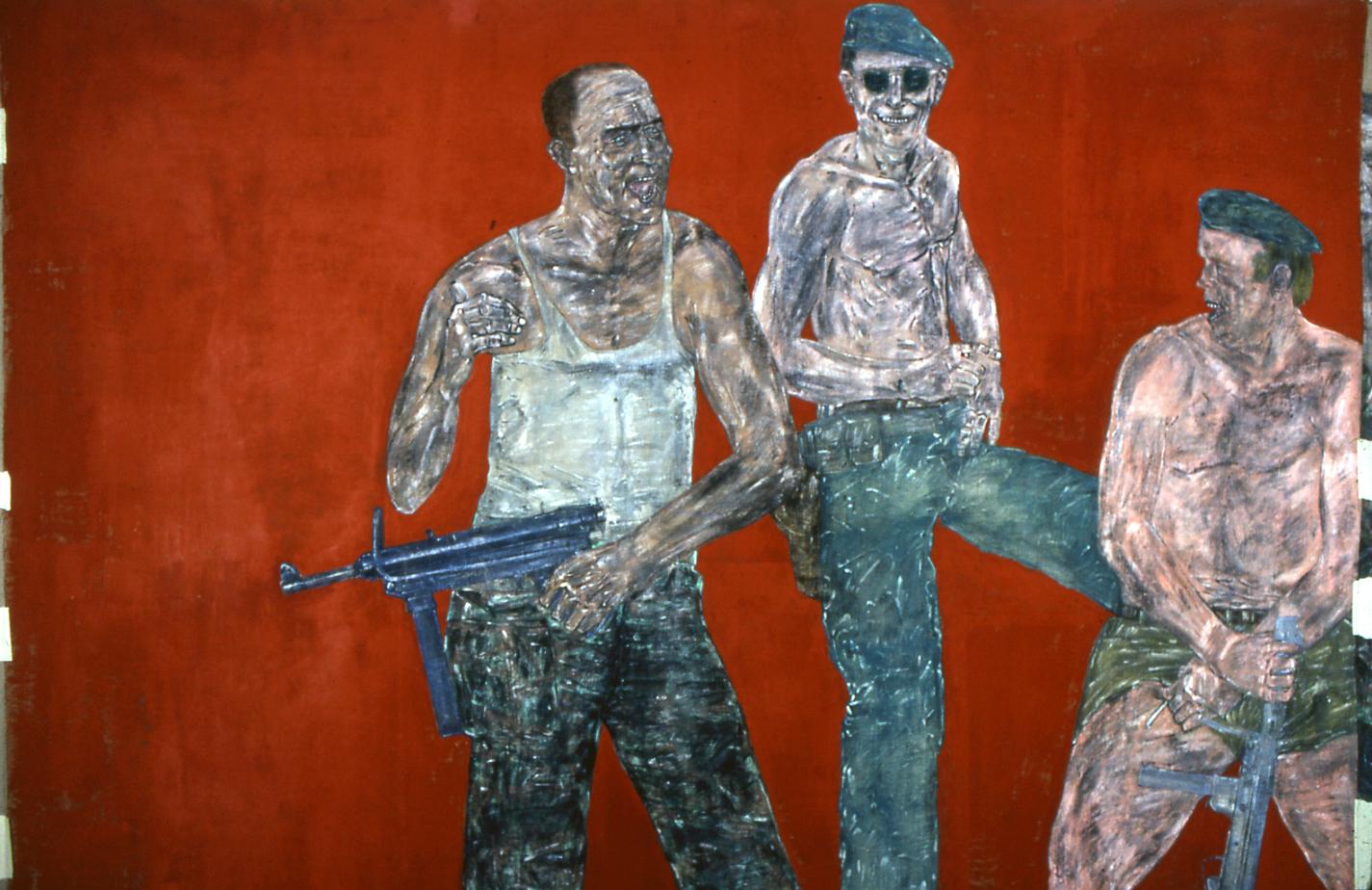
La obra de Leon Golub (Chicago, 1922- Nueva York, 2004) presenta un reto al modelo dominante de desarrollo del arte después de 1950. Ajeno a la experimentación de los medios que ha caracterizado la producción artística de estas décadas, su trabajo plantea una renovación pictórica en la que géneros que se pensaban agotados, como la pintura de historia o el retrato, vuelven a tener una capacidad expresiva y crítica inesperada. Su evolución resulta por igual un tanto paradójica, motivando que el debate entre abstracción y figuración deje de tener sentido: su estancia en París junto a su compañera, la artista Nancy Spero, desarrollada entre finales de los cincuenta y principios de los sesenta, se caracteriza por seguir las pautas del informalismo abstracto de Michel Tapié o de Jean Dubuffet, evolucionando hacia espacios en los que la obra progresivamente va ocupando el realismo más traumático.

El escenario político internacional del momento, caracterizado por la brutalidad de hechos como la guerra del Vietnam, el apartheid sudafricano o las consecuencias de los deseos imperialistas, reverbera en la pintura de Golub como si se tratara de un murmullo imposible de silenciar. Es más, no se produce el aislamiento de la sociedad y del clima político, propio de la tradición pictórica moderna, sino todo lo contrario, apareciendo así constantes alusiones en sus pinturas a personajes, sucesos políticos y sociales concretos.

En una ocasión, Golub indicó que su obra era la invitación a un lugar en el que nadie querría estar, dando por sentado que sus cuadros ponen al espectador delante de una situación que le convierte en un testigo o cómplice cuya mirada es devuelta por los personajes que ejercen dolor. El vínculo entre verdugo y espectador transforma todo acto violento en el cuestionamiento de la incapacidad de acción que se asume en la retórica visual contemporánea.

Esta exposición reúne las obras más destacadas del artista, proponiendo una lógica sensible que caracteriza el conjunto de toda su producción artística. Organizada en torno a la paradigmática Vietnam II (1973), la exposición muestra otras etapas no tan conocidas, como su primera fase informalista, las esfinges realizadas en los cincuenta, las pinturas de napalm de los sesenta, los retratos de dictadores y políticos -entre ellos Franco- o sus mercenarios e interrogatorios, reflejando así la compleja obra de Leon Golub.

Leon Golub 15Leon Golub 1    Leon Golub 12Leon Golub 5 Leon Golub 6048.tif078.tifLeon Golub 2  Leon Golub 13 Leon Golub 4Leon Golub 14

Publicado el

Egon Schiele / Landscapes

Egos Chiele Landscapes@

«The Austrian artist Egon Schiele (1890-1918) is renowned for his intensely confrontational portraits, self-portraits, erotic images, and allegories. What is less well known today is that Schiele was also a talented and prolific landscape painter. In this book, Kimberly A. Smith provides the first full examination of Schiele’s landscapes and townscapes, offering a new approach to and insights into the artist’s work and motivations.

Diverging from the conventional interpretation that Schiele’s paintings are revelations of the artist’s psychology and emotional experience, Smith focuses instead on how his landscapes relate to the political, social, and historical conditions in early-twentieth-century Austria. Schiele’s extraordinary depictions of the towns and countryside of Austria register and respond to the alienating effects of modernity, the problematic nature of selfhood, the eroding coherence of the imperial state, and other anxieties of his era.

As Smith argues, the artist’s landscape paintings express the same sense of ruin that preoccupied his contemporaries, but these pictures also contain a compelling note of redemption. In many ways, Schiele’s landscapes offer solutions to the very crises his images present. The landscape paintings thus illuminate not only the structural dynamics of these pictures but also the character of Viennese modernism itself.»

Egon Schiele Landscapes 1 Egon Schiele Landscapes 2 Egon Schiele Landscapes 3 Egon Schiele Landscapes 4 Egon Schiele Landscapes 5 Egon Schiele Landscapes 6 Egon Schiele Landscapes 7 Egon Schiele Landscapes 8 Egon Schiele Landscapes 9 Egon Schiele Landscapes 10 Egon Schiele Landscapes 11 Egon Schiele Landscapes 12

Publicado el

Ron Mueck Exposición Fundación Cartier


New Hyperrealistic Sculptures by Ron Mueck

Cartier Foundation  2013

New Hyperrealistic Sculptures by Ron Mueck sculpture hyperrealism

New Hyperrealistic Sculptures by Ron Mueck sculpture hyperrealism


New Hyperrealistic Sculptures by Ron Mueck sculpture hyperrealism


New Hyperrealistic Sculptures by Ron Mueck sculpture hyperrealism


New Hyperrealistic Sculptures by Ron Mueck sculpture hyperrealism

New Hyperrealistic Sculptures by Ron Mueck sculpture hyperrealism


Hyperrealist sculptor Ron Mueck works in the realm of the ultra-real where he spends hundreds of hours perfecting the shape of the human form, the appropriate color of skin, and the most realistic hair texture. All of his efforts culminate in incredibly lifelike figurative sculptures with one small (or large) exception: the artworks are often gigantic or miniaturized, resulting in an uncomfortable “does not compute” moment when trying to comprehend exactly what you’re looking at. Each sculpted person is as bizarre as it is amazing, in part because of the raw intimacy portrayed in their faces, as if we are somehow witnessing the documentation of a private moment.

New Hyperrealistic Sculptures by Ron Mueck sculpture hyperrealism


New Hyperrealistic Sculptures by Ron Mueck sculpture hyperrealism

New Hyperrealistic Sculptures by Ron Mueck sculpture hyperrealism


New Hyperrealistic Sculptures by Ron Mueck sculpture hyperrealism


New Hyperrealistic Sculptures by Ron Mueck sculpture hyperrealism


Like several other hyperrealist sculptors Mueck began his sculpting career in entertainment where he started work as a puppeteer, creating models and puppets for children’s movies and TV shows. Most notably he worked on Jim Henson’s film Labyrinth and even provided the voice for the character Ludo. In 1996 he made the switch to fine art and quickly rose to prominence with exhibitions at the Royal Academy and the National Gallery in London.

Last month Mueck unveiled three new works at the Fondation Cartier in Paris as part of an exhibition that runs through September 29th, including the extraordinary Couple Under an Umbrella shown above. You can watch the video to get a little more perspective on just how large this artwork really is. All images above courtesy Fondation Cartier.

Publicado el

La Técnica pictórica de Rembrandt

1-Rembrandt_Harmensz._van_Rijn_-_De_stenen_brug_-_Google_Art_Project

Fuente: “ Rembrandt, materiales, método y procedimientos del arte” por David Bomford, Christopher Brown, Ashok Roy

Es muy raro encontrar tratados de pintura de caballete que presten la de­bida atención a la técnica de un maes­tro como Rembrandt. Generalmente ésta es descrita escuetamente con una palabra como «óleo» o «temple». En un intento de ofrecer una visión de su técnica lo más completa posible, el Departamento Científico de la National Gallery de Londres, utilizando moder­nas técnicas analíticas, ha desarrolla­do un programa de investigación de los materiales utilizados por Rembrandt y sus modos de elaboración.

La finalidad básica del aglutinante es unir entre sí las partículas de los di­ferentes pigmentos para permitir su aplicación a una superficie y hacer que permanezcan adheridos a ella durante largo tiempo. Antes de los siglos XIX y XX, el artista se veía constreñido a uti­lizar materiales extraídos de la natura­leza. Entre estos materiales hay semi­llas y frutos, resinas de árbol, ceras, colas de origen animal y goma vege­tal. En los últimos cien años, con los avances de la química, se empezaron a utilizar materiales sintéticos como li­gantes de la pintura.

Sigue leyendo La Técnica pictórica de Rembrandt
Publicado el

Horst Janssen

Lesender-Janssen_537

Horst Janssen (14 November 1929 – 31 August 1995) was a German draftsman, printmaker, poster artist and illustrator. He had a prolific output of drawings, etchings, woodcuts, lithographs and wood engravings.

Janssen was a student of Alfred Mahlau at the Landeskunstschule Hamburg. He first published in the newsweekly Die Zeit in 1947.

In the early 1950s, he started working in lithography, on an initiative of Aschaffenburg paper manufacturer Guido Dessauer, using the technical facilities of a coloured paper factory. The first retrospective of Janssen’s drawings and graphic works was shown in 1965, first in the kestnergesellschaft Hanover, then in other German cities and in Basel. In 1966, he was awarded Hamburg’s Edwin Scharff Prize. International exhibitions followed. In 1968, his graphic art earned the Great Prize at the Venice Biennale; in 1977, his works were shown at the documenta VI in Kassel.

Horst Janssen Museum

The Horst Janssen Museum in his hometown of Oldenburg is dedicated to his legacy. His work is shown internationally in major museums.


Publicado el

Roger van der Weyden – El descendimiento

Roger van der Weyden@

Roger Van der Weyden

El descendimiento 

Museo El Prado

El gran maestro de Tournai centra la composición en la Compassio Mariae, la pasión que experimenta la Virgen ante el sufrimiento y la muerte de su Hijo. Para traducirla en imágenes, el pintor escoge el momento en que José de Arimatea, Nicodemo y un ayudante sostienen en el aire el cuerpo de Jesús y María cae desmayada en el suelo sostenida por San Juan y una de las santas mujeres.

La riqueza de sus materiales -el azul del manto de María es uno de los lapislázulis más puros empleados en la pintura flamenca de la época- y sus grandes dimensiones, con las figuras casi a escala natural, evidencian ya lo excepcional de la obra. El espacio poco profundo, de madera dorada, en que Weyden representa a sus figuras y las tracerías pintadas de los extremos superiores -imitando también la madera dorada-, al igual que el remate rectangular del centro, las hacen semejar esculturas policromadas. Además, el engaño óptico se refuerza aún más por el fuerte sentido plástico que Weyden imprime a sus figuras, siguiendo el ejemplo de su maestro Robert Campin, como hace en todas sus obras tempranas.

Weyden maneja con maestría las figuras representadas en un espacio limitado al fondo y en los extremos, donde los movimientos opuestos y complementarios de San Juan y la Magdalena cierran la composición. En el interior de ese espacio sobresale el juego de diagonales paralelas que diseñan los cuerpos de Cristo y de María, poniendo de manifiesto su doble pasión. Impactan los gestos, la contención con que se expresan los sentimientos y el juego de curvas y contra curvas que une a los personajes.

Es encargada por la Cofradía de los Ballesteros de Lovaina hoy en Bélgica para su capilla en la Iglesia de Nuestra Señora de Extramuros. En las esquinas superiores están representadas pequeñas ballestas. Adquirida por María de Hungría en el siglo XVI, pasa después a manos de su sobrino Felipe II. Éste la coloca en la capilla del Palacio de El Pardo hasta su entrega a El Escorial en 1574. Desde ese año estuvo allí hasta 1936 en que se trae al Museo Nacional del Prado, enviándose como contrapartida la copia deMichel Coxie.

Procedencia:

Capilla de los Ballesteros de Lovaina (Bélgica); adquirida por María de Hungría, para la capilla del Palacio de Binche; posteriormente enviado a España, a la capilla de El Pardo; Monasterio de El Escorial, 1574-1936; depositada en el Museo del Prado por la Junta de Incautación, 1936; por Decreto de 02-03-1943 quedó establecido el depósito temporal, renovado en 1998 mediante Acta de regularización de Depósitos con Patrimonio Nacional.

Roger van der Weyden - El descendimiento

Weyden, Roger van der (Tournai, h. 1399/ 1400-1464).

Pintor flamenco. Su nombre en origen debía ser Rogier de la Pasture, siendo su padre, Henri de la Pasture, cuchillero. Tanto la primera parte de su vida como el ca tálogo de su obra no están exentos de dudas y problemas. En 1427 entra como aprendiz en el taller de Robert Campin y lo abandona ya como «Maistre Rogier» en 1432. Estos datos incontrovertibles han generado mucha literatura moderna; ¿cómo un hombre ya casado y al que ha nacido quizás el primer hijo, puede entrar de aprendiz a los veintiocho años en un taller de pintura? En 1423 entre los oficios se había establecido la norma de que cualquiera que quisiera obtener su maestría franca en una ciudad debía pasar por un aprendizaje de cuatro años junto a un maestro (Châtelet).

En 1426 se dice que Weyden no estaba en Tournai, sino en Bruselas. Su mujer es hija de un zapatero de esta ciudad (Isabel Goffaert). No existe ninguna noticia entre 1432 y 1435, pero es muy probable que residiera en Lovaina. El Gremio de Ballesteros de esta ciudad le encarga El Descendimiento (Prado) hacia 1434-1435 para la iglesia de Nuestra Señora Extramuros. En todo caso, Molanus (1553-1585) le llega a llamar «Pictor et cives Lovaniensis».

El 21 de abril de 1435 se instala en Bruselas con su mujer y sus dos hijos. En marzo de 1436 es ya pintor oficial de la villa, aunque su cargo de «stad Scildere» es personal y se extinguirá, dicen (no será verdad), con su muerte. Entonces cambia su nombre francés «de la Pasture» por «van der Weyden», esto es, lo flamenquiza. Se establece en una casa cerca del barrio de los orfebres. Entre 1439 y 1441 realiza una de las obras que le darán más fama, Justicias de Herkenbald y de Trajano, por desgracia quemada en un incendio del Ayuntamiento (1695).

Se conserva un recuerdo, que no una copia, en una tapicería de Berna (h. 1460-1470). Es el segundo ejemplo en el ámbito flamenco (el primero esJuicio Final, de Diest, en 1420) de una pintura ejemplar de justicia destinada a un ayuntamiento. Trabaja en todo lo que entonces acostumbra a hacer un pintor: en 1439, el duque Felipe el Bueno le encarga la policromía de la tumba de María de Evreux, mujer de Juan III, duque de Brabante, y de su hija María; en 1441 la pintura de un dragón, para la procesión del «Grand Tour» en honor a santa Gertrudis de Nivelles. Hubo de recibir encargos de la casa ducal, en especial, retratos, además de lo dicho. En estos años llevará a ca bo el Tríptico de Miraflores(Staatliche Museen, Berlín), que el rey Juan II de Castilla y León regala en 1445 a la cartuja de Miraflores (Burgos) recién fundada. Quiere decir que es un pintor cuyo prestigio ha traspasado las fronteras de su país.

En 1450 viaja a Italia, según Facio (1456), para ganar el jubileo ­romano. Aunque debió pasar un tiempo allí, el renacimiento reciente no le causa especial impresión, si bien en algunas de sus pinturas acusa préstamos que afectan a lo compositivo. En 1448 su hijo Cornelio entra en la cartuja de Scheut y él regala la Cruci fixión de El Escorial(la cartuja la venderá en 1555 como obra de Roger y recibiendo a cambio, además, una copia). En 1460, Bianca Maria Sforza envía a su pintor Zanetto Bugatto a Bruselas junto a Weyden. Vuelve tres años después y la duquesa escribe una carta de agradecimiento a «Rugerio de Tiurnay pictori in Burseles». Es un ejemplo bastante excepcional de un italiano ya formado que viaja a Flandes para cambiar su estilo, y una señal de hasta qué punto Weyden era un artista muy reconocido. En 1462 él y su mujer entran en la cofradía de la Santa Cruz, de élite, en la que se agrupan las personas más significativas de la sociedad de Bruselas. En la capilla Saint-Jaques-sur-Coudenberg, relacionada con ella, se celebrarán misas por su memoria.

Muere en 1464, como indican las cuentas de la corporación de pintores de Tournai, donde aún se le dice nativo de Tournai y se le llama Roger de la Pasture. Hereda el sentido plástico de las formas de su maestro, el supuesto Robert Campin, y realiza un arte de notable expresividad emotiva, lejos del lenguaje conceptual de Jan van Eyck, que enlaza con la mentalidad de la llamada «Devotio moderna». Sus composiciones calan en la sensibilidad de las clases altas y de la burguesía en general. Por ello se copian e imitan durante muchos años.

Virgen con el Niño (legado Fernández Durán, Prado) es uno de estos iconos creados por él y utilizados por maestros flamencos, primero, y luego castellanos. Fue notable retratista, aunque menos objetivo que Van Eyck. Es interesante comparar la imagen de Nicolás Rolin que deja cada uno. El de Weyden forma parte de su obra más extensa, el políptico del Juicio Finalpara el hospital de Beaune, fundado por el mismo Rolin, donde se manifiesta con claridad la colaboración del taller. Algunas de sus obras más emblemáticas han causado más de una sorpresa cuando se han examinado con las técnicas modernas de reflectografía (Tríptico Columba, Alte Pinakothek, Múnich). Ocasionalmente pudo realizar alguna ilustración de libro (Crónicas de Hainaut de la Biblioteca Real de Bruselas).

Publicado el

Edgar Degas – Analyzing The sculpture works

Edgar Degas@

The Degas Debate: Analyzing the Controversial Plasters

Are 74 plasters ‘discovered’ in a foundry storeroom ‘original’ works by Degas? A Degas scholar analyzes the sculptures, outlines the controversy, and considers competing meanings of ‘original’

Little Dancer Aged Fourteen, 1878-81

The only sculpture Degas ever exhibited was the Little Dancer Aged Fourteen, 1878–81. Made of wax, with real hair, the figure wears a cotton faille bodice, multilayered tutu, and linen slippers. Controversial when it was shown at the 1881 Impressionist exhibition, it is at the center of another controversy today.

NATIONAL GALLERY OF ART, WASHINGTON, D.C., COLLECTION OF MR. AND MRS. PAUL MELLON

Posthumous reproductions have played a contentious role in the artistic legacies of Auguste Rodin, Edgar Degas, and other important sculptors who died in the early 20th century. Debates among connoisseurs about what counts as “original labor” or an “authentic copy” are often confusing and sometimes open to lawsuits. Nevertheless, sculpture created by an artist with his or her own hands usually counts as “original” and typically serves as a benchmark in determining the authenticity of copies.

Recently, dealers marketing bronzes cast from plaster replicas of Degas’s handmade sculptures have proposed a novel twist to these standard assumptions. Their bronzes and plasters differ—radically in some cases—from Degas’s existing originals, not because they are inaccurate copies, the dealers say, but because these bronzes and plasters are, in effect, more original.

According to Leonardo Benatov, current owner of the Airaindor Valsuani Foundry outside of Paris, the plaster versions were part of the inventory when he purchased the Valsuani Foundry in 1980. In the 1990s, after the copyright on Degas’s sculpture had expired, Benatov cast several of these plasters in bronze, including two editions based on Degas’s celebrated The Little Dancer Aged Fourteen. Benatov later granted New York dealer Walter Maibaum the exclusive right to sell full sets of bronzes made from the Valsuani plasters.

Maibaum and Benatov initially assumed that the plasters were posthumous casts created by Albino Palazzolo, the expert who supervised the casting of Degas’s original wax, clay, and plastiline sculptures in bronze at the Hébrard Foundry in Paris after the artist’s death in 1917. The resulting Hébrard bronzes are in major museum collections throughout the world.

The Valsuani plaster <em>Little Dancer</em> is a heavier, more muscular figure, standing with hips squared and weight distributed equally on both feet.

The Valsuani plaster Little Dancer is a heavier, more muscular figure, standing with hips squared and weight distributed equally on both feet.

OLIVIER BRUNET.

In 2005, Gregory Hedberg, now a senior consultant at New York’s Hirschl & Adler Galleries, examined the Valsuani Little Dancer plaster and decided that this “magnificent” cast was not, in fact, a posthumous copy but was instead a plaster made during Degas’s lifetime. Hedberg subsequently decided that nearly all the Valsuani plasters were casts made during the artist’s lifetime from his original wax and clay sculptures. Since then, at least eight sets of Valsuani bronzes based on these plasters have been sold for prices said to be in the range of $7 million.

As ARTnews has reported in previous articles, no major Degas sculpture specialist has expressed agreement with Hedberg’s view. Gary Tinterow, former head of European painting at theMetropolitan Museum of Art and now director of the Museum of Fine Arts, Houston, told ARTnews that “there is nothing that demonstrates that Degas had a set of plaster casts made of his sculptures during his lifetime.” Yet the Valsuani bronze sculptures continue to attract buyers. The Valsuani plasters Benatov says he found in 1980 have been sold to private collectors as well. The Valsuani plasters illustrated in this article are copies of the plasters now in private collections, and are currently in use at the Valsuani Foundry.

In a 2010 letter to ARTnews, Hedberg summed up his understanding of the disagreements between the dealers and the scholars. The “key issue boils down to this,” he wrote: The dealers believe that the similarities between the Hébrard and Valsuani sculptures are “due to the fact that the [Valsuani] plasters were cast from Degas’ original waxes . . . while Degas was alive.” The differences in appearance came about because Degas “repaired and reworked some models. Then, after Degas’ death, additional repairs were made.” The dealers reason that if the Valsuani plasters represent the artist’s first versions of his figures, before later or posthumous changes were made, they should be recognized as records of his original vision.

Hedberg characterizes the view of the scholars on the other side as follows: they believe that the Valsuani plasters “record extraordinary copies made by some highly skilled sculptor who at times faithfully recorded Degas’ original waxes and at other times made his or her own variations.”
None of the major Degas specialists has commented in print on this possibility. But Hedberg’s proposal does offer an intriguing set of options when we turn to specific examples.

Some of the more notable differences in appearance between a Valsuani plaster and a sculpture modeled by Degas’s own hand are to be found in the artist’s well-known figure The Little Dancer Aged Fourteen. First shown at the 1881 Impressionist exhibition in Paris, the Little Dancer is the only sculpture Degas exhibited during his lifetime. This wax figure, along with most of his lifetime wax sculptures, is in the National Gallery of Art in Washington, D.C.

The Little Dancer is slim, with long, sinewy legs and her feet splayed in a casual fourth position. Most of the figure’s weight rests on the straight left leg; the extended right leg is slightly relaxed. Achieving this pose pushes the hips into a contrapposto position, with the left hip higher and at an oblique angle to the right.

In contrast, the Valsuani plaster Little Dancer exhibits a different pose and body type. The upper legs are conspicuously heavier and more muscular; both knees are slightly bent; weight is distributed equally on both feet; and the hips are squared to the front. The collarbones and neck muscles are more prominent than those of the wax, and the hairstyle is quite different when viewed from the rear.

The faces of the two figures also differ. The plaster face is more regular, almost conventionally pretty, and relatively serene, with fuller, lowered eyelids casting deep shadows over the eyeballs. The eyelids of the National Gallery wax figure, in contrast, are half closed, and the pupils are incised to suggest a downward gaze. The right eye has a slightly different shape than the left. These details play into an effect that senior Degas scholar Theodore Reff has described as “a sense of strain or suffering, reflecting her effort to maintain her awkward posture and, mingled with it, a vaguely sensual yearning, especially in the half-closed eyes.”

The Valsuani Little Dancer, according to Hedberg, is not an inaccurate copy of the wax sculpture now in the National Gallery. Nor is it a cast made from that figure. The differences between the Valsuani plaster and the National Gallery wax, he argues, result from an undocumented decision by Degas to rework his composition after completing a first version.

Hedberg believes that the wax figure in the National Gallery—the model for the familiar Hébrard bronzes with tutus displayed in museums all over the world—was not the figure Degas exhibited in 1881. That figure is represented instead by the Valsuani plaster. The National Gallery dancer, he says, is an anatomically inferior, second version of the 1881 figure, probably created around 1903.

Thus, according to his logic, the Valsuani plaster represents the original version, while the existing wax Degas modeled by hand should be recognized as a mannered later variation of his original concept.

Contrary to a long history of Degas scholarship, Hedberg writes in a catalogue accompanying exhibitions of the Valsuani sculptures that “although extremely popular, no connoisseur of 19th-century sculpture ranks Degas’ second version as an unqualified masterpiece.” The first version of theLittle Dancer recorded in the Valsuani plaster and bronzes, he says, is “a masterpiece that can rival any work of art ever produced by the greatest artists of all time.”

Hedberg faces a number of obstacles in building support for his new history of the Little Dancer. There are no photographs of the 1881 Impressionist exhibition, and no letters by the artist related to the Little Dancer project survive. Contemporary viewers of the exhibition were remarkably inconsistent in their descriptions of the dancer’s size, costume, skin, hair, and social identity. As Degas scholar Richard Kendall has observed, these discrepancies indicate that “Degas’ diminutive ballerina proved as disorienting to audiences as the grandest projects of the day, overturning assumptions, crossing the frontiers of propriety and apparently threatening the identity of sculpture itself.”

The Little Dancer was never exhibited again, although the figure was on view in Degas’s studio. Shortly after the artist’s death, inventory photographs of his sculpture were taken, including three images of the wax Little Dancer now in the National Gallery. In these photos, the dancer looks very much the same as it does today.

If Hedberg is correct, we should accept that the National Gallery’s wax Little Dancer is the same sculptural object as the figure recorded in the Valsuani plaster, and that, decades after he created the Valsuani figure, Degas transformed his original, static, level-hipped, large-legged 1881 model into a thinner, young dancer with long shins and thigh muscles and a new face, standing in a different pose.

This unique theory is difficult to square with relevant technical studies and visual documents. The best evidence for the sculpture’s original conception and development consists of several drawings of the model for the sculpture, Marie van Goethem. In 1879, the 14-year old Marie was a second-year student in the dance school of the Paris Opera, and in 1880 she was recruited for the Opera Ballet. There are more drawings of Marie than of any other Degas model (at least 16, according to Reff). Dance historianJill DeVonyar, who has cocurated several exhibitions of Degas’s work, writes that drawings of Marie show a model “blessed with considerable physical gifts: good turn-out, long limbs, flexion in her ankles and a supple back.”

The 14-year-old Marie van Goethem was Degas’s model for the Little Dancer. He sketched the armature he intended to use in making the wax sculpture at top right.

The 14-year-old Marie van Goethem was Degas’s model for the Little Dancer. He sketched the armature he intended to use in making the wax sculpture at top right.

PRIVATE COLLECTION, LONDON.

In many of the drawings, Marie wears a tutu covering her upper legs. There are several studies of Marie in the nude, however, illustrating the same figure type, with the hips, legs, and right foot in the same position as the National Gallery dancer. As far as we know, the Little Dancer was Degas’s most ambitious early sculpture. Kendall has proposed that the nude drawings served as traditional preliminary studies, and represent “a cautious temporary return to routines of his youth by an artist facing an unfamiliar challenge.” The nude drawings are characteristic of Degas’s graphic style around 1878–80. None resembles the figure represented in the Valsuani plaster.

One series of nude drawings includes a sketch of the basic armature Degas used to create the National Gallery sculpture. Degas’s armature also plays a key role in assessing Hedberg’s claim that the National Gallery sculpture is a revised second version of a Valsuani original.

In 2010, the National Gallery published Edgar Degas Sculpture, an unprecedented systematic catalogue of the wax, clay, and plastiline sculpture Degas created during his lifetime. For this catalogue, National Gallery conservators Shelley G. Sturman and Daphne S. Barbour, together with three National Gallery scientists, carried out detailed technical studies of the Degas sculptures in the gallery’s collection. The studies included three-dimensional computer models; laser scans; x-radiography; and spectroscopic, chromatographic, and microscopic analyses. With these technologies, the conservators and scientists were able to track the physical histories of the sculptures and document alterations and repairs made during and after the artist’s lifetime.

The complex construction of Degas’s wax Little Dancer is visible in a radiograph (left) and a schematic diagram of the inner armature (far right). The figure was examined by a team of conservators and scientists at the National Gallery of Art.

The complex construction of Degas’s wax Little Dancer is visible in a radiograph (left) and a schematic diagram of the inner armature (right). The figure was examined by a team of conservators and scientists at the National Gallery of Art.LEFT: ©2011 NATIONAL GALLERY OF ART, WASHINGTON, D.C.; RIGHT: ILLUSTRATION BY JULIA SYBALSKY AND ABIGAIL MACK/©2007 NATIONAL GALLERY OF ART, WASHINGTON, D.C.


They confirmed that the most conspicuous posthumous revisions resulted from the removal of Degas’s external armatures and their replacement in many cases with new supports. Some of these interventions occurred when Palazzolo prepared the sculptures for casting at Hébrard’s foundry shortly after the artist’s death. Others date from the early to middle 1950s, when Palazzolo prepared the original wax and clay sculptures for sale. In 1955, the 69 extant Degas wax sculptures were imported to the United States and sold to collector Paul Mellon, who ultimately donated 52 of them to the National Gallery and the rest to other museums.

The Little Dancer Aged Fourteen receives more attention in the National Gallery catalogue than any other sculpture. The internal construction of this wax figure includes a lead-pipe armature, pieces of wood, organic material resembling cotton batting, paintbrush handles, rope, and clay. The external surface is fashioned from molten beeswax highlighted with colored pigment applied directly or mixed with the wax.

If the Valsuani plaster does represent the “first version” of the Little Dancer, achieving the complex pose of the National Gallery “second version” figure would apparently require a complicated invasion of this improvised interior as well as a remodeling of the exterior surface. Hedberg, however, believes that Degas solved the makeover problem primarily by excavating and remelting wax from the level right hip of the Valsuani “original” and relocating this material to create the higher left hip on the National Gallery figure.

Even if this shift were possible, other complex adjustments would have been required to transform the Valsuani figure into the National Gallery sculpture. The lead-pipe armature supporting each leg is nailed to the base of the National Gallery sculpture. Achieving Hedberg’s “second version” of the composition would have required bending the armature in the “first-version” right leg in a different direction, pulling it out below the “original” knee and moving it backward on the base. After the armature had been relocated, the “original” right leg would need to be entirely refashioned below the knee and the right foot turned in a different angle.

Barbour and Sturman meticulously documented physical alterations in all 52 Degas sculptures in the National Gallery collection. They observed no such adjustments to the armature, form, and surface of the Little Dancer. Furthermore, they point out that “the clay surrounding the lead pipes in the feet and lower legs served to ‘cement’ the armature in place and prevent any movement or change in the dancer’s pose.”

Pressed against the weight of this visual and technical evidence, Hedberg’s account of the “original” and “second version” of the Little Dancer appears less substantial than the alternative he attributes to his opposition, namely that the Valsuani plaster is a copy made by a sculptor who “at times faithfully recorded Degas’ original waxes and at other times made his or her own variations.”

When Degas died, in 1917, about 150 sculptures, many in bad condition, were found in his studio. None of these sculptures, with the exception of the Little Dancer, had ever been exhibited in public. Although Degas did not authorize posthumous casting, his heirs decided to reproduce the salvageable sculptures in bronze editions. After months of squabbling, they entered into a contract with the Hébrard Foundry to cast 73 of the sculptures. A 74th figure, The Schoolgirl, was cast in bronze years later.

A leading player in this conflict was Degas’s colleague, the sculptor Albert Bartholomé, who apparently believed that he was the right man to personally supervise repairs and the casting process. Degas’s friend Mary Cassatt and the artist’s nephews were adamantly opposed to Bartholomé, who, according to Cassatt, needed to “wrap himself in Degas’ glory because he himself lacked any.” Degas’s dealer, Joseph Durand-Ruel, also concluded that it would be dangerous to entrust the sculptures to Bartholomé “because everyone would say they were redone by Bartholomé and they would lose their value.” Ultimately Bartholomé brokered a compromise by recommending that the casting be entrusted to Hébrard.

According to Hedberg, Bartholomé would have been the right man to supervise the job because Hedberg believes that Bartholomé had already cast many of Degas’s wax sculptures in plaster for his own private collection. Some of the casts Bartholomé made for himself, Hedberg claims, recorded earlier versions of Degas’s sculptures, before Degas made small and sometimes major revisions to those figures over the years. Bartholomé’s private plasters ultimately found their way to the Valsuani Foundry, he continues, where they were rediscovered years later. Therefore, Hedberg concludes, “the [Valsuani] plasters were cast from Degas’ original waxes . . . while Degas was alive.” They record earlier or first versions of the sculptures before they were revised by Degas, damaged by environmental conditions, or “corrected” by Palazzolo. However, there is no record that Bartholomé’s private plasters ever existed.

Head, Study for Portrait of Mme Salle, Hébrard bronze modèle cast from ca. 1892 wax. The subject is believed to have been a young dancer, Mathilde Salle.

Head, Study for Portrait of Mme Salle, Hébrard bronze modèle cast from ca. 1892 wax. The subject is believed to have been a young dancer, Mathilde Salle.NORTON SIMON ART FOUNDATION


Bartholomé is also invoked to account for a statistical and historical improbability: Degas’s heirs selected 74 waxes to be cast in bronze from the approximately 150 sculptures remaining in the artist’s studio. According to Hedberg, Bartholomé had made plaster copies of Degas’s works beginning in the late 1880s, yet the Bartholomé/Valsuani plasters represent exactly the same 74 examples that were salvaged for casting after the artist’s death.

Maibaum offered his explanation for this unlikely outcome in a 2011 letter to ARTnews. “It is well known that in 1917–18 Bartholomé assisted the heirs in the decision-making process as to which of the waxes should be cast in bronze. Since Degas allowed Bartholomé to make plasters of certain waxes, it is logical to conclude that Bartholomé told the heirs which of the waxes Degas considered more or less ‘finished.’ And those are the ones which ultimately were cast in bronze–essentially the same figures as the plasters.”

But there is no evidence that Degas had ever “allowed Bartholomé to make plasters of certain waxes.” Thérèse Burollet, the leading authority on Bartholomé, who will soon publish a monograph and catalogue raisonné of his work, wrote in an email to ARTnews: “Nothing in the documents [I have] consulted, letters, archives, press articles or family traditions, allows one to think Bartholomé cast in plaster a single work by Degas either during his lifetime or in 1917” (the year of Degas’s death).

The Valsuani plaster Salle study is a different interpret- ation of the head.

The Valsuani plaster Salle study is a different interpretation of the head.OLIVIER BRUNET


If Bartholomé did not cast early versions of sculptures Degas revised at a later date, how are we to explain the formal discrepancies between many of the Valsuani plasters and Degas’s surviving originals?

Maibaum has proposed yet another framework for assessing the status of the Valsuani plasters. In a paper not listed on the program but distributed at acolloquium on posthumous bronzes held last spring at the Hermitage Museum in Saint Petersburg, Maibaum argued that the critical question in determining the plasters’ authenticity is: “Were the plasters made from Degas’ waxes? If the answer is yes, the plasters are authentic. . . . In essence, if the physical evidence substantiates that the plasters were made from Degas’ waxes, they must be authentic, no matter if it can or cannot be determined as to who made them or when.”

The physical evidence Maibaum cites includes comparisons between the plasters and the inventory photographs of the waxes taken shortly after Degas’s death and some measurements comparing the plasters to a unique set of Degas bronze—the modèles—in the collection of the Norton Simon Museum in Pasadena, California.

The modèles are the first Degas bronzes cast at Hébrard. As Palazzolo explained in a 1955 interview, in order to preserve Degas’s handmade creations, he used flexible gelatin molds to make a set of duplicate wax models. These wax “intermodels” were melted in a lost-wax casting process used to create durable master bronzes—the modèles—from which series of bronzes were subsequently cast. Conservators Barbour and Sturman, who also published a detailed technical study of the Simon master bronzes in 2009, determined that these modèle bronzes were executed with great skill and in some cases now provide a more accurate record of Degas’s work than his extant waxes.

Hedberg made approximately 300 point-to-point measurements comparing the Valsuani plasters to the Simon master bronzes. Since bronze can shrink by approximately one to two percent as it cools, and plaster does not shrink, Maibaum reasoned that if the plasters turned out to be larger than the modèles, they were not cast from the modèles and could have been made directly from Degas’s handmade waxes. In most cases, Maibaum says, the plasters did turn out to be larger than the modèles. (According to the National Gallery conservators, it should be noted, plaster generally expands slightly as it dries.)

The logic of this argument is not easy to follow. Maibaum also states in his paper that if the plasters were copies of the modèles, “they would faithfully reproduce the dimensions, forms and details of the corresponding bronzes. They do not.”

Since the plasters do not match the forms of the modèle bronzes in some cases and the details of the bronzes in most cases, how could Hedberg make valid point-to-point measurements to compare these different objects? Furthermore, accurate measurements in three dimensions are difficult to attain without specialized technologies such as the three-dimensional laser scans utilized in the recent National Gallery studies of Degas’s sculpture.

The physical evidence provided by the 1917–18 inventory photographs Maibaum cites is difficult to assess as well. Seated Woman Wiping her Left Hip, for example, is missing her head in the 1917–18 inventory photograph, but the head was returned when Palazzolo made the modèle cast. The modèle retains a visible break in the back of the neck where the head was reattached, but there is no break in the neck of the corresponding Valsuani plaster.

In Maibaum’s view, this discrepancy tells us that the Valsuani plaster was probably cast prior to 1917, when the head was still attached. But the missing crack could just as easily be explained as an artistic decision made by Hedberg’s hypothetical copyist, who “sometimes made his or her own variations” of Degas’s models.

The inventory photographs raise other questions about the dealers’ claims. Comparing the existing wax, the inventory photo, and the modèle cast of Woman Washing Her Left Leg, for example, Barbour and Sturman ascertained that Degas’s original wax figure had been removed from its base when it was molded for bronze casting at Hébrard. A wax copy of the figure was made—an intermodel—and joined with a new flat base. Both were then cast together as a unit to create the master bronze.

This new base, a posthumous invention of the Hébrard Foundry, is imitated in the corresponding Valsuani plaster. It is difficult to imagine how the lifetime sculpture said to be represented in the Valsuani plaster could have anticipated revisions made, probably by Palazzolo, years after the artist’s death. Similar questions can be raised about the bases for the Valsuani casts of Horse Trotting, the Feet Not Touching the Ground and Dancer in the Role of Harlequin.

The inventory photograph of Dancer Ready to Dance, the Right Foot Forward presents another kind of challenge. In the photograph, a substantial external armature extends from the base of the sculpture to the top of the figure’s head. Large wires attached to this metal rod hold each arm in a curved position around the head. “When the external armature was removed before casting,” Sturman and Barbour observed in their text, “the left arm drooped so that it is now rendered almost perpendicular to the body in a compromise of the original intent.” The drooping left arm is in the same position in the Valsuani plaster. Why didn’t the “lifetime” plaster preserve the artist’s original intent instead of replicating an error that resulted from the casting process years after the artist’s death?

Returning to Hedberg’s proposals about the origins of the Valsuani plasters and reviewing relevant art-historical and technical evidence, we can ask which option is more likely: that the plasters are posthumous freehand copies of Hébrard bronzes or that they were cast from various versions of Degas’s original waxes while he was still alive. If the plasters were cast from Degas’s handmade figures after the artist’s death, and without permission of the artist or his heirs, do they still count as “authentic”?

The National Gallery’s published studies do not confirm Hedberg’s assertion that the Little Dancerphotographed in Degas’s studio after his death, and now in the National Gallery, is a revised second version of an earlier level-hipped, large-legged, more static figure with a different pose and face. Furthermore, drawings of the nude model for the sculpture made in the years just before the Little Dancer was first shown, in 1881, clearly resemble the figure and pose in the National Gallery sculpture.

There is no historical evidence of Bartholomé’s involvement with the Valsuani plasters, raising serious doubts about the dealers’ explanation for the one-to-one correspondence between the set of 74 examples chosen for casting at Hébrard after Degas’s death and the 74 examples represented by the Valsuani plasters.

The measurements and other physical evidence Maibaum cites to support his contention that the plasters were cast from the original waxes are inconclusive, and he does not explain how and when the plasters could have been made, if not by Bartholomé.

There could be interpretations of the history of the Valsuani plasters other than those Hedberg proposes, but at this point the theory that the plasters are post-humous freehand copies modeled after the Hébrard bronzes appears to be the most plausible one. The freehand-copy theory accounts for many of the large and small formal differences between the Valsuani plasters, the Hébrard bronzes, and Degas’s handmade waxes. It also explains the one-to-one correspondence between the set of Valsuani plasters and the 74 examples selected for casting after the artist’s death.

Valsuani Foundry records document casts of Degas sculpture made at Valsuani by Palazzolo in the 1950s and ’60s. Although the Hébrard Foundry, where Palazzolo cast Degas bronzes after the artist’s death, closed in the mid-1930s, Palazzolo continued to mark the casts he made years later at Valsuani with the stamp of the old Hébrard Foundry. Since Palazzolo must have brought the Hébrard master bronzes to Valsuani in order to create these new casts, a complete set of possible models for copyists could have been available at Valsuani for decades.

While such speculations remain unconfirmed, the status of the Valsuani casts seems to be suspended in a gap between two concepts of “original”: the plasters as first and lifetime records of Degas’s sculptural oeuvre versus the plasters as independently created interpretations, variations, or emulations of Degas’s work by another hand (or hands). The plasters’ origin remains unknown, but careful assessments of relevant evidence may point the way toward a future resolution.

Patricia Failing is a professor of art history at the University of Washington in Seattle and anARTnews contributing editor.

Fuente: Artnews

BY Patricia Failing POSTED 06/05/13

Publicado el

Antonio Saura. Entre el rosa y el negro

Antonio saura@

Antonio Saura

Entre el rosa y el negro

Enrique Andrés Ruiz

Como escritor, Antonio Saura, más que ocupar un lugar, que es como suele decirse para calzar el perfil de alguien en un determinado panorama cultural, viene a describir más bien una suerte de migración o de trashumancia permanente entre dos talantes intelectuales que se suelen tomar comúnmente por irreconciliables. Encastilladas en su verdad, esas posiciones se resistieron muy a menudo a dejarse contaminar, como si esa su verdad propia dependiera de su exclusividad, lo que es lo mismo decir que de su soledad final, por cierto nunca alcanzada. Así ha sido, más o menos, la dinámica del dogma vanguardista, «como avanzadilla destructora del contrario», responsable al cabo de que el Manual de Historia del Arte Contemporáneo sobre el que hasta hace muy poco no cabían dudas fuera urdido, como dice el propio pintor en uno de sus últimos escritos, como «una narración sincopada, como un hipo continuo, en cierto modo como el encadenamiento de capítulos de una fábula».

Frente a la vanguardia, la modernidad. Y pocos testimonios literarios, pocos textos contemporáneos dan cuenta del desvío que a partir de un determinado momento (también Saura dice a las claras cuál fue ese momento) se produce en la propia entraña de lo moderno para dar a la postre con su negación o con su olvido como los escritos por Antonio Saura, en práctica paralela y nunca antecesora ni sucesora de su misma pintura. El escritor Antonio Saura fue siempre, como decía Abel Martín, «de lo uno a lo otro», y en la permanente travesía de ese viaje de aquí para allá no quiso conciliar, y por lo tanto anular, ninguno de los contrarios, que hubiese sido lo propio de la estrategia sancionada por la vanguardia (y por la antivanguardia), sino pura y apasionadamente viajar, no detenerse, no dar crédito estéril a certeza alguna asentada en la inmovilidad de una posición.

Con ello, no hizo otra cosa que remontar a la fuente baudeleriana de la modernidad para la que ese viaje, como muchas veces se dice sin saber por qué, es la situación mental de quien siente la tensión propia de un modo del tiempo en el que se dan cita lo fugaz y lo imperecedero, la construcción y la destrucción, la tradición y la iconoclastia, pero nunca una u otra solas. A ese vórtice, a ese quicio, Antonio Saura acarreó con sus escritos, de un lado, la tradición crítica y racional del regeneracionismo progresista, culto, leído, internacionalista y cosmopolita que se refleja de manera bastante transparente en el «Balance provisional» con el que resumió en 1980 su pesimista y descorazonada visión del fetichismo y la beatería falsamente modernizantes que se observaban en la España cultural de los primeros años democráticos. Por este flanco, los ensayos de Antonio Saura evocan un aroma «furgón de cola» o «palabras de la tribu» que dice bien de uno de los cabos de su perpetua migración, en concreto del que le emparenta con la familia ilustrada de una cierta modernidad hispánica siempre a la busca de su heterodoxia, tal como hicieron los autores de los libros de aquellos dos títulos ya célebres.

La raíz de este entronque bien pudiera tener causas históricas relacionadas con la situación generacional del puñado de artistas que protagonizó el apogeo de la pintura española de los años cincuenta, para los que el compromiso colectivo venía abrazado a una revisión y recuperación del pasado intelectual nacional anterior a la guerra civil, y con ello, a los hilos europeos de lo que Saura llama en muchas ocasiones, en consonancia con su propia modernidad ilustrada, «el espíritu de la época». Ese talante crítico, de mayoría de edad intelectual, que se percibe en su examen del arte español del franquismo, del estado museístico del arte más reciente o del desmoronamiento vanguardista y de su postrera pervivencia como frigidez pseudoconceptual, ha impregnado siempre los escritos de Saura desde los revulsivos artículos y manifiestos que, junto a sus textos de estricta creación literaria, acompañaron sus primeras andaduras de pintor. De hecho, es esta faceta de polemista la que probablemente, y con razón pero sin tino, identifique su actividad literaria. Desde sus viejas polémicas con López Ibor en 1952 a cuento del surrealismo, o con Zabaleta, unos años después, en plena discusión española sobre la abstracción y la figuración, o con los «normativos» con los que venía la primera glaciación antipictórica de los años sesenta, hasta las más recientes sobre el traslado del Guernica, sobre la celebración de ARCO o sobre la colección imposible del Museo Reina Sofía, la recalcitrancia de Antonio Saura fue muy conocida y, como él mismo supo, muy mal entendida.

En esa cerrazón, en esa Fijeza (acertado título de la edición de sus ensayos, que anuncia la próxima de sus artículos –Crónica–, de sus textos poéticos –Marginalia– y de sus reflexiones paralelas –Escritura como pintura–), que no es otra cosa que fidelidad a la propia pasión íntima, hubo siempre una vuelta de tuerca a las razones, siempre más simples pero no menos razones, de la opinión contraria. Esas polémicas solían aparecer en momentos en que la discusión se aferraba a posiciones antagónicas igualmente beatas. Saura sabía que cabía algo más que decir, que quedaba por decir lo otro. Y su afilada y punzante escritura resonaba en voz rota para hacer saber algo irreductible que casi siempre fue confundido. «Contra el Guernica» se titulaba el libelo aquel de las ampollas de 1982 en el que se trataba, por ejemplo, de desviar el enfoque, reducido a cuestión de mitología histórica nacional, y dirigirlo a la verdadea cuestión en liza, no otra que la necesidad de despojar a la pintura Entre el rosa y el negro, –ensuciando lo más barrido– de la vulgarización simbólica, haciendo ver la «fenomenología» (otra de sus recetas preferidas), es decir, la aparición pura del pensamiento plástico en que consiste la modernidad formal de la pintura. Sólo Bergamín –uno de su raza– y pocos más acertaron a entender aquella «erudición transformada en esperpento». Y así, con el recuerdo de Bergamín, aparece como por sorpresa el otro lado, el otro polo, el otro cabo del viaje sin término del Antonio Saura escritor, un lado por el que también a menudo ha sido confundido, quizá asociándolo a otra modernidad virada al irracionalismo de sus orígenes surrealistas o al cetrino infierno trágico que transitó de por vida, llevado por la advocación de eso que José María Moreno Galván, escribiendo de sus pinturas de 1971, llamó «Theologia diabolis». El propio Moreno Galván, como ahora Emmanuel Guigon, a quien se deben las grandes recuperaciones saurianas del Museo de Teruel, detectaba el carácter moral de la pintura negra, antiangélica, antivirtuosa, antibella de Antonio Saura, pintada por un «ojo que piensa», como a él le gustaba decir, que «nunca quiso dejarse atar por la ligadura mítica de la abstracción ni por la de su contraria». Moral, entiendo, en la misma medida en que resultan ser moralistas Unamuno, Bergamín o Ramón Gaya, quizá el único pintor y escritor con el que se puedan comparar –diferenciándolos, claro, contraponiéndolos en todo– los ensayos de Saura. Y a Gaya se debe la observación de esa cerrazón, de esa fijeza española, de esa indeclinabilidad que es rasgo y matriz de un pensamiento particular muchas veces tergiversado como irracionalismo, como antimodernidad. (Y no se quiere decir aquí que haya una modernidad rosa y otra negra, una en sentido formal y otra en sentido moral, una pura y otra impura, una ilustrada y otra romántica, una racional y otra animal, sino que precisamente la modernidad de Saura parece consistir en ir de lo uno a lo otro, en asumir esa contradictoria condición errática.) Las relaciones entre España y la modernidad, en Gaya y en Saura, se hacen diálogo de antípodas en el que se salvan una a la otra, precisamente por no coincidir, es más, por no querer coincidir. En «El caso del arte español», Saura anduvo lejos, sin embargo, de encastillarse en el orgullo letal de la «diferencia» española. Su ilustración racional y crítica no se lo hubiera permitido. No era eso, no es eso la tal diferencia, parece decirnos, sino un desapego por las teorías estéticas –por estéticas, no por foráneas– que constituye una excepción del pensamiento occidental en la que los medios expresivos son reducidos a una nada, sacrificados por el logro vivo de la intensidad y olvidados al cabo –su especulación, su programa–, en la soledad de una «elegante rudeza».

A esa cuerda expresiva intransferible, Antonio Saura la llamó «la mirada cruel», y la creyó ver en Las meninas, pintura a la que dedicó un hermoso ensayo tras su restauración; en las Pinturas negras de Goya, sobre todo en ese Perro en el que se creyó ver a sí mismo y en el que desde luego vio un adiós a la pintura que es un saludo a esa modernidad contradictoria de la pintura: el de un ser sin espacio, sin consuelo, sin fundamento ni teoría que lo ampare, un ser que sólo está ahí para conseguir, por fin, que la propia pintura se funda con la imagen. Creyó verla en Tintoretto, en El Greco, en Rembrandt, en Turner, y de ahí en adelante a esa línea genealógica (Picasso, Ensor, Munch, Shiele, Giacometti, Dubuffet, De Kooning, Pollock, Asger Jorn…) también le dio nombre, y la llamó «la nueva subjetividad». Todos esos términos saurianos, generalmente de clara filiación vanguardista y de tronco bretoniano y surreal, no ocultan el ladoZeitgeist de la retórica de su autor y, en alguien interesado sobre todo en el modo en que ciertas obras niegan el curso de la historia y del tiempo, esta es una contradicción más, y una más de su propio vanguardismo. Si la modernidad es algo, o todavía puede serlo, como el propio Saura también la entendió, resultará ser lo que se resiste a cualquier correspondencia con espíritu alguno, sea el del tiempo, sea el del pueblo, sea el de la naturaleza, sea el de la historia. Pero la fidelidad de Antonio Saura al árbol genealógico que él mismo plantó, a su propia fijeza, fue creciendo con él a la vez que el escritor emprendía la poda de la hojarasca gregaria que la teoría y la historia del arte reúnen luego en una sobreposición de estilos, grupos, tendencias y programas. Y así sustituyó –esa era la empresa– la historia del arte por una historia de la intensidad. Tan es así que su mirada no parece tener en cuenta la parcelación canónica de las artes o de las especialidades profesionales en que se convierten.

Sirva el ejemplo del que sin duda es el mejor ensayo escrito sobre la tauromaquia como arte, y a fin de cuentas como arte moderno, y su manera de señalar la trasparencia, la fugacidad y el riesgo de una sustancia artística memorable y fugaz, tanto como debiera serlo la propia pintura, fulgurante y milagrosa, que crece «como un ser vivo», muy distinta de la generalmente desgraciada pintura taurina resuelta en un pobre e incapaz reflejo que deja indigente a la memoria. En la tauromaquia vio Saura, en consonancia con su pesquisa genealógica, otra premonición del espíritu moderno, otra mezcla de la razón, de la inteligencia, de la monstruosidad y de la poesía. Además de con Bergamín, coincidió en eso con Michel Leiris, el autor de La literatura considerada como una tauromaquia, inserta en su L’Âge d’homme, y a veces en términos muy similares. «Vanos encantos de bailarina» llamaba Leiris al arte moderno sin la modernidad contradictoria y dinámica de la tauromaquia, y en «La fiesta por dentro» se lee por primera vez en los ensayos de nuestro escritor ese diálogo inconcluso del negro y el rosa, de la razón y sus monstruos, del tiempo y la eternidad, de la belleza y el mal, de la libertad y de la muerte, y de todas las demás latitudes antagónicas que los modernos de su estirpe visitan una y otra vez en su errancia trashumante. Esa contradicción la vio Saura en Goya, o mejor, la personificó en el Goya padre espiritual de su raigambre, el Goya rosa de los cartones y el Goya negro de la Quinta, el afrancesado y el español, el ilustrado y el popular. Pero en su apasionada y meticulosa búsqueda, el reflexivo, el crítico, el irreductible Saura, remonta las fuentes históricas y se allega al barroco más pensante para encontrar otras premoniciones modernas, para hacer al cabo de la modernidad una condición a la vez dentro y fuera del tiempo. «Se trata, en realidad –decía en «Fin de siglo», a mediados de los años ochenta– de hacer de la modernidad una poética.» Y ¿cuál es esa poética? En 1953, Antonio Saura, después de sus primeros tanteos surrealistas y de sus contactos con Pórtico Dau al Set, se incorpora en París al grupo surrealista de Breton y colabora en Medium y en las actividades de Phases. En 1954 ya había abandonado, con Simon Hantaï, aquel convivio, pero del comercio con el surrealismo le quedó para siempre el afán por la búsqueda de ese momento milagroso de la aparición de la imagen, el célebresatori que en su día definió Julien Gracq. Las fuentes de todo aquello eran, sin embargo, muy antiguas. Saura las reconoció en la pintura «a lo valentón» del «toque bravo», como él dice, de Velázquez o, lo que es lo mismo, en la complejidad intelectual de la imagen barroca de aquella pintura española alla prima, de «crueles borrones», como decían los tratadistas, en la que vio el antecedente de la pintura que alcanza su propia independencia y liberalidad como pintura y como pensamiento, desmintiendo, de paso, el baldón del antiintelectualismo o del irracionalismo barroco.

La modernidad, su modernidad, es desde luego barroca, pero lo es en tanto que batalla contra los principios de identidad y de contradicción, en defensa de la complejidad de ese punto milagroso en que confluyen el pensamiento y la pictoricidad. No resulta extraño, por tanto, que su permanencia en academia alguna, sea la surrealista, sea la informal (en 1957 fundó El Paso y en 1959 ya estuvo dispuesto a deshacer el grupo), fuese siempre descreída y breve. Ni que sus ríspidas críticas a la neovanguardia del fin de siglo encontraran en la pía devoción por Marcel Duchamp, «uno de los ejemplos a mi juicio más pernicioso de la vanguardia», el último atajo por el que la modernidad, suprimiendo uno de los cabos de su permanente tensión (en este caso por el pseudoingenio de publicista que niega el lado retiniano de la pintura), se pierde a sí misma, haciendo imposible de nuevo la contradicción, la libertad, lo complejo y rico de la aventura a que invita el trashumante viaje.

Antonio Saura 1  Antonio Saura 3 Antonio Saura 4  Antonio Saura 6 Antonio Saura 7Antonio Saura 5Antonio Saura 8

Publicado el

Egon Schiele

Egon Schiele@

Egon Schiele

Egon Schiele nace en 1890 en la pequeña ciudad de Tulln, en la Baja Austria, en el seno de una familia burguesa ligada al funcionariado. Se cría con sus dos hermanas, Melanie (1886−1974) y Gertrude (1894−1981).

Ya en su etapa escolar, Schiele dibuja con profusión. En el instituto de Klosterneuburg, el pintor Max Kahrer es uno de sus primeros promotores y le enseña diversas técnicas artísticas.

Debido a su mal rendimiento escolar, su madre decide sacarlo de la escuela antes de tiempo. Su talento para el dibujo le lleva a seguir unacarrera artística.

En octubre de 1906, casi dos años después de la muerte de su padre, supera el examen de ingreso en la Academia de Bellas Artes de Viena. Su profesor es el pintor de historia Christian Griepenkerl.

En 1909, participa en la Internationale Kunstschau (Muestra Internacional de Arte), donde se rinde homenaje a Gustav Klimt y en la que Oskar Kokoschka hace su debut. La obra de Schiele aún está bajo el influjo de Klimt y del Jugendstil vienés.

Como protesta contra su profesor, funda con algunos de sus compañeros de clase y otros que compartían ideas afines el Neukunstgruppe (Grupo de Arte Nuevo). En 1909, abandona la Academia. Con ocasión de la primera exposición del Neukunstgruppe, Schiele conoce al influyente crítico de arte Arthur Roessler.

En 1910, se produce el cambio de rumbo artístico hacia elExpresionismo: con su nuevo cromatismo expresionista, Schiele se rebela tanto contra el naturalismo como contra el dominante Jugendstil vienés; en su obra emergen con enorme brío nuevos temas, como el desnudo erótico, las mujeres encintas y, sobre todo, el autorretrato.

En 1911, conoce a Walburga («Wally») Neuzil, que será su modelo favorita y su compañera hasta que el artista se case en 1915 con Edith Harms.

Su carrera artística se ve interrumpida cuando, en abril de 1912, se dicta su prisión preventiva: se le inculpa de pederastia y secuestro de menores. Las acusaciones acaban por mostrarse infundadas, pero Schiele ha de permanecer 24 días en prisión: el artista plasma esta experiencia traumática en la famosa serie de la cárcel.

En junio de 1915, un año después de estallar la Primera Guerra Mundial, es destinado a Praga tras un segundo reclutamiento. Ese mismo mes se casa con Edith Harms, hija de una familia acomodada.

Desde finales de 1915, su arte expresionista cede ante un mayoracercamiento a lo natural, lo que se refleja especialmente en sus desnudos femeninos y retratos, cada vez más realistas.

Tras la inesperada muerte de Gustav Klimt a principios de 1918, Egon Schiele es considerado como su legítimo heredero en la escena artística de Viena.

En marzo de 1918, logra el éxito económico a raíz de la exposición 49ª de la Secesión vienesa: el artista obtiene lucrativos encargos de retratos y también aumenta la demanda de sus desnudos eróticos.

Algunos días antes de finalizar la guerra, el 28 de octubre de 1918, la esposa de Schiele, Edith, que estaba embarazada, muere por una devastadora epidemia de «gripe española». Tres días después, fallece Egon Schiele de la misma enfermedad.

Egon Schiele 1 Egon Schiele 2 Egon Schiele 3 Egon Schiele 4 Egon Schiele 6Egon Schiele 5      Egon Schiele 13Egon Schiele 11 Egon Schiele 7  Egon Schiele 14 Egon Schiele 15 Egon Schiele 16 Egon Schiele 19Egon Schiele 17Egon Schiele 18 Egon Schiele 10


Publicado el

Alexandre Cabanel / El Nacimiento de Venus

Alexandre Cabanel@

Alexandre Cabanel

Alexandre Cabanel (Montpellier 28 de septiembre de 1823 – París 23 de enero de 1889). Pintor francés.

Alumno de François-Édouard Picot en la École des Beaux-Arts, ganó una segunda medalla en el Salón de Roma en 1845 y residió durante cinco años en la Villa Médicis. La fama le llegó con su lienzo Naissance de Vénus (el nacimiento de Venus), que fue adquirido por el emperador Napoleón III en 1863. Ese mismo año, fue nombrado profesor en la École des Beaux-Arts y fue elegido miembro de la Académie des Beaux-Arts. Entre 1868 y 1888, fue en 17 ocasiones miembro del jurado del Salón de París, en el cual le fue concedida la medalla de honor en 18651867 y 1878.

Pintor de historia, de género y retratista, su obra evolucionó con los años hacia temas románticos, tales como Albaydé, inspirado en un poema de Orientales de Victor Hugo. Su obra fue especialmente conocida y reclamada por los coleccionistas internacionales y por las instituciones, y fue uno de los artistas preferidos de los emperadores Napoleón III y Eugenia de Montijo. Artista contrario al Naturalismo y al Impresionismo, y en particular enemigo de Édouard Manet, fue criticado a su vez por Émile Zola y los naturalistas, así como por todos aquellos que defendían la emergencia de un arte menos galante y más social y exigente.

Alexandre Cabanel fue un importante maestro, y tuvo como alumnos, entre otros, a Jean-Joseph Benjamin-ConstantAlbert BesnardVlaho BukovacCharles BulteauGaston BussièreLouis CapdevielleEugène CarrièreFernand CormonPierre Auguste CotÉdouard Debat-PonsanÉmile FriantPierre FritelFrançois GuiguetJules Bastien LepageFrançois FlamengCharles FouquerayHenri GervexSimó GómezCharles Lucien LéandreHenri Le SidanerAristide MaillolÉdouard-Antoine MarsalFernand Pelez de CordovaHenri RegnaultLouis RoyerJean-Jacques ScherrerJoseph-Noël SylvestrePaul TavernierÉtienne TerrusAdolphe WilletteEdmond BorchardRodolfo Amoedo yAlmeida Júnior.


La Naissance de Vénus [El nacimiento de Venus]

El Nacimiento de Venus fue uno de los grandes éxitos del Salón de 1863 donde fue adquirido por Napoleón III, para su colección personal. Cabanel, pintor colmado de recompensas, desempeña entonces un gran papel en la enseñanza de Bellas Artes y en la dirección del Salón. Su virtuoso dominio de la técnica hace que esta pintura sea un ejemplo perfecto del arte que gustaba entonces, tanto al público como a las instancias oficiales. En el espíritu ecléctico del Segundo Imperio, aquí mezcla las referencias a Ingres y a la pintura del siglo XVIII.

Cabanel reutiliza un famoso episodio de la mitología de la Antigüedad: Venus, al nacer, fue depositada en una playa por la espuma del mar. Este tema, que tuvo mucho éxito en el siglo XIX, proporciona a algunos artistas la oportunidad de abarcar el erotismo, sin chocar al público, gracias a la coartada de un tema clásico. Para Cabanel, la mitología sirve, en efecto, de pretexto para abarcar el desnudo, cuya idealización no excluye la lascividad. Emile Zola denuncia la ambigüedad de esta representación: “La diosa, ahogada en un río de leche, parece una deliciosa ramera, no en carne y hueso – esto parecería indecente – sino en una especie de mazapán blanco y rosa». El escritor denuncia el uso de una gama de colores pálida, lisa y nacarada.
El mismo año, la Olympia de Edouard Manet provoca un escándalo. El tema de ambos lienzos es idéntico: una mujer desnuda tumbada. Pero la tranquila confianza con la que el personaje de Manet fija al espectador parece mucho más provocadora que la lánguida pose de la Venus de Cabanel.

Alexandre Cabanel 1

Obras

Alexandre Cabanel 9Alexandre Cabanel 6Alexandre Cabanel 8 Alexandre Cabanel 7  Alexandre Cabanel 5 Alexandre Cabanel 4 Alexandre Cabanel 3


Publicado el

Banksy / Arte Urbano

Banksy@

BANKSY     » EL NIÑO ESCLAVO»


Borje Bergareche. Junio 2013

La obra fue retirada de una pared del norte de Londres en febrero, y reaparece este domingo en el London Film Museum tras un intento frustrado de subasta online en Miami

El «niño esclavo» de Banksy puede alcanzar el millón de euros en su subasta en Londres

El mural de Banksy que desapareció en febrero de una pared de una tienda «todo a cien» en el norte de Londres encontrará el destino final a su ajetreada vida en los próximos días, cuando salga a subasta en Covent Garden. La obra, titulada «Trabajo esclavo», será expuesta a partir de este domingo en el London Film Museum, antes de ser sometida a las leyes del mercado por el Sincura Group, la empresa de servicios privados encargada de encontrarle un comprador final.

Legalmente un grafiti pertenece al propietario de la pared, pero ha creado un fuerte debate

Dos empleados de la tienda Poundland de Wood Green, en el distrito de Haringey, notaron obras en el exterior mientras tomaban un té en una pausa. Varios operarios se estaban llevando un trozo de pared exterior del comercio. Alarmados, llamaron a la policía, que comprobó con los propietarios que todo estaba en regla. En efecto, legalmente un grafiti u obra de «street art» pertenece al propietario de la pared si la finca no es de titularidad pública.

Viajes en furgoneta e intento fallido en Miami

Pero, lejos de generar una situación clara, el caso del mural desaparecido ha acentuado los dilemas que el arte callejero plantea para las nociones tradicionales de propiedad y mercado del arte. La obra describe a un niño de aspecto asiático fabricando banderitas británicas con una máquina de coser. Con ella, Banksy quiso poner una nota crítica a las celebraciones del Jubileo de Diamantes de Isabel II. Según ha trascendido, el trozo de pared tuvo un periodo de vida rocambolesco cuando los poseedores de la pieza la tuvieron dando vueltas en el maletero de una furgoneta por el norte y el oeste de Londres mientras buscaban un intermediario o «art dealer» en EE.UU., según cuenta «The Sunday Times».

El encargo de sacarla a la venta recayó en Robin Barton, dueño de la compañía Bankrobber, conocido por haberse encargado de llevar al mercado del arte otras obras de Banksy y de artistas callejeros que otros marchantes no sabían gestionar. El «niño esclavo» «reapareció» finalmente unos días más tarde en Miami para ser subastado por un portal digital especializado, Fine Art Auctions. En la etiqueta, un precio de salida de 700.000 dólares (540.000 euros).

Un equipo de restauradores ha reducido su grosor de 25 cm. a unos siete

El intento de vender la obra generó unmovimiento de protesta entre los vecinos y regidores de Haringey, que reivindican que Banksy hizo la obra para su municipio, en el que había llegado a convertirse en una visita obligada. La casa de subastas online decidió sacarla de la puja ante las presiones recibidas y el debate generado por las peculiares circunstancias de la obra. «Es una obra de arte donada a la comunidad para su disfrute público, y a la gente le resultará muy molesto solo poder verlo en una recepción cara con champán cuando, en realidad, pertenece a la gente del Norte de Londres, y no a un propietario privado», explicaba recientemente Alan Strickland, concejal de Wood Green, a la BBC.

Desde su retirada en Miami, se cree que en este tiempo el accidentado –y deseado– trozo de pared ha sido tratado por un equipo de expertos en restauración para adelgazar el grosor del muro y adecuarlo a los gustos de los potenciales coleccionistas. ¿Cómo se cuelga una pared en la pared?

Subasta «desinteresada» en Londres

El objetivo era reducir sus casi 25 centímetros a unos siete. «Es un proceso muy lento, con cada corte tienes que asegurarte de que la estructura de la pieza permanece intacta», explicaba uno de los restauradores, que noo han querido dar su nombre, a «The Sunday Times». Estos cuidados serían el prolegómeno de su salida a subasta en los próximos días en la sede del Sincura Group en Covent Garden, tras su exposición previa en el museo del cine. «Esperamos venderla muy por encima de los 700.000 dólares, y me sorprendería si no se vende por un millón de libras [1,16 millones de euros]», explica Tony Baxter, director de Sincura.

La obra tiene ya un comprador interesado en EE.UU. Baxter justifica su intervención en la venta como un último intento para que el mural de Banksy permanezca en suelo británico. Y asegura que les costó «varios meses y mucho dinero encontrar las respuestas» sobre la escurridiza obra, y que no se enriquecerá con la subasta. «Lo que esperamos es que alguien la compre y, quizás, la devuelva a la comunidad», aseguraba al «Evening Standard». La sesión incluirá otras obras de Banksy y de otros artistas como Damien Hirst o Andy Warhol.

En el mejor espíritu «grafitero», pocos dan la cara en el misterio del mural robado. Banksy, el artista callejero más célebre y escurridizo de la escena del «street art», fue identificado en 2008 como Robin Gunningham, de Bristol, aunque nunca ha confirmado su identidad. A su pesar, o no, es ya un artista consagrado que en marzo vendía una de sus obras por 105.000 euros en una subasta en Londres. Realiza obras «oficiales» de estudio, pero todavía es su obra callejera la que genera más interés. No está claro cómo se resolverá en este caso el problema de la autentificación del mural de Poundland.

Ya en 2011, una galería de Nueva York no logró encontrar comprador a dos grafiti del artista cuando este denunció que no estaban autentificadas. Otros defienden que el atractivo de tener una pared de Banksy colgada en la pared podrá con cualquier obstáculo legal.Mientras tanto, los presuntos propietarios de la obra tampoco dan la cara. La lonja que alberga la tienda de bajo precio en Haringey está registrada a nombre de dos empresarios de Essex, identificados como Robert davies y leslie Gilbert en los registros, según la prensa británica. Pero no han querido ni confirmar ni desmentir su papel en la misteriosa operación «Trabajo Esclavo».


Obras de Bansky

Banksy 3 Banksy 4Banksy 5 Banksy 2Banksy 1Banksy 10 Banksy 9Banksy 8 Banksy 7Banksy 6 Banksy 11 Banksy 13 Banksy 14 Banksy 15 Banksy 20 Banksy 19 Banksy 18 Banksy 17 Banksy 16 Banksy 21 Banksy 22 Banksy 23 Banksy 24 Banksy 25

Publicado el

Antonio López / Escultor

Antonio Lopez 2@

Antonio López García nació en 1936 en Tomelloso, Ciudad Real. En 1949, con solo trece años de edad llegó a Madrid, con la intención de aprender el arte de la Pintura, y desde entonces su vida ha estado ligada a nuestra ciudad. Entre 1950 y 1955 estudió en la Academia de Bellas Artes de San Fernando, años después allí fue profesor, y finalmente en 1993 fue nombrado Académico.

Es considerado el maestro del hiperrealismo, pero su arte va mucho más allá, sus obras trasmiten una cierta magia y remiten sin duda a los grandes realistas españoles, como su admirado Velázquez. Antonio López es uno de los artistas españoles actuales más importantes. En 1985 obtuvo el Premio Príncipe de Asturias, y en 2006 el Premio Velázquez otorgado por el Ministerio de Cultura. Es el pintor español vivo más cotizado, después de que una de sus pinturas fuera vendida en subasta por 1,7 millones de euros.

Lo que tal vez no sea tan conocido es que Antonio López es también un magnífico escultor. En Madrid tenemos dos ejemplos emocionantes.

Es sabido que el artista en la mayoría de los casos emplea años en completar cada una de sus obras, su minuciosidad y afán de perfección le lleva a algo parecido a la obsesión, como él mismo ha reconocido. Un ejemplo son sus impresionantes esculturas “Hombre y Mujer”.

Su historia comenzó, en forma de dibujos, en 1961. Y el nacimiento de las figuras modeladas a tamaño natural tuvo lugar en 1968, aunque no serían finalizadas hasta 1994. Una “historia desmesurada”, como él mismo dice.

En 1973 el autor dio por terminada a la Mujer, año en que las esculturas fueron adquiridas por una coleccionista americana. Pero, con permiso de la dueña, que nunca llegó a tenerlas físicamente, Antonio López continuó trabajando en la figura del Hombre durante muchos años en su taller.

Realizadas en madera de abedul, constan de muchas piezas pequeñas talladas y ensambladas entre sí, mediante tornillos o pequeños trozos de la misma madera, encoladas, y policromadas al óleo y mediante pigmentos. Los ojos son de cristal, como los que utilizan las personas tuertas, por lo que las figuras se convierten en algo inquietante, parecen vivas, especialmente el Hombre, cuyo rostro tiene tanta expresividad que da la impresión de que te devuelve la mirada.

«Hombre y Mujer»

Más de treinta y cinco años después de que Antonio López realizara los primeros dibujos, siendo aún un joven de 25 años, ambas figuras llegaron al Museo Reina Sofía, y allí se encuentran desde octubre de 2001, en la sala 405 de la planta 4 del edificio Sabatini.

Adquiridas por la empresa Repsol, pasaron a ser propiedad del Estado como pago de impuestos por parte de esta Compañía. Se dio la curiosa circunstancia de que la primera propietaria estuvo presente el día de la inauguración en el Museo Reina Sofía.

En la misma sala, detrás de las esculturas, actualmente se exponen los primeros dibujos efectuados por el artista en 1961 con carboncillo y lápiz conté.

Pero el Hombre y la Mujer no son las únicas esculturas de Antonio López que podemos admirar en Madrid. Muy cerca del Museo, al otro lado de la glorieta de Atocha, hay otras dos.

Ya consagrado, Antonio López ha vuelto a Atocha, el primer lugar que pisó al llegar a Madrid, siendo aún casi un niño. En el verano de 2008 fueron instaladas en la Estación dos esculturas de gran tamaño tituladas “Día” y “Noche”.

Encargadas por el Ministerio de Fomento en 2002, fueron colocadas en el vestíbulo de las Llegadas en la estación de Puerta de Atocha. Las pueden contemplar los viajeros que llegan, llegamos, en el AVE a Madrid, o los que esperan, esperamos, a esos viajeros en el gran vestíbulo, escenario perfecto para esas esculturas gigantes. Estos bustos de bronce de tres metros de alto por tres de ancho necesitaban espacio para poder trasmitir la ternura que encierran, y aquí lo han encontrado.

«Día»

Es un bebé, su nieta, se llama Carmen, que entonces contaba solo seis meses de edad y aún ignoraba que su rostro iba a quedar inmortalizado de esta forma y quién es su abuelo. La niña despierta y la niña dormida representan para el autor el Día y la Noche, el paso del tiempo acompañado por el paso de los trenes.

Las cabezas fueron fundidas en bronce a partir de moldes de escayola, e instaladas sobre sendas peanas, cada escultura pesa más de dos mil kilos.

«Noche»

La Vida, el hombre y la mujer, el Tiempo, el día y la noche. El gran artista del realismo parece también un gran filósofo.

Antonio López escultor 1 Antonio López escultor 3 Antonio López escultor 4 OLYMPUS DIGITAL CAMERA Antonio López escultor 7 Antonio López escultor 8

Publicado el

Miwa Yanagi

Nacida en Kobe en 1967, Miwa Yanagi es una de las más destacadas artistas trabajando en el campo de la fotografí a y del video hoy en dí a. Su temática gira en torno al papel que desempeña la mujer en la sociedad.

Sus tempranas series “Elevator Girl” representan esa ocupación tan única y exclusivamente femenina que existe en Japón. El reducidí simo espacio en el que las uniformadas chicas del ascensor repiten un dí as tras otro las mismas palabras y los mismos gestos pretende ser una metáfora de las restricciones que la sociedad impone sobre el comportamiento de la mujer.

En las series que llevan como tí tulo “My Grandmothers” Yanagi pide a una serie de chicas que imaginen cómo serán sus vidas dentro de 50 años, tiempo en el que posiblemente ellas ya estarí­an libres de cualquier presión social y podrí an por tanto hacer cualquier cosa que desearan.

Yanagi elige deliberadamente las respuestas menos convencionales (ellas son abuelas no felizmente casadas rodeadas de una familia en estas series) y fotografí a a las chicas en estos papeles imaginarios, usando el ordenador para conseguir el efecto de envejecimiento de sus caras.

En el año 2004, en sus series “Fairy Tales”, continúa explorando el tema de la identidad de la mujer fotografiando escenas de historias conocidas en las que aparecen chicas jóvenes y ancianas. Un par de ejemplos son las fotos inspiradas en los cuentos de hadas de los Hermanos Grimm o incluso en la novela de Garcí a Márquez “La increí ble y triste historia de la cándida Eréndira y su abuela desalmada”.

Un tí tulo que no lleva nombre y que pertenece a esta última serie muestra a una mujer vistiendo sobre su cabeza una estructura que se asemeja a la lona de un circo. Sus piernas, que quedan al descubierto por debajo de sus rodillas, son las de una chica joven, mientras que sus manos son las de una mujer mayor. La fotografí a parece representar un intento de encontrar un escape de esa oscuridad que existe en el interior de la tienda para lograr acceder a la luz del mundo exterior.

El nuevo trabajo de Miwa Yanagi puede verse en el National Museum of Art (国立国際美術館), en Osaka, dentro de la exposición que lleva como tí tulo “Po-po Nyangnyang!” y que comenzó el pasado dí a 20 de junio. Allí  estará hasta el 23 de septiembre.

Miwa Yanagi 1
Miwa Yanagi 2
Miwa Yanagi 3
Miwa Yanagi 4
Sleeping Beauty, 2004
Miwa Yanagi 6
Miwa Yanagi 7
Miwa Yanagi 8
Miwa Yanagi 9
Publicado el

Francis Bacon interviewed by David Sylvester

Francis Bacon @

Francis Bacon by David Sylvester

‘One continuous accident mounting on top of another’

An edited extract from Interviews with Francis Bacon by David Sylvester in 1963, 1966 and 1979

The Guardian, September 2007


David Sylvester: Have you ever had any desire at all to do an abstract painting?
Francis Bacon: I’ve had a desire to do forms, as when I originally did Three Forms at the Base of the Crucifixion. They were influenced by the Picasso things which were done at the end of the 20s …

After that triptych, you started to paint in a more figurative way: was it more out of a positive desire to paint figuratively or more out of a feeling that you couldn’t develop that kind of organic form further at that time?
Well, one of the pictures I did in 1946, the one like a butcher’s shop, came to me as an accident. I was attempting to make a bird alighting on a field. And it may have been bound up in some way with the three forms that had gone before, but suddenly the lines that I’d drawn suggested something totally different, and out of this suggestion arose this picture. I had no intention to do this picture; I never thought of it in that way. It was like one continuous accident mounting on top of another.

Did the bird alighting suggest the umbrella or what?
It suddenly suggested an opening-up into another area of feeling altogether. And then I made these things; I gradually made them. So that I don’t think the bird suggested the umbrella; it suddenly suggested this whole image. And I carried it out very quickly, in about three or four days.

It often happens, does it, this transformation of the image in the course of working?
It does, but now I always hope it will arrive more positively. Now I feel that I want to do very, very specific objects, though made out of something, which is completely irrational from the point of view of being an illustration. I want to do very specific things like portraits, and they will be portraits of the people, but, when you come to analyse them, you just won’t know – or it would be very hard to see how the image is made up at all. And this is why in a way it is very wearing, because it is really a complete accident. For instance, the other day I painted a head of somebody, and what made the sockets of the eyes, the nose, the mouth were, when you analysed them, just forms which had nothing to do with eyes, nose or mouth; but the paint moving from one contour into another made a likeness of this person I was trying to paint. I stopped; I thought for a moment I’d got something much nearer to what I want. Then the next day I tried to take it further and tried to make it more poignant, more near, and I lost the image completely. Because this image is a kind of tightrope walk between what is called figurative painting and abstraction. It will go right out from abstraction, but will really have nothing to do with it. It’s an attempt to bring the figurative thing up on to the nervous system more violently and more poignantly.

In painting this Crucifixion, did you have the three canvases up simultaneously, or did you work on them quite separately?
I worked on them separately, and gradually, as I finished them, I worked on the three across the room together. I did in about a fortnight, when I was in a bad mood of drinking, and I did it under tremendous hangovers and drink; I sometimes hardly knew what I was doing. And it’s one of the only pictures that I’ve been able to do under drink. I think perhaps the drink helped me to be a bit freer.

Have you been able to do the same in any picture that you’ve done since?
I haven’t. But I think with great effort I’m making myself freer. I mean, you either have to do it through drugs or drink.
Or extreme tiredness?
Extreme tiredness? Possibly. Or will.

The will to lose one’s will?
Absolutely. The will to make oneself completely free. Will is the wrong word, because in the end you could call it despair. Because it really comes out of an absolute feeling of it’s impossible to do these things, so I might as well just do anything. And out of this anything, one sees what happens.

If people didn’t come and take them away from you, I take it, nothing would ever leave the studio; you’d go on till you’d destroyed them all.
Probably so.

Can you say what impelled you to do the triptych?
I’ve always been very moved by pictures about slaughterhouses and meat, and to me they belong very much to the whole thing of the crucifixion. There’ve been extraordinary photographs, which have been done of animals just being taken up before they were slaughtered; and the smell of death. We don’t know, of course, but it appears by these photographs that they’re so aware of what is going to happen to them, they do everything to attempt to escape. I think these pictures were very much based on that kind of thing, which to me is very, very near this whole thing of the crucifixion. I know for religious people, for Christians, the crucifixion has a totally different significance. But as a nonbeliever, it was just an act of man’s behaviour, a way of behaviour to another.

But you do, in fact, paint other pictures which are connected with religion, because, apart from the crucifixion, which is a theme you’ve painted and returned to for 30 years, there are the Popes. Do you know why you constantly paint pictures which touch on religion?
In the Popes it doesn’t come from anything to do with religion; it comes from an obsession with Velasquez’s Pope Innocent X.

But why was it you chose the Pope?
Because I think it is one of the greatest portraits that have ever been.

But aren’t there other equally great portraits by Velasquez which you might have become obsessed by? Are you sure there’s nothing special for you in the fact of its being a Pope?
I think it’s the magnificent colour of it.

But you’ve also done two or three paintings of a modern Pope, Pius XII, based on photographs, as if the interest in the Velasquez had become transferred on to the Pope himself as a sort of heroic figure.
It is true, of course; the Pope is unique. He’s put in a unique position by being the Pope, and therefore, like in certain great tragedies, he’s as though raised on to a dais on which the grandeur of this image can be displayed to the world.

Since there’s the same uniqueness, of course, in the figure of Christ, doesn’t it really come back to the idea of the uniqueness and the special situation of the tragic hero? The tragic hero is necessarily somebody who is elevated above other men to begin with.
Well, I’d never thought of it in that way, but when you suggest it to me, I think it may be so. One wants to do this thing of just walking along the edge of the precipice, and in Velasquez it’s a very, very extraordinary thing that he has been able to keep it so near to what we call illustration and at the same time so deeply unlock the greatest and deepest things that man can feel. Which makes him such an amazingly mysterious painter. Because one really does believe that Velasquez recorded the court at that time and, when one looks at his pictures, one is possibly looking at something which is very, very near to how things looked. But of course so many things have happened since Velasquez that the situation has become much more involved and much more difficult, for very many reasons. And one of them, of course, which has never actually been worked out, is why photography has altered completely this whole thing of figurative painting, and totally altered it.

In a positive as well as a negative way?
I think in a very positive way. I think that Velasquez believed that he was recording the court at that time and recording certain people at that time; but a really good artist today would be forced to make a game of the same situation. He knows that the recording can be done by film, so that that side of his activity has been taken over by something else and all that he is involved with is making the sensibility open up through the image. Also, I think that man now realises that he is an accident, that he is a completely futile being, that he has to play out the game without reason. I think that, even when Velasquez was painting, even when Rembrandt was painting, in a peculiar way, they were still, whatever their attitude to life, slightly conditioned by certain types of religious possibilities, which man now, you could say, has had completely cancelled out for him. Now, of course, man can only attempt to make something very, very positive by trying to beguile himself for a time by the way he behaves, by prolonging possibly his life by buying a kind of immortality through the doctors. You see, all art has now become completely a game by which man distracts himself; and you may say it has always been like that, but now it’s entirely a game. And I think that that is the way things have changed, and what is fascinating now is that it’s going to become much more difficult for the artist, because he must really deepen the game to be any good at all.

Can you say why photographs interest you so much?
Well, I think one’s sense of appearance is assaulted all the time by photography and by film … 99% of the time I find that photographs are very much more interesting than either abstract or figurative painting. I’ve always been haunted by them.

One very personal recurrent configuration in your work is the interlocking of crucifixion imagery with that of the butcher’s shop. The connection with meat must mean a great deal to you.
Well, it does. If you go to some of those great stores, where you just go through those great halls of death, you can see meat and fish and birds and everything else all lying dead there. And, of course, one has got to remember as a painter that there is this great beauty of the colour of meat.

The conjunction of the meat with the crucifixion seems to happen in two ways – through the presence on the scene of sides of meat and through the transformation of the crucified figure itself into a hanging carcass of meat.
Well, of course, we are meat, we are potential carcasses. If I go into a butcher’s shop I always think it’s surprising that I wasn’t there instead of the animal. But using the meat in that particular way is possibly like the way one might use the spine, because we are constantly seeing images of the human body through x-ray photographs and that obviously does alter the ways by which one can use the body. You must know the beautiful Dégas pastel in the National Gallery of a woman sponging her back. And you will find at the very top of the spine that the spine almost comes out of the skin altogether. And this gives it such a grip and a twist that you’re more conscious of the vulnerability of the rest of the body than if he had drawn the spine naturally up to the neck. He breaks it so that this thing seems to protrude from the flesh. Now, whether Dégas did this purposely or not, it makes it a much greater picture, because you’re suddenly conscious of the spine as well as the flesh, which he usually just painted covering the bones. In my case, these things have certainly been influenced by x-ray photographs.

It’s clear that much of your obsession with painting meat has to do with matters of form and colour – it’s clear from the works themselves. Yet the Crucifixion paintings have surely been among those which have made critics emphasise what they call the element of horror in your work.
Well, they certainly have always emphasised the horror side of it. But I don’t feel this particularly in my work. I have never tried to be horrific.

The open mouths – are they always meant to be a scream?
Most of them, but not all. You know how the mouth changes shape. I’ve always been very moved by the movements of the mouth and the shape of the mouth and the teeth. People say that these have all sorts of sexual implications, and I was always very obsessed by the actual appearance of the mouth and teeth, and perhaps I have lost that obsession now, but it was a very strong thing at one time. I like, you may say, the glitter and colour that comes from the mouth, and I’ve always hoped in a sense to be able to paint the mouth like Monet painted a sunset.

The Pope … is it Papa?
Well, I certainly have never thought of it in that way, but I don’t know – it’s difficult to know what forms obsessions. My father was very narrow-minded. He was an intelligent man who never developed his intellect at all. As you know, he was a trainer of racehorses. And he just fought with people. He really had no friends at all, because he fought with everybody, because he had this very opinionated attitude. And he certainly didn’t get on with his children …

And what were your feelings towards him?
Well, I disliked him, but I was sexually attracted to him when I was young. When I first sensed it, I hardly knew it was sexual. It was only later, through the grooms and the people in the stables I had affairs with, that I realised that it was a sexual thing towards my father.

So perhaps the obsession with the Velasquez Pope had a strong personal meaning?
Well it’s one of the most beautiful pictures in the world and I think I’m not at all exceptional as a painter in being obsessed by it. I think a number of artists have recognised it as being something very remarkable.

Most people seem to feel there’s somehow a distinct presence or threat of violence [in your work].
Well, there might be one reason for this, of course. I was born in Ireland, in 1909. My father, because he was a racehorse trainer, lived not very far from the Curragh, where there was a British cavalry regiment, and I always remember them, just before the 1914 war was starting, galloping up the drive of the house which my father had, and carrying out manoeuvres. And then I was brought to London during the war and spent quite a lot of time there, because my father was in the War Office then, and I was made aware of what is called the possibility of danger even at a very young age. Then I went back to Ireland and was brought up during the Sinn Fein movement. And I lived for a time with my grandmother, who married the commissioner of police for Kildare among her numerous marriages, and we lived in a sandbagged house, and as I went out, these ditches were dug across the road for a car or horse-and-cart or anything like that to fall into, and there would be snipers waiting on the edges. And then, when I was 16 or 17, I went to Berlin, and of course I saw the Berlin of 1927 and 1928 where there was a wide open city, which was, in a way, very, very violent. And after Berlin I went to Paris, and then I lived all those disturbed years between then and the war which started in 1939. So I could say, perhaps, I have been accustomed to always living through forms of violence.

We’ve talked before about roulette and about the feeling one sometimes has at the table that one is kind of in tune with the wheel and can do nothing wrong. How does this relate to the painting process?
Well, I’m sure there certainly is a very strong relationship. After all, Picasso once said: «I don’t need to play games of chance, I’m always working with it myself.»

And with the painting?
Well, again, I don’t think one really knows whether it’s a run of luck or whether it’s instinct working in your favour or whether it’s instinct and consciousness and everything intermingling and working in your favour.

Your taste for roulette doesn’t, as it were, extend to Russian roulette.
No. Because to do what I want to do would mean, if possible, living. Whereas the other day somebody was telling me about De Stael – that Russian roulette was an obsession with him and that very often he would drive round the corniche at night at tremendous speed on the wrong side of the road, purposely to see whether he could avoid the thing or not avoid it. I do know how he’s supposed to have died, that out of despair he committed suicide. But for me the idea of Russian roulette would be futile. Also, I haven’t got that kind of what’s called bravery. I’m sure physical danger actually can be very exhilarating. But I think I’m too much of a coward to court it myself. And also, as I want to go on living, as I want to make my work better, out of vanity, you may say, I have got to live, I’ve got to exist.

Where did you go to school? Or did you not?
I went for a short time to a place called Dean Close, in Cheltenham. It was a kind of minor public school and I didn’t like it. I was continually running away, so in the end they took me away. I was there only about a year. So I had a very limited education. Then, when I was about 16, my mother made me an allowance of £3 a week, which in those days was enough to exist on. I came to London, and then I went to Berlin. One is always helped when one is young because people always like you when you are young, and I went with somebody who had picked me up – or whatever you like to say – to stay at the Adlon Hotel. It was the most wonderful hotel. I always remember the wheeling-in of the breakfast in the morning – wonderful trolleys with enormous swans’ necks coming out of the four corners. And the nightlife of Berlin was very exciting for me, coming straight from Ireland. But I didn’t stay in Berlin very long. I went to Paris then for a short time. There I saw at Rosenberg’s an exhibition of Picasso, and at that moment I thought, well I will try and paint too.

How did your parents react when they heard about that idea?
They were horrified at the thought that I might want to be an artist.

You’ve often said that when you’re painting you very much prefer to be alone – that, for instance, when you are doing a portrait you don’t like to have the subject actually there.
I feel that I am much freer if I’m on my own, but I’m sure that there are a lot of painters who would perhaps be even more inventive if they had people round them. It doesn’t happen in my case. I find that if I am on my own I can allow the paint to dictate to me. So the images that I’m putting down on the canvas dictate the thing to me and it gradually builds up and comes along. That is the reason I like being alone – left with my own despair of being able to do anything at all on the canvas.

· Copyright 1975, 1980 and 1987 David Sylvester. Reproduced by kind permission of Thames & Hudson Ltd, London.

Bacon 2 Bacon 3 Bacon 4 Bacon 11 Bacon 13 Bacon 10 Three Studies for Figures at the Base of a Crucifixion circa 1944 by Francis Bacon 1909-1992Bacon 12Bacon 5 Portrait of Isabel Rawsthorne 1966 by Francis Bacon 1909-1992 Bacon 8 Bacon 7 Bacon 6

Publicado el

Lucien Freud by David Kamp

Lucien Freud@

Freud, Interrupted. (February 2012)

Lucian Freud, who died last year, still creating masterpieces at 88, was intensely private, rejecting the idea that an artist’s life mattered to his art. But Sigmund’s grandson, arguably the greatest portrait painter of his era, forged his closest bonds in his studio. With two major Freud retrospectives in view, David Kamp learns that those who sat for him—duchesses, drag queens, most of his women, and many of his children—will never forget what they discovered.

Lucian Freud’s final portrait is of a naked man and a dog. It is unfinished but otherwise betrays no sign of the agedness of its creator, who died last July 20, halfway through his 89th year. The scale is big, a square canvas of about five feet by five feet, and the brushwork is as sure and layered as in any painting he had ever done—smooth and free around the man’s shoulders, crusty and impastoed along the arms. The palette is Caucasian-fleshy from afar but remarkably varied and intricate up close: purples and greens in the man’s legs, vivid streaks of yellow in his right hand, rust and blue at the naughty bits.

For the last 57 years of his life, Freud painted standing up rather than sitting down; the physical restrictions of seated painting, he said, had begun getting him “more and more agitated” in the 1950s, so he kicked the chair away. Painting on his feet required extraordinary stamina, given Freud’s self-imposed work schedule: a morning session with one model, an afternoon break, and an evening session with another model, seven days a week, all year round. What’s more, these sessions had a tendency to stretch on: a deliberate worker, Freud took 6, 12, 18 months or longer to complete a painting, marathoning into the night if the mood struck. But he had stamina in spades. Painting was his workout; he took no other exercise, and yet photographs of him working shirtless in 2005, when he was 82, show him to be lean and all sinew, a jockey-size Iggy Pop.

But by June 2011, Freud recognized that his body was finally failing him, and that he had only so many brushstrokes left. The naked man in the portrait was completed, but the dog, a tan-and-white whippet, would never get its hind legs. Freud prioritized its head and face, adding a little dart of terre verte (“green earth”) mixed with umber to depict the tip of the animal’s pricked-up right ear. In early July, Freud was addressing the painting’s foreground: the folds and ripples in the sheet that covered the low platform upon which his two models sprawled. Here and there, as his energy permitted, he applied quick strokes of flake white, a thick, lead-heavy paint, to the lower part of the canvas.

That was as far as he got. Able to stand no longer, he at last retired to his bedroom, one floor up from the studio he kept in his Georgian town house in West London. As he lay in bed, friends and family gathered to pay their respects. There were many visitors from both categories. Freud had an otherworldly magnetism that his intimates struggle to put into words. Deborah Cavendish, the Dowager Duchess of Devonshire, once ascribed to him “a sort of starry quality … an extraordinary sort of mercurial thing. He’s like something not quite like a human being, more like a will-o’-the-wisp.” Over the course of his life he fathered 14 acknowledged children with six women. Among his nine daughters are the fashion designer Bella Freud and the novelist Esther Freud. Two weeks into their bedside vigil, he was gone.

Freud’s was not one of those postscript deaths, the final headline in a life that had long ago ceased to matter or progress. It was an interruption—the ultimate inconvenience for a man who still had plenty of work to do and plenty of people who wanted to see his work. The restaurateur Jeremy King, who was more than a hundred sittings into an uncompleted etching when Freud died—having already sat for a painting completed in 2007—recalls that the artist “never came to terms with the fact that he was slowing down. He constantly said, ‘What’s wrong with me?’ And I’d say, ‘Well, Lucian, you’re actually much more active than any other 68-year-old I know, let alone 88.’ And the moment he lifted his hands, most of his ailments seemed to melt away. The concentration and the adrenaline pushed him through.”

From his mid-60s onward, the pinochle years for most men his age, Freud had been enjoying a fruitful and vigorous late period. This wasn’t a function of critical recognition, though it happened to be in this period that critical favor finally smiled upon him, with Time’s Robert Hughes judging him “the best realist painter alive,” a sobriquet that stuck. Nor was it a matter of commercial success, though it was in 2008 that Freud’s Benefits Supervisor Sleeping (1995) fetched the highest-ever auction price for a painting by a living artist, selling at Christie’s to the Russian petrogarch Roman Abramovich for $33.6 million.

Freud simply did great work as an old man, some of his greatest. “In a sense, I think he knew this was his last big push at making some remarkable works. I could just see that he was really ambitious, pushing as hard as he could,” says the naked man in that final painting, David Dawson, the artist’s longtime assistant and the owner of Eli, the whippet star of several late paintings. (Freud had bestowed the dog upon Dawson as a Christmas present in 2000.) When Dawson started working for Freud, 20 years ago, the artist was in the middle of a series of nudes of the drag performer and demimonde fixture Leigh Bowery. Bowery was a huge man, lengthwise and girthwise, with a bald, oblong head—a lot to work with in terms of topography, physiognomy, and epidermal hectarage. Yet Freud went bigger still, painting Bowery larger than life-size. Freud had his canvases extended northward, eastward, and westward as it suited him; often, he would work the upper reaches of a painting from atop a set of portable steps.

An Island upon an Island

There were lots of big paintings in this late period: not just of Bowery and his clubgoing friend Sue Tilley, the heavyset welfare-agent-by-day of Benefits Supervisor Sleeping, but of more ordinarily proportioned people, such as Freud’s military-officer friend Andrew Parker Bowles. The seven-foot-tall portrait of Parker Bowles, The Brigadier, painted over 18 months of sittings between 2003 and 2004, was a playful experiment: Freud dispensing with his usual propensity for exposed flesh to do a Reynolds- or Gainsborough-style painting of a distinguished British gentleman in uniform—albeit with a characteristically lumpy, earthy, Freudian twist. “Lucian asked to paint me in the uniform I wore when I was a commander of the Household Cavalry,” says Parker Bowles, the former husband of Camilla and a former Silver Stick in Waiting to the Queen. “But it had been 20 years since I’d worn it, and I’d got fatter. So I undid my tunic and my stomach came out.”

The painting is magnificent—melancholy and funny at the same time: a military man resplendent in his beribboned coat with a gold-braid collar and his smart dark trousers with wide red stripes down the side, but with his face lost in thought (nostalgia? regret? ennui?) and his midsection asserting itself as the picture’s focal point. The placket down the middle of Parker Bowles’s white shirt divides his gut into two testicular bulges. “When I look in the mirror, I think, Not bad, but then I see the painting and hear people say things like ‘It shows the decline of the British Empire,’ ” says Parker Bowles. “Well, so be it.”

In addition to tackling the big canvases, Freud resumed making etchings late in life, returning to a form he’d left behind in his youth. He took on his share of small paintings, too, such as his neck-up portraits of King, David Hockney (2002), and a distinctly Broderick Crawford-resembling Queen Elizabeth II (2001).

At the time of his death, Freud was not only partway through the etching of King, whose restaurant the Wolseley he dined in several nights a week, but also well into his second painted portrait of Sally Clarke, whose restaurant-café, Clarke’s, a Notting Hill institution just down the road from his house, was where he took his breakfast and lunch nearly every day.

This overdrive work ethic was at once an acknowledgment of pending mortality and a hedge against it. Dawson marvels at what his boss managed to achieve. “The sheer volume, the scale,” he says. “He never rushed the work. But, my God, one great painting after another came out. He felt he could do it and he was able to. And this was his last chance.”

Despite standing only about five feet six, Freud was an imposing figure, with a fierce gaze often likened to a hawk’s, and a severe, aristocratic mien; even when painting, he always wore a long scarf, rakishly knotted at the neck. He was also an intensely private man who didn’t want his biography to inform people’s reception of his art. That he was the middle son of the youngest son of Sigmund Freud; that he had been born in 1922 in Berlin and moved with his family to England in 1933, the year Hitler became chancellor of Germany; that his acquaintances over the course of his life ran the gamut from Pablo Picasso to Alberto Giacometti to the Duke of Beaufort to the gangster Kray twins to Kate Moss; that he was a ladies’ man and an inveterate horseplayer—all irrelevant. An artist, he said, should appear in his work “no more than God in nature. The man is nothing; the work is everything.”

And, fair enough, one needn’t know anything about Freud to appreciate his pictures. Consider his mastery, in paintings ranging from Pregnant Girl (1960–61) to Naked Girl with Egg (1980–81) to Woman Holding Her Thumb (1992) to Naked Portrait (2004–5), of how bosoms sag and pool atop a recumbent woman’s chest—an unidealized view of womanhood that’s nevertheless almost feminist in its resistance to prescribed expectations of lady portraiture. Or consider the hyper-masculine whomp delivered by Head of a Big Man (1975), its middle-aged sitter’s florid, meaty noggin rising menacingly out of a pale-blue dress shirt like the head of a cranky tortoise out of its shell. These images may be unsparing, but they are not, as Freud’s detractors and even some of his admirers say, cruel and/or grotesque. Rather, they are intensive engagements with his models as living creatures, what their heads and bodies are like as blood, oxygen, and emotion circulate through them. They’re fun, amazing pictures to get lost in.

This year, two major retrospectives will give the British and American public an unprecedented opportunity for full-on Freud immersion. On February 9 the National Portrait Gallery’s exhibition “Lucian Freud Portraits” opens in London as part of the city’s Cultural Olympiad run-up to the Summer Olympic Games. Featuring more than 130 pieces, it is the first Freud retrospective devoted exclusively to his depictions of people, and the artist was personally involved in its preparation—although, says the museum’s curator of contemporary art, Sarah Howgate, “He did say, ‘Well, I won’t be around in 2012.’ ” The “Portraits” show will move to Texas this summer, opening at the Modern Art Museum of Fort Worth on the second of July. And on February 17 the Blain/Southern gallery, in London, will unveil “Lucian Freud: Drawings,” the most comprehensive survey ever of Freud’s works on paper, presenting more than a hundred drawings and etchings from the 1940s to the near present. The “Drawings” retrospective will be at Blain/Southern through April 5 and then at Acquavella Galleries, in New York, from April 30 through the ninth of June.

It was with the National Portrait Gallery exhibition in mind that Freud dedicated himself to getting as far as he could on Portrait of the Hound, as the square painting of Dawson and Eli has come to be known. He had spent much of his career being deeply unfashionable, a figurative artist besotted with Constable and Titian as the midcentury world around him went Abstract Expressionist, Op, and Pop. Not that this ever seemed to affect him. While others in his cohort—such as the artist-illustrator John Minton, who was the subject of a gloomy, arresting Freud portrait in 1952 and took his own life in 1957—despaired of their irrelevance, Freud carried on, an island upon an island.

He did, however, undergo one major stylistic shift. His early works are coolly colored, draftsman-precise, and strictly two-dimensional—bereft of the fleshly qualities with which he would come to be identified. His late-40s paintings of his first wife, Kitty Garman, the daughter of the sculptor Sir Jacob Epstein, are wonderful in their own way but seemingly the work of some other artist: her face rendered with a rolling-pinned flatness, and every last frizz of her split-ended hair faithfully documented. But Freud’s friendship with the artist Francis Bacon, which began in the 1940s, prompted him to change his approach: “I think that Francis’s way of painting freely helped me feel more daring,” he said.

The new, free approach proved revelatory, not just to the artist but to his audience. The transitional Woman in a White Shirt, painted in 1956 and ’57, is a good example. Its subject was his friend the Duchess of Devonshire, née Deborah Mitford, the youngest of the Mitford sisters. But her English-rose beauty is hardly evident in the portrait, roiled as it is with swabs and swirls of drab color—“all greenish khaki,” as the now 91-year-old Dowager Duchess writes in her newest memoir, Wait for Me! Yet the wonder of it is, Freud’s painting, in its turbulent strokes and M.R.I.-like scrutiny, foretold the future: “As I have got older,” its subject writes, “so my likeness to the portrait grows.”

Freud’s brushwork would get only freer from there as he swapped out his soft sable brushes for stiff, bristly hog’s-hair ones that he would snip down to nubs. From the 60s forward, the paint got thicker, too—whorled, layered, and smeared as he laboriously built up form through color. Not uncoincidentally, Freud’s paintings became more sensual, increasingly if not exclusively focused on nude bodies.

Pampered Sitters

Given Freud’s aversion to publicity and his emphasis on “the work,” it’s tempting to take him at his word and avoid any discussion of “the man.” Yet the truth is, who he was and what he was like were essential to how he went about this work.

The flip side of Freud’s fierceness was his magnetism, his profound charisma. Sebastian Smee, the Australian-born art critic for The Boston Globe and one of the select group of writers that Freud let into his life, describes the time he spent alone with the artist as having been charged with “a kind of emotional risk. At the back of your mind, I suppose, was always the sense that if you said something stupid or obnoxious or somehow deeply irritating to him you might leave and never be summoned again. And yet, countering this, there was the reality of this incredibly sensitive and deeply considerate person who, if he liked you, would forgive all manner of idiocies, extend you no end of courtesies, and, even better, extend you the great compliment of speaking his mind in front of you.”

And that’s from someone who never modeled for Freud. For those who did, he cast still more of a spell. His charisma was crucial to his method. It was what made his models bear happily the long ordeal of sitting for him, and therefore what afforded Freud the opportunity to observe his subjects at length—picking up on every twitch of a facial muscle, every iteration of how a subcutaneous layer of thigh fat bulged through a sitter’s skin.

“I was fascinated by his process,” says David Hockney. “He was slow. Very slow. I worked it out that I sat for him for 120 hours. And because he took a long, long time, we talked a lot: about our lives, people we knew in common, bitchy artist gossip. He wanted you to talk so he could watch how your face moved. He had these incredible eyes that sort of pierced into you, and I could tell when he was working on a specific part of my face, my left cheek or something. Because those eyes would be peering in: peering and piercing.”

The most comprehensive account of what it’s like to sit for Freud is Man with a Blue Scarf, an excellent book published in 2010 by the author and Bloomberg News art critic Martin Gayford. It chronicles, in journal style, the process by which Freud painted a portrait of Gayford over a succession of night sittings between November 2003 and July 2004. Somewhat early in the process, Gayford realizes what he is in for:

When he is really concentrating he mutters constantly, giving himself instructions: “Yes, perhaps—a bit,” “Quite!,” “No-o, I don’t think so,” “A bit more yellow.” Once or twice he is about to apply a stroke, then withdraws, considers again, then re-scrutinizes, measuring my face with little mapping movements of the brush, describing a small curve in the air or moving it upwards. The whole procedure is hugely deliberative. When I get up and stretch my legs after about forty minutes of work, despite what seemed to be plenty of vigorous activity with the brush, little seems to have changed on the canvas.

Freud liked to call himself a biologist at heart, and he applied himself to his work with the discipline and rigor of a scientist in a lab. Each day, he tore a clean piece of white cotton sheeting from the pile of rags he kept in the studio—decommissioned hotel sheets purchased in bulk from a recycling business—and tucked it under his belt to serve as an apron. He wiped his brush clean after each individual brushstroke, painstakingly remixing the colors on the heavy palette he held in his right hand. (Freud painted left-handed.)

Not that his workday was a pageant of solemnity. His subjects talk of the merriment and pampering that being a Freud sitter entailed: the Lucian-led sing-alongs of such standards as Cole Porter’s “Miss Otis Regrets” and Rodgers & Hart’s “Where or When”; the stories he shared of his youth and his bubbly times in 1950s Paris; the silly verse he recited from memory; the meals he’d spring for at the Wolseley and Clarke’s; the food he prepared himself, often woodcock, partridge, or snipe that Parker Bowles may have shot and sent up from the country.

There was an ulterior motive beyond sociability to all this lavishing of attention: “He would be watching you the whole time, so he’d get a bigger understanding of what he was painting,” says Dawson. The biologist in him wanted to subject the sitter to a variety of conditions: hungry, caffeinated, tired, peeved, slightly drunk.

“The time he used to like me most was if I had a hangover,” says Cozette McCreery, the subject of the painting Irish Woman on a Bed (2003–4), who met the artist while working as an assistant to his daughter Bella. “I asked, ‘Is that because I’ll just sit here and shut up?’ And he was like, ‘No, no, you have a sort of glow!’ ”

A favorite conversational topic of Freud’s during sittings, not at all taboo, was his paternal grandfather. Freud had warm personal memories of the old man, both from his childhood on the Continent and from Sigmund’s brief time in London, to which he fled in 1938, a year before his death. But Lucian was scathingly dismissive of psychoanalysis. To his sitters, he was fond of reciting this limerick, with its saucy double entendre at the end:

Those girls who frequent picture palaces
Have no use for this psychoanalysis
And although Dr. Freud
Is extremely annoyed
They cling to their long-standing fallacies.

McCreery remembers the glee with which Freud considered the idea that critics might look for Freudian-as-in-Sigmund resonance in his work. In the very strange picture in which she appears, she slouches, nude and semi-upright, on a rickety-looking wrought-iron bed, her calves resting upon a gashed pillow that is leaking feathers. Some white cherries rest on the bed beside her, a few of them seemingly floating up next to her thigh.

“He said, ‘I’m going to stab the pillow—I want feathers everywhere!’ And he just burst out laughing,” McCreery says. “I was like, ‘What’s so funny?’ And he said, ‘What would my ancestorhave made of this? A stabbed pillow and cherries!’ He actually hoped that it would cause a very obvious ripple somewhere along the line.”

Extended Families

Yet there is no avoiding the obvious parallels between the sitting process and psychotherapy: the regimented one-on-one sessions; the interplay between the observer and the sitter; the accumulated hours fraught with self-examination. “Literally, he would begin a conversation with ‘Tell me about your childhood,’ ” McCreery says.

“I learned an awful lot about myself,” says Jeremy King. “Not just by looking at the portrait, but talking to him, watching him, and just sitting there. Because, of course, it’s an incredibly meditative experience. You do feel quite exposed.”

The crucial difference from therapy was that the artist was the more active participant in the transaction, and, moreover, he had no obligation to observe professionally mandated boundaries. “I’d relish the chance to have such an intense and intimate experience,” says King, “and I could certainly understand why, with some of his models, particularly when he was younger, it would develop into more. Because it is very, very sensual.”

For his nudes, which Freud preferred to call naked portraits—“The word ‘nude’ implied to him an object, not a person,” says Dawson—the artist kept the heat cranked up. This was ostensibly in the interest of keeping his sitters comfortable, and it was certainly useful in keeping dog posers like Eli blissfully still for hours on end. But the radiator warmth also lent an overall air of languor and decadence to the poses of Freud’s naked human sitters, even as the studios in which he painted—in Paddington, Holland Park, and, finally, Notting Hill—appeared in the paintings exactly as they were: ratty, spare, and unsumptuous.

Freud’s women sitters were often lovers, or women who became his lovers, and, in some cases, lovers who became the mothers of his children. He had two children with his first wife, Kitty Garman, his daughters Annie and Annabel. He had none with his second wife, the society beauty Caroline Blackwood (later the wife of poet Robert Lowell), and never married again after they divorced, in 1958. But he had already carried on procreating, fathering a son, Alexander, in 1957 with a student at the Slade School of Fine Art named Suzy Boyt, the subject of his early new-style painting Woman Smiling (1958–59). Three more children with Boyt followed in the next 12 years: Rose, Isobel, and Susie. (Freud considered another child of Boyt’s, Kai, to be his stepson.) More or less concurrently, Freud had four children with Katherine McAdam, whom he had met when she was a student at St. Martin’s art college: Jane, Paul, Lucy, and David.

With another art student, Bernardine Coverley, Freud had Bella and Esther in the early 60s; his painting Pregnant Girl (1960–61) is effectively the “before,” capturing the topless, 18-year-old Coverley in tender repose, to the “after” of Baby on a Green Sofa (1961), in which baby Bella naps with arms outstretched and fists balled. With Lady Jacquetta Eliot, Countess of St. Germans—who lies nude in a bed behind the artist’s seated mother, Lucie, in Large Interior W9(1973)—Freud had a son, Freddie, born in 1971. And with the artist Celia Paul—like Coverley, the subject of a gentle portrait painted while she was expecting, in this case Girl in Striped Nightshirt (1985)—Freud had a son, Frank, who at 27 is the youngest of his children, with Annie, at 63, the eldest.

As raffishly bohemian as these arrangements may sound, it was no easy road for the women and children involved. Freud was selfish about his time—he unapologetically used the word—and had no interest in raising his children as a conventional father would; painting came first. There is a small shelf of literature by the Freud offspring that, directly or indirectly, acknowledges the fallout from having him as a father. Esther Freud, Rose Boyt, and Susie Boyt have written novels with autobiographical elements to them, while Annie Freud has published two collections of poems that, on occasion, nod slyly toward her father. The best known of these works is Esther’s Hideous Kinky, which is based on her and Bella’s experiences living in Morocco with their questing, proto-hippie mom, Coverley, as she tried to figure out her life in the 60s as a partnerless and still very young woman. (The novel, in which the girls’ father is a distant poet who occasionally sends money, was made into a 1998 film starring Kate Winslet in the mother role.)

Even so, all of Freud’s children save the McAdams, whose mother took an unromantic view of his infidelity and cut off communication with the artist, wound up sitting for him. In a 2004 documentary about Freud’s sitters directed by Jake Auerbach, the son of Freud’s best artist friend, the painter Frank Auerbach, some of the younger Freuds reflected on the experience. “You have a choice, and not all of his children have made it, from very young, that you can get the good bit if you want to accept what he’s like. Or you can not get it by being angry for him not being like someone else’s father,” said Esther. “When I was 16, I moved to London, and almost immediately I started to sit for him. And it was a really lovely way to get to know him because until then I hadn’t ever lived in the same city as him.”

Rose Boyt, whose novels Sexual Intercourse and Rose betray a darker sensibility than Esther’s, recalled in the film the circumstances under which Freud’s extraordinary portrait of her, also called Rose (1978–79), came about. It’s an atypical Freud nude, of a pissed-off-looking college-aged girl lying on a couch with one leg planted on the floor and the other folded up tight with tension, her right heel jammed against her right buttock. “I didn’t want to feel floppy and soggy. I wanted to feel ‘I’m just about to spring into action,’ ” Rose said. “I could have been extremely, extremely, extremely angry. And I wasn’t. And I felt that there was a potential for me to suddenly get up and say, ‘Look, fuck off! I’m not doing this anymore!’ or ‘Where were you when I needed you, you bastard?’ And I think he maybe was a little bit worried in case I was suddenly going to actually spring up and protest.”

Yet his children generally seemed to accept that sitting for Freud was the way to have a fulfilling relationship with their father. With further hindsight, Rose’s feelings about the sitting experience have grown warmer. “Sitting for Rose was an education,” she writes via e-mail. “I mean literally—my father taught me about Shakespeare and T.S. Eliot in particular, and I became so interested in books I decided to go to university.” The sessions for the portrait went as late as four in the morning, she says, and “often, once he had finished, my father just chucked a blanket over me and I slept on the sofa in the studio until morning when I went off to college.”

The eldest of Freud’s sons, Alexander Boyt, known in the family as Ali, sat at three very different junctures in his life: as one of the two elfin moppets (the other being Rose) huddled at the feet of their outsize father in one of his most iconic paintings, Reflection with Two Children (Self-Portrait) (1965); as a spaced-out 70s longhair in Ali (1974); and as a pensive, necktied grown man in The Painter’s Son, Ali (1998).

“The memories of stories told and ideas expressed when sitting are the bits that warm me most,” writes Ali, now a services officer for drug and alcohol abusers in North London, in an e-mail. “The talking about women and love and the Pope. The brilliant and ludicrous ‘There is only so much hypocrisy I allow myself’ and ‘All I know about love is that you’d rather have a miserable time with someone you love than a nice time with someone you don’t care about.’ I once apologized to Dad for something I did, and he replied, ‘That’s nice of you to say, but it doesn’t work like that. There is no such thing as free will. People just have to do what they have to do.’ ”

(The Freud children contacted for this article declined to be interviewed in person, out of grief as much as respect for their father’s privacy. Four of them are in double mourning. Garman, known later in life as Kitty Godley, died in January 2011 at the age of 84. Coverley passed away just four days after Freud, and just two weeks after receiving a surprise diagnosis of advanced cancer. She was only 68.)

Leigh Bowery, uninhibited soul that he was, didn’t shy away from being nosy about this family stuff when he interviewed Freud for an underground arts magazine called Lovely Jobly in 1991. “When did you get the idea of working from your naked grown-up daughters?” he asked.

“When I started painting naked people,” Freud replied.

“I can’t think of another artist who has done that. It must make things, well, slightly extreme,” said Bowery.

“My naked daughters have nothing to be ashamed of,” Freud said.

Seven Days a Week

Freud was just about to enter his 70s when Bowery interviewed him, but he was already aware of the clock’s ticking. He talked bluntly of a new penchant for working still-longer hours “as I’ve gotten weaker,” and expressed a fear that if he slept too much or worked too little “I might stiffen up and not be able to get up again.”

It was around this time that Dawson came into his life, a soft-spoken, imperturbable struggling artist who grew up in rural Scotland and Wales and was earning money working for Freud’s then dealer, James Kirkman. Dawson started taking on menial tasks for Freud as a “run-around boy,” he says. Freud shortly thereafter had a falling-out with Kirkman but kept Dawson in the breakup. “I suppose we just liked each other’s company,” Dawson says. “I probably came along at the right time and made sure that all he had to worry about was painting.”

In 1992, Freud sought out the New York art dealer William Acquavella for a lunch, keen to have Acquavella represent him. Acquavella, whose gallery is situated in a large town house on the Upper East Side and specializes in secondary-market sales of big-name dead artists, was surprised at the overture. “I was more into Picasso, Matisse, Miró,” he says. “And I’d heard that Lucian was difficult. But we met, and I went to his studio and saw all these huge Leigh Bowery paintings he’d been working on. I was knocked out and I bought them all. We couldn’t have been more different, but from then on I represented Lucian and we became good friends. It was all handshake. We never had a piece of paper between us.”

Like Dawson, Acquavella took care of things so that Freud, in the homestretch of his life, could focus on painting. The artist alerted his new dealer to the small matter of some gambling debts he had accrued. Acquavella met with Freud’s bookie, Alfie McLean, who owned a chain of betting shops in Northern Ireland. McLean also happened to be the imposing “Big Man” ofHead of a Big Man and its related paintings, The Big Man (1976–77) and The Big Man II(1981–82). McLean, indulgent though he was of Freud—who, in keeping with the familial spirit with which he approached his sitters, had also painted pictures of McLean’s grown sons—told Acquavella that the painter owed him $4.6 million. Acquavella not only settled the debt but started selling Freud’s new paintings at six- and seven-figure prices, making the artist, for the first time in his life, a rich man.

“Once he started making money, he didn’t gamble anymore,” says Acquavella. “He said, ‘It’s not fun when you have the money. It’s only fun when you have no money.’ ”

The older Freud got, the more circumscribed his world became, seldom taking him beyond his circuit of the studio, Clarke’s, the Wolseley, and another favorite dinnertime haunt, the Italian restaurant Locanda Locatelli. He needed to keep painting. Freud had always been an acutely impatient man outside of his workplace, known for walking heedlessly into fast-moving traffic and careering down narrow London roads at terrifying speeds in his old Bentley. (Ali Boyt: “My friend says I drive like a 15-year-old in a stolen car. Dad was the only one who thought I drove well.”) Advanced age did not mellow Freud in this regard. Alexi Williams-Wynn, one of his later models, recalls that “the speed with which I entered his life and began sitting was, I think, very characteristic of him—highly impulsive, urgent, impatient towards anything beyond his life in the studio.”

Williams-Wynn, 50 years Freud’s junior, was studying sculpture at the Royal Academy. She wrote him a fan letter and, to her surprise, received an invitation from the artist to meet for a cup of tea. He asked her on the spot to begin sitting for him, for what became Naked Portrait(2004–5). Shortly into this experience, they became lovers. “I wasn’t taking it seriously at first—I was fully aware of the age difference,” she says, “but I fell in love with him. It was sort of out of my hands.”

Freud had been working at the time on a large self-portrait in his Holland Park space, a sixth-floor walk-up that he kept as a satellite to his Notting Hill base of operations—its walls scenically crusted with years of palette-knife wipe-offs, producing an effect somewhere between seagull guano and action painting. Deciding that the picture was too much of an artist-in-his-atelier cliché, he reconceptualized it so that Williams-Wynn took a prominent role. The painting, the last he ever did in Holland Park, was titled The Painter Surprised by a Naked Admirer. It shows Freud pausing before a canvas with brush in hand, stooped and somewhat befuddled, as the comely Williams-Wynn wraps her unclothed body around his legs, a rapturous expression on her face.

Naked Admirer was technically tricky to execute, especially since the painting Freud is putatively at work on within the picture is of the same image as the real painting: Williams-Wynn wrapping herself around him in the studio—one of those eternal-mirroring mind-warps. To paint it, Freud had to look at his and his model’s reflections in a mirror across the room, disentangle himself from Williams-Wynn, and pivot to the canvas, painting from memory what he had just glimpsed. Then back to positions for the next brushstroke.

“I quickly found myself sitting seven days a week, night and day. This lasted a year,” says Williams-Wynn. “We were lovers, so the situation seemed quite normal in a heightened, exhilarating kind of way.” Yet when the sittings for the two paintings ended, so, effectively, did the affair—a disorienting experience that, Williams-Wynn admits, took a long time to get over. Still, she says, “being with Lucian made me realize that this is no joke: being an artist, being alive. It also made me understand that selfishness is what it takes to make great art.”

King describes a similar lesson learned. “I always thought ‘selfish’ was a pejorative term,” he says, “but what he basically said is ‘I am what I am. This is what I like to do. If you want to fit in with that, you’re very welcome to come into my life. But don’t try and make me something I’m not.’ That form of selfishness I respected a great deal, because there’s a strong honesty about it.”

Running Out of Time

Last April, Freud completed his final naked portrait of a woman, an artist in her 20s named Perienne Christian. Freud found her through her tutor at the Prince’s Drawing School, from which she had recently graduated. It was a platonic relationship, but, inevitably, one that evolved into something as intimate as the artist-sitter relationships that had come before it. “He was extremely aware of running out of time and wanting to do so much more,” says Christian. “We did talk about death towards the end. He was frustrated by his mortality.”

And there was still Portrait of the Hound to work on. It was actually Dawson’s fourth double portrait with a dog. The first was Sunny Morning—Eight Legs (1997), in which he nestled on a bed with Freud’s own whippet, Pluto. Freud, mischievously, resolved the issue of achieving pictorial balance by painting a second set of Dawson’s legs underneath the bed, a choice that required Dawson, ever the model of selflessness, to lie for hours, nude, under the furniture.

Then came the epic David and Eli (2003–4), labeled upon its unveiling a “masterpiece” by Robert Hughes, who couldn’t help noting, given the tricks Freud plays with perspective, that Dawson’s scrotum appears “larger than the pillow behind his head,” and Eli and David (2005–6), which reveals Freud, he of the supposedly clinical, unflinching gaze, at his sweetest. Dawson sits serene and shirtless in a wing chair, Eli in his lap. Dawson’s arms and shoulders are stroked with cold off-whites, but his face and sternum are red, flush with the warmth that Eli, nodding off, provides like a hot-water bottle.

Freud never painted to elicit responses of “Awww!,” but he was not averse to sentiment. There’s a similar sweetness evident in Last Portrait of Leigh, a painting of Bowery’s slumberous head, no bigger than a sheet of A4 paper, that Freud completed shortly after Bowery died of H.I.V.-related illness on New Year’s Eve in 1994. If sitting was a way for his children to develop a closeness to Freud, so was painting a way for Freud, if he so chose, to develop a closeness to his sitters. Notwithstanding his insistence that “the man is nothing” in the finished art, the creation of this art was everything to the man: Freud’s way of relating to the world, the people he encountered in it, and, indeed, the people he put in it. “My work,” he said, “is purely autobiographical. It is about myself and my surroundings. It is an attempt at a record. I work from people that interest me, and that I care about and think about, in rooms that I live in and know.”

Fuente: Vanity Fair. Febrero 2012

Lucien Freud 10 Lucien Freud 11 Lucien Freud 12 Lucien Freud 13

Publicado el

August Sander

German photographer. After seven years as a miner and a period of national service, he studied painting in Dresden from 1901 to 1902, which allowed him to approach photography artistically. He had developed an interest in photography through work in photographic firms in Berlin, Magdeburg, Halle and Dresden from 1898 to 1899. In 1901 he went to Linz, where he first worked in the Greif Studio, which he ran from 1902 with his partner Franz Stukenberg as the Studio Sander & Stukenberg, until he founded the Studio August Sander für Kunstphotographie und Malerei in 1904. He sold the studio in 1909 and returned to Cologne, where he ran the Studio Blumberg & Hermann, and in 1910 he founded his own studio in Lindenthal.

At this point Sander started his major project, Menschen des 20. Jahrhunderts, with which he was involved until the 1950s. The theme for the project grew out of the portraits he made of Westerwald farmers, in whom he saw the archetypal contemporary man. Building on this, Sander developed a philosophy that placed man within a cyclic model of society. In these terms, the peasant class constituted the basis of society, hence his title for the series of 12 peasant portraits,Stamm-Mappe (see G. Sander, 1980, nos 1–12). The next group, of skilled workers, is the foundation of civic life, from lawyer to member of parliament, from soldier to banker. These are followed by intellectuals: artists, musicians and poets. The cycle closes with the Letzte Menschen, the insane, gypsies and beggars.

Although this cyclic model of society was anything but progressive, Sander came into conflict with the Nazis. The political activities of his son Erich were also held against him, and he had to interrupt work on this project between 1933 and 1939, when he devoted himself mainly to the themes of the Rhine countryside and the city of Cologne. The unusual quality of his portraiture is, above all, its systematic manner; this made the work a well-designed unity, not only in a sociological and philosophical sense, but also in photographic terms.

Sander’s portraits, whether half- or full-length, are always set in a simple environment. He gave a controlled and intentional hint at the origin and profession of the sitter through the background or through clothes, hairstyle and gesture. There is no doubt of the peasant origin of the Three Young Farmers in Sunday Dress, Westerwald (1913; Cologne, Mus. Ludwig) on their way to a dance, for example, despite their clothing. They are given away by the landscape background, their physiognomy, their clumsy shoes and the rough walking-sticks they are carrying. In contrast, Three Generations of a Farming Family (1912; see G. Sander, 1980, no. 12) shows clearly that the group had sat on their chairs especially for the photograph. In the same way, the Master Cobbler (c. 1924; see G. Sander, 1980, no. 97) is sitting almost demonstratively at his work table, looking into the camera. In the picture of the Publisher (c. 1923–4; see G. Sander, 1980, no. 280), posing nonchalantly with stick and newspaper, it is apparent that the subject’s relationship with the countryside behind him is not that of a farmer but of a walker.

Sander tried in all his works to incorporate this relationship of sitter to setting up to the last detail, with great confidence but at the same time with caution. Unfortunately he did not manage to publish his cycle during his lifetime. Through publication of Antlitz der Zeit and Deutschenspiegel in 1929, he could at least exhibit excerpts of his idea in book form. His son Gunther worked on Sander’s archive of more than 540 portraits and published them under the title that August had originally planned, Menschen des 20. Jahrhunderts, in Munich in 1980.

After the demolition of his studio by bombing in 1944, when 40,000 negatives were destroyed, Sander retired to Kuchhausen in the Westerwald, where he carried on working under primitive conditions. His name was almost forgotten in Cologne, when L. Fritz Gruber, the organizer of the Photokina photographic exhibitions there, brought his photographs back to public attention by showing them at Photokina in 1951. He also convinced the city of Cologne to purchase for the Stadtmuseum the whole archive of views of the city, taken between 1935 and 1945, including the negatives. A publication titled Das alte Köln was to commemorate this purchase but was only completed posthumously in 1984. This part of Sander’s work also shows a systematic approach, giving proof on the one hand of his closeness to his home town and, on the other hand, of a very specific and unusual mode of perception. His series of landscape photographs of the Rhine area, taken between 1934 and 1939, is an analogous case, forgotten for a long time and only published in book form in 1975.

The reason for Sander’s international reputation as one of the most important German post-war photographers lies in his strict documentation of his view of Man. Although his selection of people was mainly influenced by personal meetings and was thus hardly representative in a demographic sense, his portraits remain highly accurate reflections of their time. His individual approach determined the nature of his work and guaranteed him an outstanding position in international documentary photography. In 1964 he received the culture prize of the Deutsche Gesellschaft für Photographie, of which he had already been an honorary member since 1961. The great breakthrough in his public reputation, attested to by the retrospective mounted in 1969 by the Museum of Modern Art in New York, occurred only after his death.

Reinhold Misselbeck
From Grove Art Online

© 2009 Oxford University Press

august sander 2
august sander 12
august sander 1
august sander 3
august sander 6
august sander 5
august sander 9
august sander 7
august sander 11
august sander 4
SS Captain 1937, printed 1990 by August Sander 1876-1964
august sander 10

Publicado el

Paula Rego

PAula Rego @

Paula Rego (Lisboa, 1935) es una de las pintoras figurativas más relevantes de la escena internacional y una de las voces plásticas más lúcidas y combativas surgidas en la segunda mitad del siglo XX. La producción artística de Rego está enraizada en experiencias y recuerdos personales, en siniestras fantasías, en la historia del arte y en la literatura. Aprincipios de los años cincuenta se traslada a Inglaterra para estudiar en la Slade School of Fine Art y adopta Londres como ciudad de residencia principal.

Ajena a las modas pasajeras, Rego ha practicado siempre la pintura figurativa bajo formas muy diversas y es de los pocos artistas modernos cuya obra gira en torno a la vida misma, como también lo hicieron los predecesores que reivindica, Goya y Hogarth, revelando así lo mejor y lo peor de la condición humana. Su obra tiene una manifiesta voluntad subversiva y liberadora, con una evidente dimensión de lucha contra la autoridad. En ella la artista habla de la dominación, la opresión y la violencia con lo que cuestiona los estereotipos impuestos socialmente. Con enorme fidelidad a su experiencia del mundo inspirada en los recuerdos de su solitaria pero mágica infancia en Portugal y en los muchos papeles que ha asumido en su vida, Rego ha creado una obra intensamente conmovedora y humana con un lenguaje apasionado y enérgico.

La presente exposición (Septiembre – Diciembre 2007 Museo Reina Sofia) es su retrospectiva más completa y recorre su trayectoria artística a través de importantes grupos de obras de cada periodo, permitiendo explorar en profundidad la interrelación de sus diferentes registros, así como la evolución de la artista como un viaje a través de la mente y de la complejidad de las experiencias vitales. Comienza con obras de su periodo de estudiante, y continúa con las pinturas y collages políticos, alimentados por el odio hacia el régimen de Salazar y realizados con un estilo muy libre en la década de los cincuenta y principios de los sesenta. Tras un periodo de vacío artístico, su creación se reanuda a principios de los ochenta con obras de gran formato y fluida ejecución, pintadas en acrílico sobre papel. En la exposición se presentan además los pasteles de gran formato, por los que tal vez sea más conocida en la actualidad, grupos sustanciales de grabados, que desde finales de 1980 constituyen una parte considerable de su producción y una cuidada selección de sus numerosos dibujos, muchos de los cuales se exponen por primera vez al público.

Paula Rego 1 Paula Rego 2 Paula Rego 3 Paula Rego 4 Paula Rego 5 Paula Rego 6

Publicado el

Tony Bevan

Tony Bevan @

Tony Bevan (b.1951) is one of Britain’s most distinctive figurative painters. Since the early 1980s he has been making images in acrylic and charcoal that extend the tradition of expressive figure-based painting associated with such older painters as Francis Bacon and Frank Auerbach. Bevan’s singular approach focuses in particular on the human head which is frequently enlarged, often isolated, and usually abstracted by being reduced to a structure of vector-like lines and marks. Such taut, linear structures are descriptive but also evoke the artist’s exploration of character, mood and psychic states. Bevan’s approach to portraiture is thus inherently and assertively subjective, transforming literal appearance through the implication of complex and ambiguous emotion.

Tony Bevan 1 Tony Bevan 2 Tony Bevan 5  Tony Bevan 4Tony Bevan 7 Tony Bevan 3Tony Bevan 9 Tony Bevan 10 NPG 6818; Tony Bevan by Tony Bevan

Publicado el

Parmigianino

PArmigianino @

Mazzola, Francesco o Parmigianino (1503-1540).


Pintor italiano, nacido en Parma en 1503 y muerto en Cremona en 1540, cuyo nombre verdadero era Francesco Mazzola. Se formó en su ciudad con sus tíos Pier Ilario Filippo y Michele Mazzola, modestos pintores de provincia, para continuar su aprendizaje en contacto directo con Correggio, quien en ese momento trabajaba en los grandes ciclos de frescos de Parma.

Su primera obra es de 1519, El Bautismo de Cristo, dedicándose igualmente a la decoración de algunas capillas de San Juan Evangelista. Hacia 1523 trabaja en el tocador de Paola de Gonzaga en la Rocca de los Sanvitale en Fontanello, donde hace una recreación de la estancia de San Pablo de Correggio.

Instalado en Roma, en 1524, conoce la obra de Miguel Ángel y Rafael, que serían influencias decisivas. En la ciudad se sabe que tomó parte en los encuentros y discusiones que tenían lugar en la casa de Paolo Valdambrini, secretario del Papa Clemente VII, a los que acudía Rosso Fiorentino, Perino de Vaga y Giulio Romano. Entre las obras de este período destacan La Visión de San Jerónimo de 1525, y Los esponsales místicos de Santa Catalina y el Retrato de Lorenzo Cybo, del mismo año.

Tras el saco de Roma en 1627, se instala en Bolonia y posteriormente en Parma, donde pasó los últimos años de su vida atormentado por los constantes requerimientos del capítulo de la iglesia de Steccata, que le apremiaba para que finalizara los frescos que le habían sido encargados en 1531. Encarcelado a causa de las deudas, logró huir a Casalmaggiore, y allí, mientras trataba de resolver sus problemas mediante la alquimia, murió desesperado con sólo 37 años.

La importancia de su obra supera ampliamente las pocas obras legadas, entre las que destacan La conversión de san Pablo de 1527, La Virgen de la Rosa de 1529, La Virgen del cuello largo de 1535, o el Autorretrato ante el espejo, la Esclava turca y la Antea.

Su obra y su personalidad se afirman en contacto con el primer manierismo toscano, y a través de las obras de los grandes maestros Rafael y Miguel Ángel, consiguiendo traducir en términos originales los modelos del Renacimiento con una orientación ya plenamente manierista. Para él la función del arte era trasmitir sensaciones exquisitas y excitantes, para lo cual tiene que crear una necesaria artificiosidad. De Correggio asimilará el clasicismo, convirtiéndolo en manierismo, manteniendo el ilusionismo del primero pero traduciéndolo a modelos más decorativos y una mayor vitalidad de las formas.

En los Esponsales de Santa catalina, de 1521, hay una rebuscada elegancia en las formas y una composición en la que todas la figuras giran alrededor del pedestal de la Virgen; este cuerpo geométrico se va a repetir deliberadamente en toda la composición, incluso el marco arquitectónico aparece con forma semicilíndrica. En laVisión de San Jerónimo, realizada tras su llegada a Roma y tras conocer las obras de Rafael y Miguel Ángel, resume todas estas experiencias. La dimensión de sus personajes y su expansividad formal se inspiran en Miguel Ángel, pero la energía propia de este artista, se reduce y se sustituye por la elegancia. Hay grandiosidad en las apariencias y dignidad en la representación del tema, aunque parece haberse evaporado todo sentimiento específicamente cristiano. Esta representación ilustra la actitud de las creencias de la Roma de Clemente VII, virtualmente indiferente a los valores tradicionales de la devoción cristiana, para la cual los símbolos religiosos y el dogma sólo poseían una dimensión estética. En sus obras posteriores a su estancia en Roma, mantendrá el aire elegante y en ciertos momentos majestuoso, tendiendo cada vez más a una belleza abstracta y a una gracia artificial.


Parmigianino 1


Retrato del conde de San Segundo delante de un cortinaje. La composición, serena y equilibrada, está marcada por el hieratismo del personaje, la riqueza del paño dorado, inspirado en el Retrato de Julio II de Rafael, y por el paisaje que se abre en el lateral derecho con edificios clásicos y libros apoyados en el alfeizar de la ventana.

La sofisticación del manierismo de Parmigianino queda especialmente patente en las figuras del Conde y de la estatua del dios clásico (posiblemente Perseo o Marte) situado a la derecha, que se alargan alejándose de las proporciones lógicas.

Pedro Maria Rossi (1504-1547) fue un brillante militar que sirvió a Francisco I de Francia, Cosme I de Medici y Carlos V (1500-1558). El retrato se pintó cuando militaba en el bando imperial, lo que explica la presencia de la palabra “IMPERIO” sobre uno de los libros, y la cantidad de citas clásicas.

Esta obra perteneció a la colección del marqués de Serra. En 1664 fue adquirida por el conde de Peñaranda para Felipe IV (1605-1665), apareciendo en el inventario de 1686 en el Alcazar de Madrid y en el de 1772 de El Buen Retiro.

Probablemente sea pareja del retrato del mismo artista Camilla Gonzaga, condesa de San Segundo, y sus hijos (P00280), aunque en los inventarios aparezcan desparejados.


Parmigianino 3

Retrato de Camilla Gonzaga, casada en 1523 con el conde de San Segundo, y tres de los seis hijos del matrimonio, posiblemente Troilo, Hipólito y Federico.

Esta obra es seguramente pareja del cuadro del mismo artista de Pedro María Rossi, conde de San Segundo (P00279), aunque aparezcan desparejados en los inventarios.

El retrato de la Condesa y sus hijos es considerado de inferior calidad al de su esposo, y su frialdad ha sido achacada a la posible intervención del taller. Sin embargo, cabe destacar el gran interés iconográfico de su composición, siendo la primera vez que se muestra en Italia a una mujer rodeada de sus hijos a modo de la Caridad clásica, como sólo había hecho anteriormente Hans Holbein.

Parmigianino fue uno de los máximos representantes del Manierismo italiano, caracterizándose especialmente por el extremado alargamiento de sus figuras que aparecían sofisticadas y selectas. Aunque nació en Parma, ciudad de la cual recibe su sobrenombre, los conflictos bélicos que golpearon Italia en el siglo XVI le obligaron a viajar y a trabajar por gran parte del país, llegando incluso a ser hecho prisionero en Roma durante el saqueo de las tropas de Carlos V (1500-1558).

Esta obra perteneció a la colección del marqués de Serra. En 1664 fue adquirida por el conde de Peñaranda para Felipe IV (1605-1665), apareciendo en el inventario de 1686 en el Alcázar de Madrid y en el de 1772 de El Buen Retiro.

Parmigianino 4 Parmigianino 5 Parmigianino 6

Publicado el

Simon Prades

Simon Prades @

Simon Prades

Simon Prades is a freelancing Illustrator living and working in Saarbrücken, Germany and teaching Illustration at the university of applied sciences in Trier. His works show his diverse interests in movies, books and travelling and we especially enjoy the small hidden details in his illustrations. He mainly works in analog mediums, such as ink, pencil and aquarell without ignoring the computer as a tool to finish his work.

Simon Prades 1 Simon Prades 2 Simon Prades 3 Simon Prades 4 Simon Prades 5 Simon Prades 6 Simon Prades 7 Simon Prades 8Simon Prades 9

Publicado el

Alberto García-Alix

Acudimos a casa de Alberto García-Alix para hablar con él del pasado, del presente,del  futuro, de lo humano y de lo divino, de fotografía, de motos, de drogas y de R&R (y de paso nos echamos unas risas) días antes de que Francia le concediera la  insignia de Caballero de la Orden de las Artes y las Letras.
© Mike Steel

¿Cómo empezaste en este oficio?
Por casualidad. Mis padres me regalaron una cámara porque quería hacer fotos de motos. Mi hermano Alfredo corría en motos y yo, algunas veces, también. Él tenía un amigo que siempre venía con nosotros y hacía fotos. Nos las enseñaba los miércoles. Si la carrera era el sábado o el domingo, el miércoles venía a casa con las fotos. Eran en blanco y negro. Las hacía con una Leica.
Por navidades, les pregunté a mis padres si podían regalarme una cámara. Me regalaron una compacta. Le pedí a mi padre si la podía cambiar por algo que fuera más… y me dijo que sí. La cambiamos por una Nikon… (duda). No, por una Canon FTB, un trasto.
En ese momento de mi vida conocí a un chico que se llamaba Fernando Pais. Nos fuimos de casa de nuestros padres a vivir solos. Él tenía un par de Nikon F2, hacía fotos y, además, tenía una ampliadora que montó en casa.
Yo tenía mi cámara y… me tomé un tripi que me sentó mal. No mucho, pero sí que me sentó mal. Tuve una mala bajada. Decidí que tenía que hacer algo para no estar todo el día sin hacer nada. Ni estudiaba, ni trabajaba, ni nada. Y decidí meterme en el laboratorio. Mi amigo no me enseño mucho. Sólo me dijo: “revelador, paro, fijador”. Empecé a meterme por las tardes.
Compraba un carrete, tiraba una sola foto -no dos o tres-, con una me conformaba. Era un juego. Fue en el laboratorio donde me fasciné con la fotografía. Al principio me quedaban muy oscuras. Entonces comencé a jugar con el tiempo, a cerrar el diafragma, a acercarme, la luz muy contrastada -en aquella época gustaba la luz muy contrastada- y empecé a encontrar la atmósfera.
Uno se fascina cuando, a través del laboratorio, empieza a encontrar la atmósfera de lo que vio. No ya lo que vio, sino la atmósfera. Cuando aparece la atmósfera es algo mágico.
Me pasaba las tardes dándole más tiempo, utilizando papeles más suaves, ahora más duros… Luego según va la vida girando, he ido con el laboratorio a cuestas. En todas las casas lo montaba.

¿Te acuerdas de cuál fue tu primera cámara?
La que mencioné antes, la Canon FTB.

¿La primera foto o fotógrafo que te impresionó?
Nunca sabría cual fue la primera foto porque la fotografía es como una entidad. ¿No?
Creo que la exposición definitiva fue en el año 81, al ver una exposición de August Sander, un fotógrafo alemán de entreguerras, en el Instituto Alemán. Se habían traído los originales. Lo recuerdo como algo que había intuido pero que no sabría precisar con palabras: no solo era el poder de la imagen, era la poesía de la imagen. De repente, los retratos de este hombre me noquearon. Volví varias veces. Caí en trance, lo recuerdo como que caí en trance.

¿Cómo la corrida de toros del otro día? (antes de comenzar la entrevista, Alix nos cuenta que ha estado en Nimes viendo la corrida de José Tomás en la que se enfrentó a seis toros y describe la experiencia como “casi mística”).
Bueno, lo de la corrida del otro día fue más trance (risas). Ya me puedo morir tranquilo (más risas).

¿La última foto o el último fotógrafo que te ha hecho sentir lo mismo?
Lo mismo no se vuelve a sentir nunca. Te puede gustar pero sentir lo mismo, no. En aquella época, no soñaba ni con ser fotógrafo, ni pensaba ser fotógrafo (risas). No me veía como tal. Pero una vez que mirar se convierte en algo apasionante… He aprendido a base de hacer malas fotos, como todos (más risas).

© Mili Sánchez

¿Con qué cámara sueles disparar? ¿Te da igual una que otra?
Con una Hasselblad y con la Leica. Si voy a la calle, la Leica. La prefiero.

¿Tienes una óptica favorita?
No, solo tengo dos ópticas. No, tres en la Leica: 28, 35 y 50mm. Bueno, eso ahora porque antes no tenía tanta óptica. Antes solo tenía el 35 y el 50 mm. Hace un año y medio que compré el 28. Con la Hassel solo tengo dos lentes: 80 y 135 mm; y una lente de aproximamiento.

¿Horizontal o vertical?
¡¡Como Dios manda, joder!! (risas)

¿Qué prefieres: disparar a tiempo y hacer lo que esperabas, o no llegar a tiempo y sorprenderte?
Yo creo que uno se sorprende siempre.

¿Reencuadras las fotos?
No. Vamos, una de cada millón. Si me sale una mancha en un lateral o por algo así, si no nunca toco.
El viaje empieza cuando miro por cámara. Es cuando disfruto del cuadro. Antes, la foto no la veo. La veo a través de encontrar la predisposición para coger la cámara. Ahí comienza el ejercicio de ver. Y, cuando acabo, le doy un beso al carrete para bendecirlo. ¡Que sea lo que Dios quiera! (risas)
Como trabajo en analógico, puede pasar una semana o diez días hasta que revelo el carrete. Y mientras, sueño con lo que vi. Me da un tempo.

¿Cómo te has adaptado al mundo digital?
Yo, que soy un permanente insatisfecho, no podría hacer fotos en digital. Estaría siempre intentando corregir, no me contentaría. Un día me dejaron probar una (cámara digital). Me di cuenta de que no me daba ni rapidez, ni más poesía. No me daba nada.
Por lo que no me he adaptado al mundo digital para hacer una foto… de momento. Nunca se puede decir “de este agua no beberé”. Sí que lo he empleado, por ejemplo, en la narración visual. En video hecho con el móvil. Pero ahí estoy jugando en casa. Grabo cosas y las empleo. Pero no en la fotografía. En la fotografía, no.

¿Digital o químico? ¿Por qué?
(Químico) Porque lógicamente tengo fe.

¿Qué películas utilizas?
Tri-X.

¿Retocas las imágenes? ¿Con que software?
Retoco con los ojos (risas).

¿Cómo ves el panorama a día de hoy?
¿Qué panorama?

El fotográfico.
El fotográfico es el que menos importa. Pero el país está hecho una mierda. Vamos para atrás como los cangrejos. Da dolor de estomago pensarlo.

© Luis Baylón

Provienes de una familia burguesa (¿¿cambiar burguesa por acomodada??), tu madre era licenciada en historia y tu padre, oftalmólogo. Tu hermano Carlos es pintor y cineasta. Tu hermano Alfredo es un brillante investigador y pediatra. Tu hermana Lola trabaja para una ONG. Tú eres un reconocido fotógrafo. ¿Cómo fue tu educación y la de tus hermanos? ¿Cómo era el ambiente familiar?
Nuestra educación fue bastante liberal aunque no en los primeros años, cuando vivíamos en León. Íbamos a un colegio de Maristas. ¡Una ruina! El otro día me hice un retrato pensando en aquella época. Ahora está expuesta en Juana (la galería Juana de Aizpuru).
Mi padre y mi madre leían mucho. Pero nosotros éramos muy gamberros, por lo que nos castigaban mucho. Si me castigaban un sábado, me leía Cumbres Borrascosas (risas). Leer es ver. Ver grandes historias. Yo era un gran lector.

¿Eras?
Sí, entonces era un gran lector, ahora me entero sólo de la mitad (risas). En la universidad empecé a encontrar amigos con los que podía hablar de esos temas (libros). Con la pandilla, no. Ellos leían pocos libros.

¿Quiénes? ¿Los moteros? 
No, en aquella época no había moteros. Te hablo de cuando tenía 15 ó 16 años.

¿Empezaste pronto con las motos?
Sí, a los trece años. Me acerqué al arte  porque vi a los grandes pilotos de aquella época. Para mí las motos eran como ver ahora a José Tomás (risas). Nosotros, toda la familia, éramos fans de Santi Herrero. Cuando se mató nos dolió mucho.

Tu padre tuvo la oportunidad de estudiar fuera de España, concretamente en USA, ¿viajabas mucho con tus padres de niño?
Al pueblo de las criadas (risas). Con cinco hijos mis padres no podían ir muy lejos (más risas).

Ana Curra en tú libroFotografías 1977-1998 dice que “para mí, Alberto es fotógrafo como podría ser cualquier otra cosa. Él es fundamentalmente un artista de la vida“. Leyendo tu biografía, podrías haber acabado siendo actor, piloto, director de cine…  ¿Cuándo te diste cuenta de que eras fotógrafo?
Desde que yo lo decidí. ¡Pura soberbia! Perseverar. Vamos, yo no me veía ningún futuro como fotógrafo. Ni por lo profesional, ni por la vida personal que llevaba. No iba a pedir trabajo a ningún sitio. A no ser que fueran amigos o tal…
Por el año 81-82, cuando empezó La Movida, había una gente que editaba postales de fotos. Publicaron a todos: Ouka Leele, Juan Ramón Yuste… Un amigo me dijo que fuera a enseñarles mis fotos. Y fui. El hombre que me atendió las miró, me miró, y me dijo: “mira, vamos a hablar claro. Dedícate a otra cosa” (risas).

¿Te acuerdas del nombre de la persona?
Sí, pero no lo voy a decir (más risas).

¿O sea que tú ya lo sabías, aunque los demás no lo supiesen? 
Me daba igual. Pensé: “pero tú que me estás contando a mí”. Porque además eran las fotos (retratos) de Willy y Carlos (sus hermanos). Yo mandaba en mi hambre, vivía de otras cosas, así que me daba igual. Pero al salir de allí, lo típico, todos los amigos me preguntaron qué me había dicho. “¡Pues que me dedique a otra cosa!“, les contesté (risas).
La fotografía es perseverar. Se persevera por amor y por ilusión. Lo que me fastidia es haber aprendido mal. Hoy en día toda la gente tiene un montón de referencias, un montón de libros. Yo, en aquella época, no me podía haber comprado, por ejemplo, un libro de fotografías de Robert Frank. A Frank lo conocí muy tarde. Para mí la fotografía era un cazador con la escopeta y dos leones en blanco y negro. Era lo que había (risas).
Más adelante, cuando ya hacía fotos, conocí a Diane Arbus.

¿Al principio?
Al principio no, porque empecé a hacer fotos en el año 76. Me fui enamorando y haciendo fotos. Tuvieron que pasar varios años, porque la fotografía era algo importante en mi vida, pero no vivía de ello. Eso sí, vivía con una mujer que por lo menos me apoyó. Nunca me dijo: “¿con qué se come eso?”.  Porque la fotografía me costaba dinero y nosotros éramos drogadictos. Vivíamos de otras cosas. Pero os digo una cosa; aunque no tenía ni puta idea, me sentía poderoso con la cámara. Poderoso no por talento, sino por individualidad;yo decido cómo, y dónde, y porqué, y qué veo.
Lo que primaba en esa época no era la fotografía era esto (hace un gesto de inyectarse heroína). La fotografía estaba aquí (en su cabeza) y una entre mil veces -porque tenía carrete- hacía fotos.

Para ser tan joven y tenerlo tan claro…
Yo no sé qué tenía claro. (Alix comienza a mostrarnos algunos de sus trabajos). Por ejemplo, esta foto la tenía clara desde el primer momento en que la vi. Estaba en casa de mis padres y recuerdo ese momento (Foto 1). Esta de aquí es de mi cocina. Aquí viví con Luis Baylón…nos echaron. Bueno, me echaron a mí, pero como él vivía conmigo (risas). Era en la calle Relatores (Foto 2). Esta es más antigua, de cuando estaba en el ejército (Foto 3). Esta otra fue una de las que fui a vender al de las postales… (Foto de Willy y Carlos arriba)
Cessepe, Bárbara (Ouka Leele) y el Hortelano se habían ido a Barcelona. Y yo, desde el 76, comencé a ir a menudo. Allí conocí a una gente que hacía una revista de fotos en papel de periódico. Y fue la primera vez que le gustaron a alguien mis fotos.
Los de la tienda El Ojo, que eran muy amigos de Luis (Baylón) y míos, también se fijaron en que hacía otro tipo de fotos. Una vez les salve de un atraco y todo. La tienda ya no existe. Estaba en la calle Montano, era de los hermanos Ronsón. Con ellos vi la primera cámara de placas. Un día me preguntaron: “¿y tú qué haces?”. Les enseñé mis fotos, les gustaron y me dijeron: “Mira Alberto, a partir de ahora si necesitas material llévatelo”. Así no tenía que dejar a deber los carretes (risas). Además, iba aprendiendo. Revelaba mis propios negativos, hacía todo. Del 76 hasta que me fui al ejército me formo un poco. Aprendo a revelar, a usar la ampliadora…

Cuando empezaste en la fotografía el mundo que había a tu alrededor se regía por la máxima que da título a la canción de Faron Young: Live fast, love hard, die young. ¿Crees que parte del éxito de tus primeras imágenes se debe a la fascinación que éstas ejercían en la gente que no se atrevía a cruzar ese “lado oscuro”?
No, al contrario. Los primeros que ven tus fotos son tus amigos. Además, las fotos comprometidas no las exponía. De hecho, algunas las he llegado a romper por miedo a la policía. Los negativos de los setenta sobrevivieron; los de los ochenta, unos cuantos -deben de ser del año 84-85- los rompí. La foto se puede convertir en un chivato y tuve miedo. Fui un imbécil y destruí unos cuantos negativos. No eran muchos, pero unos cuantos.
Las fotos que sí me atrevía a mostrar eran retratos de amigos. Ésta era de mi oficina, que era mi bar (Foto 4). Esta foto (Foto 5) a mí me reconcilió cuando vi la de Walker Evans.  Muchos amigos me decían: “¿pero esto es una foto? ¿qué es esto?”. ¡Pues el baño de una habitación de hotel cutre, porqué no teníamos ninguno un duro! No podíamos ir a sitios caros, íbamos a sitios baratos. Sentía que ellos no veían la soledad que yo veía, la dimensión de la vida. Era una antigua habitación de mujeres, porque antiguamente tenían bidé, y la alquilaban a parejas. Me quedé fascinado nada más revelar esa foto porque daba muchos grises. Fue muy bonito verla salir. Quedaba muy corpórea. Por eso, cuando vi la exposición de Walker Evans en el año 81 y vi esas habitaciones dije: “!! Joder, no me jodas!!”. La dimensión de lo que quise ver entonces la comprendía también en él. Me daba una  gran lección.                                                                            

Todo lo que me pulsa, si tengo la cámara, me obligo a mirar. Iba por la calle y tiraba fotos, iba por donde sea y tiraba fotos, pero nunca con idea de construir un reportaje.
No tuve hambre de maestros, yo me soñé los maestros. ¡Es cierto! Ya en los años noventa vi de pronto un libro de Robert Frank y me decía “Joder, esto tendría que haberlo visto antes”. O tendría que haber conocido gente que tuvieran más inquietudes o que estuvieran más en mi mundo porque de fotos… Yo no era fotógrafo porque perteneciera al mundo de la fotografía. No trabajaba como fotógrafo. Aunque la verdad es que soy un privilegiado porque desde el primer momento tuve la suerte de conocer a
gente a la que le gustaba mi trabajo. Llegué al mundo de la fotografía a través del mundo del arte. Los primeros que ven mis fotos -vía Kiko Rivas- y deciden hacerme una exposición son la Galería Buades.
Venían todos los amigos, y de repente empezó la Movida. Una galería de arte se llenaba de rockers de punks, de tal y cual. Además, en esa época lógicamente el público no compraba. (Para los galeristas) era muy divertido tener a Alberto y a toda la panda en la galería, pero vender no se vendía. Muy moderno (risas). Aún así, todos hacíamos algo. Todos éramos jóvenes. Había esperanza. ¡Es que hoy en día no hay ni esperanza! Antes nos creíamos la hostia. Para meterse en problemas hay que tener energía porque si no…
Luego, era muy fuerte. En la soledad de mi laboratorio al revelar las fotos veía mi interior. Muchas veces pensaba: “qué dura es esta foto”. Hay alguna de mi hermano en la que ya el deterioro se notaba. Lo veían mis amigos. La vida va pasando. La vida pasa y de repente empecé a tener fotos de muertos, de amigos muertos.

El laboratorio es curioso. Cuando estás revelando, la foto tarda en salir dos minutos. Durante esos dos minutos estás en silencio delante de la foto, y dialogas con ella. Muchas veces cuando hago una foto de estas (de su hermano), dialogo con ellas: “Hombre Willy, coño, fíjate, quién nos iba a decir a ti y a mí”. A veces, me pilla.
Hay un momento en que lo pierdo todo. Pierdo las cámaras, pierdo tal… sólo me queda la moto. Hacemos un viaje a Vigo.
La galerista Valle Quintana, a la que le lloré mis cuitas, me dijo: “estás así porque tú quieres. Te hago una exposición y te vendo, eso te lo aseguro”. No tenía un pavo y ella puso el dinero con la condición de que hiciera la exposición en dos meses. Kiko Rivas me lo administró para que no me lo gastara en drogas. Me metí en casa de mis padres y monté el laboratorio allí. Y sí, monté una exposición y sí, se vendió. Fue muy bien, dio dinero y, por primera vez, me veía…(como fotógrafo).
Volví a comprar equipo; cogí una casa entre Pacífico y Vallecas; y comencé a hacer fotos. Empecé con la cámara de medio formato, con estás fotos (muestra las de Elena Mar). Esta otra era para Chus Bures (diseñador de joyas), fue uno de mis primeros trabajos comerciales.

La exposición con Valle Quintana la vio mucha gente. Algunos quisieron que trabajase para ellos, como Manuel Piña (diseñador de moda). ¡En esos momentos que estoy empezando, me ofrece hacer moda con él! Además, pagan de puta madre. Ahí yo iba de artista “enfant terrible” (risas). Hicimos un cartel con la foto para Chus Bures de Elena Mar, lo pusimos por todo Madrid y fue todo un exitazo. La gente pintaba cosas sobre el cartel, y no tengo ninguna foto de ello, cosa de la que me arrepiento muchísimo.

¿Tu relación con los tatuajes es la misma que tienes con la fotografía, una forma de conservar el presente, de fijarlo?
No, no. Mi relación con el tatuaje ha cambiado mucho con el tiempo. Cuando me hice el primero mi visión del tatuaje era una, ahora es otra. Al principio no era rebeldía, era Rock & Roll. Estaba en ese mundo y me gustaban los tatuajes. Pero ahora no. Ahora no sé si me gustan. Me los hago para reírme de mí mismo y porque necesito suerte y me pongo una estrella para que no se me caiga (risas). Hay que tener mucho cuidado con los tatuajes, te puedes poner un demonio….

Desde tu primera moto (una Ducati de 50cc) hasta las Harleys que conduces desde hace años, la moto siempre ha sido un elemento muy importante en tu vida, tanto como para dedicarle un libro entero a los Bikers (Ed. La Tripulación 1993) y hasta tener tu propio equipo de competición en las Superbikes (Pura Vida Racing Team) ¿Qué representan para tí las motos?
¡La mayor gloría de Dios¡ Alegría. Yo no sé conducir coche. He ido toda mi vida en moto. Cuando era niño, antes de que me gustaran las mujeres, me gustaban las motos. Quería ser mayor para conducir motos. Yo no soñaba con trabajos ni nada, sino tener moto para viajar. La libertad total.

Tu carrera de retratista siempre ha girado (salvo excepciones) alrededor de un mundo cercano e intimo, de amigos, o por lo menos al mundo al que perteneces o con el que te identificas. De repente con tu trabajo realizado en China nos muestras otro tipo de fotografía que tiene una barrera cultural e idiomática. ¿A qué se debe este cambio? ¿Te sientes cómodo con él?
Me siento cómodo, sí. He aprendido. ¡Hostia, cuando uno se da cuenta de que ha aprendido…! Cuando comencé a hacer fotos miraba mucho al exterior. Estaba bien. El cambio fue cuando me empecé a mirar al interior. La imagen me miraba y se volvía para dialogar. Es como si quisiera hacerte un retrato, pusiera la cámara y -mientras veo la luz y lo veo todo- me pregunto cuánta ración de miedo nos cabe a ti  y a mi. Es el momento del diálogo. Antes no dialogaba así.
El otro día retrataba a una prima de Javier Esteban (fotógrafo) que se acaba de morir. Tenía un cáncer y sabía que se moría. Le quedaban pocos día y vino con Javier. Cuando estás mirando en el otro rostro piensas esas cosas, ¿no? Hay un diálogo.
Sí, hay una etapa que lo cambia todo. Pero no es China, es París. Es parís. Mi situación aquí (en España) era privilegiada, pero yo estaba hecho unos zorros. Estaba deprimido, creo que es la palabra más precisa. Y la fotografía era para mirarme a mí mismo, por primera vez. Antes había un dialogo, pero donde realmente lo sentí fue en París. Empecé a buscar, digamos, mi tristeza. Comencé con los videos. Hice un trabajo introspectivo. Tuve la suerte de que la Galería Chantal Crousel lo produjera y lo mostrara.

Era un video muy oscuro…
Sí, además la fotografía también se vuelve más oscura. Empiezo a dialogar más conmigo mismo. Lo hacía siempre, pero esta vez es mucho más introspectivo. Los cambios se producen cuando voy a París. Después de París, la espita ya está abierta. Ya conozco el diálogo.

Autorretrato “Ajuste de cuentas” 2008

Siempre has estado en contacto con el video y con el cine. ¿El uso del video y los audiovisuales en un pasado cercano a qué se debe: a un renovado interés o a que la imagen fija te empieza a aburrir?
No, nunca me he aburrido de nada. No me dieron tiempo (risas). Antes de empezar a hacer fotos quería estudiar cine. Me pasaba las tardes en la filmoteca viendo películas. Las analizaba, las desmenuzaba. Me gustaba mucho el cine negro. La iluminación. De hecho, cuando era joven busqué trabajo en una película de González Gil, con José Aguayo de director de fotografía y cámara. El cine me interesaba. Apareció de repente Kiko Rivas en un programa que se llamaba Pista Libre e hicimos una película que se llamaba El día que muera Bombita. Me pasó el guión con todo su mundo, yo tenía que dirigirla. ¡Aquello fue el rosario de la aurora, no tenía ni puta idea!
Luego hice dos películas como actor para Ceesepe. Después, un corto para el programa de Televisión Española de Paloma Chamorro (La Edad de Oro), No hables mal de mí con Silvio (Fernández Melgarejo). Como Silvio era amigo, le contraté para que se ganara algún dinero. ¡Quién nos iba a decir que esa mierda de película es mítica! Por el Silvio, no por mí, claro (risas). ¡Qué cabrón, como me lo hizo pasar de mal! (más risas). Salí a hostias con los técnicos de televisión y la Paloma Chamorro defendiéndome. Para mí, fue tal el fracaso que sentí con esa película…. No me pude entender con los técnicos…. No había guión. Sólo una idea que yo le había dado a Kiko Rivas con una estructura. Me dolió tanto que me sentía un fracaso. No lo aparqué del todo, pero intenté vivir de la fotografía. Era lo que me daba de comer. Ya nadie me volvió a ofrecer rodar.

En una entrevista Duane Michaels dijo que él siempre había hecho lo que le daba la gana con su fotografía personal, que nunca se dejo influir por mercados o galeristas, porque las habichuelas ya se las ganaba haciendo fotos comerciales ¿Fue este tu caso?
No, no. Esta foto era comercial (muestra una de Elena Mar). Yo empleaba a las amigas, las explotaba (risas). Manuel Piña lo vio y flipó tanto que contratamos a Elena Mar de modelo para hacer la foto de la toalla. Le dije a Manuel que “ok, pero la pagas bien”. La pagó bien y encima le mandó un ramo de flores amarillas, porque Manuel Piña era un gran señor.
Con Chus Bures hacía lo mismo, emplear a los amigos, y para Modesto y Lomba… hacía retratos para Vogue. Yo nunca separaba. Para mí todo era lo mismo, eran fotos. Esa fue mi suerte. Jugaba en mi terreno.
Los amigos… venían los Radio Futura “¿nos haces unas fotos?”. Además, pagando. Los citaba en mi barrio, en mi casa. Cuando la gente ve estas fotos empiezo a tener cierto nombre… Trabajar para Manuel Piña y tal… A mí ya me habían visto en todas las fiestas. Ahora empezaban a verme de delirante fotógrafo (risas).
Era una época muy animada. Pasaban muchos fotógrafos extranjeros por España, enseguida hablaban de ti fuera. Gracias a las exposiciones me empezó a salir trabajo. Vino Alberto Annaud a verme, quería que tuviera una página en El País. Los amigos empezaban a triunfar con la música. Había un cierto comercio. Ahora es más difícil. Pienso que estaba en el sitio adecuado en el momento adecuado. No volverá nunca a ser lo mismo. Tuve la suerte de que los clientes que tenía utilizaban a amigos míos, venían a mí casa…. Todo se cocía en mi casa. Allí estaba el Canto de la Tripulación, ahí estaba todo. Venían treinta motoristas y se quedaban en mi casa. Los vecinos se quejaban. Me decían: “dile a tus amigos que se pongan las camisetas” (risas).
Ahora para mí es lo mismo. Nunca he cambiado en esto. Cambia la manera de ver, evoluciona, pero lo que es el tipo de foto y adónde va…. La composición me atraía en aquel tiempo tanto, que me gustaba la arquitectura y cualquier cosa de ese tipo. No es nada nuevo. Lo que sí es nuevo es la intenciónalidad. Al final las fotos que se ven, fueron las que se publicaron. Porque si le das un repaso a los contactos, a lo mejor piensas que otra es mejor. Las fotos tienen su momento. Ahora te gusta que esté la cara perfecta, ves una movida y dices “¡qué horror!”. Y luego te gusta más la movida porque tiene más expresión…. Pero al final, la que se conoce es la otra, la publicada.

¿Disparabas muchos carretes cuando hacías un retrato?
No, podía utilizar dos o tres carretes. Tardo mucho en enfocar, tardo mucho en controlar lo que estoy mirando, tardo en concentrarme en lo que estoy haciendo.
Lo primero que hago es ver si me distrae algo. Para la buena foto nunca se tiran muchos disparos. Primero decido el espacio donde se va a hacer la foto, la luz…. Después cavilo todo lo que veo en el espacio. Soy lento. Cuando no queda más remedio, tiro. Me odio a veces por ser tardón. Pero bueno, fotografiar es un poco domesticar. Tengo que parar la tensión interior. Tener una tensión interior para que la gente se hipnotice ella misma con el objetivo, que se mantenga ahí. Dirijo -si puedo- aunque otras veces no. Al final con los retratos, si hay complicidad y te dan tiempo, funcionan.

Hace años te embarcaste, junto a un montón de amigos, en la aventura editorial El Canto de la Tripulación. Ahora, después de varios años, te vuelves a embarcar en un nuevo proyecto: Cabeza de Chorlito. ¿En qué consiste y en qué se diferencia del primero?
Es un proyecto para sacar adelante pequeñas aventuras. De momento, entre Fred (Frederique Bangerter) y yo hemos hecho la caja de los diaporamas. Bueno, la que hace el trabajo y lo mantiene es ella porque yo… trabajo, no. ¡Menos mal que la tengo!
Lo siguiente que queremos hacer es un libro con la historia de El Canto de la Tripulación. Estoy preparando y desempolvando cajas y cajas de material. He visto trabajos de amigos fotógrafos increíbles.

¿Son trabajos que presentaron en su momento para El Canto de la Tripulación?
No, no. Por ejemplo, Emilio Pereda -que es un gran amigo mío- venía con nosotros de fotógrafo. Tiraba constantemente fotos, pero sin ninguna intencionalidad, con una cámara pequeña, con una Olimpus. Cuando me ha dado su material y lo hemos escaneado…. Todas las historias, todo (es un) maravilloso trabajo.
Ahora estoy recuperando toda la documentación para este libro. La parte escrita la están haciendo dos amigos míos: Gonzalo García Pino que estaba con nosotros en La Tripulación –vamos, el alma moral de La Tripulación- y Nadia Arroyo. Yo voy a aportar toda la documentación y la edición. A ver cómo va, pero estamos en ello. Luego hay que sacarlo y venderlo. Nosotros no tenemos canales de distribución, lo hacemos sólo por internet, a través de fiestas o eventos. Pero es que se lo debo a la vida, le debo a la vida que exista esa documentación. No por mí, si por mí fuera me retiraba. ¡Me retiraba ya!
Si fuese a una editorial, me quitaría de problemas y me quedaría tan contento. Pero eso sería traicionar el espíritu de La Tripulación, dejaría de ser la aventura. Gonzalo y Nadia me entienden. Vamos a hacerlo así, ¡como en los viejos tiempos!

Fuente: Revista Ojos Rojos

Alberto García Alix 01
Alberto García Alix 02
Alberto García Alix 03
Alberto García Alix 04
Alberto García Alix 05
542FABRICA- 044.
Alberto García Alix 08
Alberto García Alix 13
Alberto García Alix 09
Alberto García Alix 11
542FABRICA- 074.
416FABR-1984 103.